BROWN MOUNTAIN LIGHTS
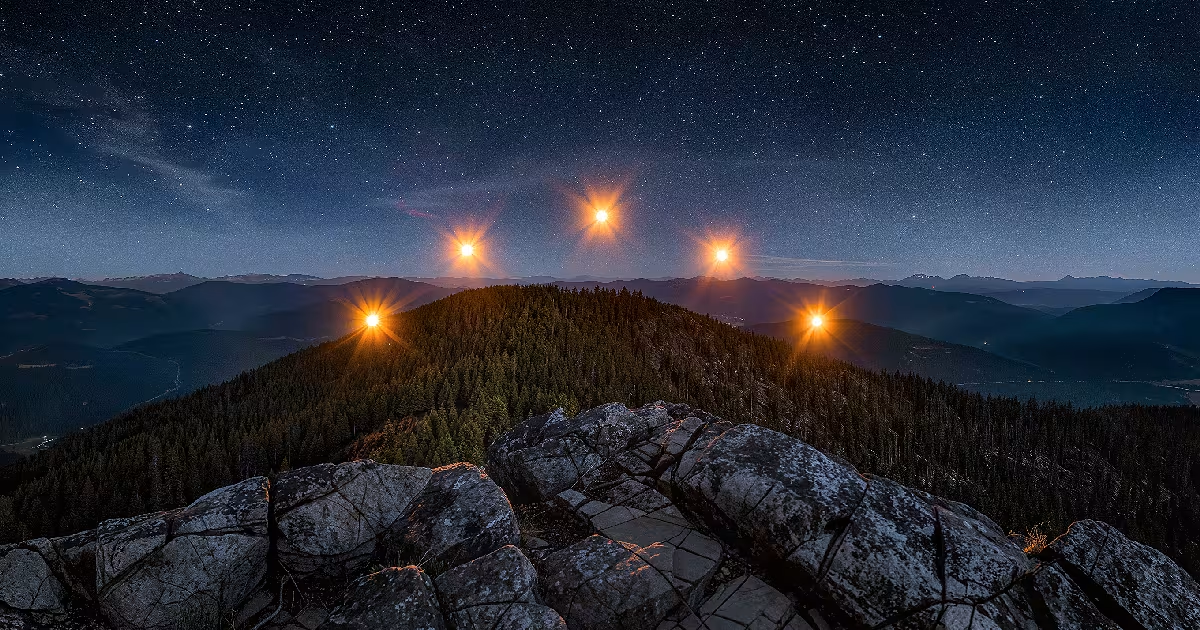
Glowing orbs hang over a dark ridge, seen from a rocky overlook.
Illustration, not a photograph.
Opening
From the overlooks of the Blue Ridge Mountains in western North Carolina, people have watched for more than a century for the Brown Mountain Lights: glowing orbs said to rise above a long, low ridge in Burke County, hang in the air, drift and vanish. They have been studied twice by the US Geological Survey, filmed by university cameras, written into a bluegrass song and a famous episode of The X-Files, and explained, again and again, as something ordinary. People keep going to look anyway.
Timeline
24 September 1913. The Charlotte Daily Observer reports mysterious red lights seen just above the horizon every night near Brown Mountain, appearing at regular times in the evening. It is the earliest known published account.
1913. The US Geological Survey sends geologist D. B. Sterrett to investigate. He concludes that the lights are the headlamps of westbound Southern Railway locomotives, visible from the viewing spot, and that the times match the train schedules.
July 1916. A great flood washes out railways across the region and stops the trains for a time. People report that the lights carried on anyway, which is used ever since as an argument against the train explanation.
1922. A second USGS geologist, George Rogers Mansfield, spends time in the area with surveying instruments and concludes that the lights are a mix of train headlights, car headlights, and brush fires, with some from distant towns.
1938. A story first appears in print that Cherokee legend tells of the lights, as the spirits of women searching for warriors killed in a battle. Researchers have found no older source for it.
1961 to 1962. Scotty Wiseman writes the song "Brown Mountain Light", based on a legend passed down from his great-uncle, about an old slave searching the mountain with a lantern for his lost master. The Kingston Trio record it in 1962, making the lights famous across America.
1999. The X-Files episode "Field Trip" sends Mulder and Scully to Brown Mountain.
2010s. Physicists Daniel Caton and Lee Hawkins of Appalachian State University set up low-light cameras to watch the mountain. By 2014 they have recorded thousands of hours of footage without capturing a light they cannot explain.
July 2016. The Appalachian State cameras finally catch a brief, grainy light near the mountain that the team cannot immediately explain. It is the first time their instruments have recorded something that might be one of the famous lights.
Key figures
D. B. Sterrett and George Rogers Mansfield of the USGS carried out the only official investigations. Scotty Wiseman, a North Carolina musician, gave the lights their song. The physicist Daniel Caton and Lee Hawkins at Appalachian State University led the modern camera study. And thousands of visitors, local people and tourists alike, have kept the legend going with their own sightings.
Physical and documentary trail
The lights have an unusually good paper trail for a ghost light. There is the 1913 newspaper report, two USGS investigations with published conclusions, the 1916 flood records, decades of witness accounts, and a modern camera survey. Photographs and videos exist, though most show distant lights that could be anything.
Things you might not know
- The government looked twice. The USGS investigated in 1913 and again in 1922. Both times it blamed lights from trains, cars and fires.
- The "Cherokee legend" first appeared in 1938. No older source has been found for the story about women searching for lost warriors, and experts have doubted it.
- The trains got brighter just before the lights appeared. Southern Railway fitted powerful new headlamps to its locomotives in 1909, a few years before the first newspaper report.
- The Kingston Trio sang about them. Scotty Wiseman's song "Brown Mountain Light" was recorded by the hugely popular folk group in 1962.
- Mulder and Scully went there. The X-Files episode "Field Trip" (1999) was set at Brown Mountain.
- Thousands of hours of video, then one light. Appalachian State's cameras recorded around 6,300 hours by 2014 without catching an unexplained light. Then, in July 2016, they caught a grainy one they could not immediately explain.
- You can watch for yourself. Popular viewing spots include the Brown Mountain Overlook on NC Highway 181, Wiseman's View and the Blue Ridge Parkway, with autumn the favourite season.
Competing explanations
Trains, cars, fires and towns. The official explanation since 1913. Distant lights seen across valleys at night can appear to float, flicker and vanish, especially as atmospheric conditions change.
A natural phenomenon. Some scientists have suggested rarer causes, such as reflections from atmospheric layers, or electrical effects related to the rocks, similar to explanations offered for the Marfa and Hessdalen lights.
Something unexplained. Many local people and visitors say what they have seen looks nothing like headlights: orbs that rise from the ridge, split, change colour and move against the wind. The 1916 flood stories, if accurate, are hard to square with trains.
Later life of the case
Brown Mountain is now a tourist attraction, with official viewing areas, interpretive signs and an annual flow of visitors. It is often listed alongside the Marfa Lights in Texas and the Hessdalen lights in Norway as one of the world's great ghost lights.
Finding
Most of what people have seen from the Brown Mountain overlooks is very likely distant lights from trains, cars, towns and fires, as the USGS concluded more than a century ago. But a stubborn number of sightings, from careful witnesses, do not fit that explanation easily.
What still will not resolve: what the 2016 camera light was, and whether the orbs witnesses describe can be caught clearly. If one is, Brown Mountain will become one of the most important light cases in the world.