SENECA GUNS
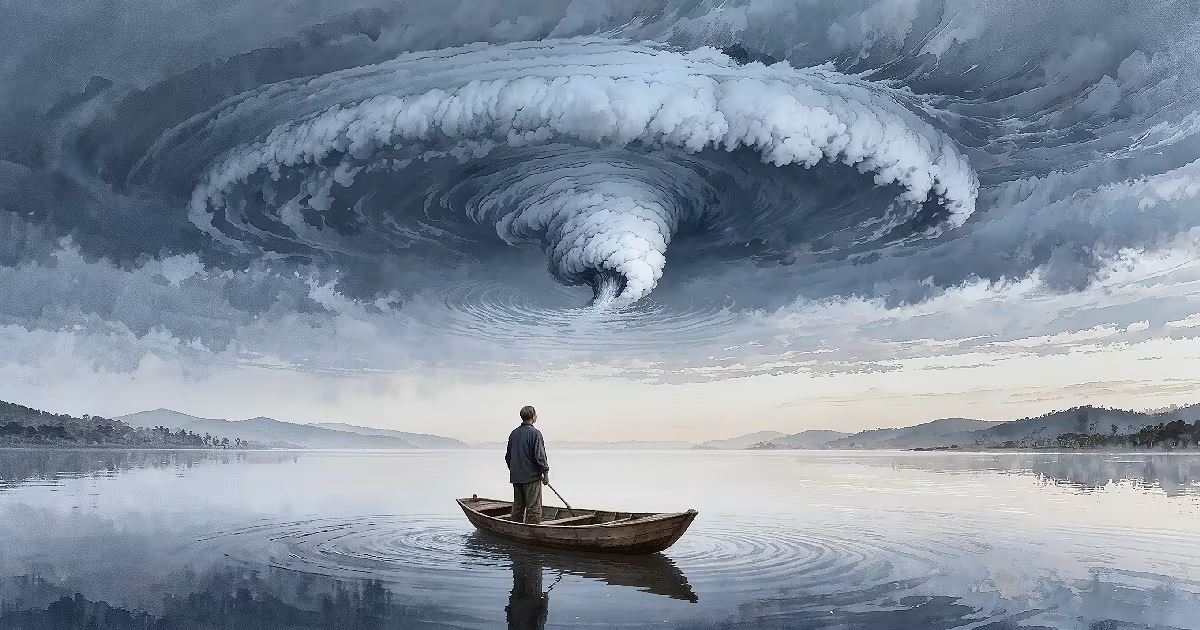
A lone boatman looks up as the sky swirls over a still lake.
Illustration, not a photograph.
Opening
All over the world, and for as long as people have written things down, the sky has gone boom for no obvious reason. A deep, single report like distant cannon fire rolls over a lake or coast, sometimes shaking windows, with no storm, no aircraft and no earthquake to explain it. Around New York's Finger Lakes and on the Carolina coast they are called the Seneca Guns. In Bangladesh they were the Barisal Guns, in Japan uminari, "cries from the sea", and on the Belgian and Dutch coasts mistpouffers, "fog belches". Scientists call them skyquakes. Some have explanations. Many still do not.
Timeline
Before the 1600s. The Wangunk people of what is now Connecticut call an area by the Connecticut River Machimoodus, usually translated as "the place of noises", for the booms and rumbles heard under its hills. The village of Moodus takes its name from it.
1805. Near the Great Falls of the Missouri, in Montana, Meriwether Lewis records repeated booming noises from the mountains, which he compares to a six-pound cannon fired three miles away.
1811 to 1812. During the great New Madrid earthquakes on the Mississippi, settlers describe sounds like artillery before and during the shocks.
1850. James Fenimore Cooper, author of The Last of the Mohicans, publishes "The Lake Gun" in a gift-book miscellany called The Parthenon, for a fee of $100. A traveller on Seneca Lake investigates two local wonders: the unexplained booms, and a floating tree trunk known as the Wandering Jew. A Seneca guide explains that the log is a chief called See-wise, turned to wood for leading his people astray, and that the booms are warnings from the Manitou. The name Seneca Guns spreads from there.
1867. Bábu Gour Doss Bysack describes the booms of the Barisal district, in the Ganges and Brahmaputra delta of what is now Bangladesh, in the Proceedings of the Asiatic Society of Bengal.
1870 to 1896. Letters about the Barisal Guns follow from landowners and officials in Bengal, and in January 1896 George B. Scott's account appears in the journal Nature, bringing the sounds to scientists worldwide.
1886. The Charleston earthquake in South Carolina, about magnitude 7, is accompanied by well-documented booming sounds. The Carolina coast becomes a centre of Seneca Gun reports.
1981. Seismologists record a swarm of tiny earthquakes under Moodus, Connecticut, and link them to the town's famous noises.
18 to 20 March 2012. In Clintonville, Wisconsin, a town of about 4,600, residents are kept awake by booms, rattling pipes and sounds like fireworks. Police and utility crews check gas and water lines. The US Geological Survey then confirms a magnitude 1.5 earthquake about four miles down, part of a swarm of tiny quakes. Wisconsin's hard rock carried the energy well enough to be heard.
August 2012. On the North Carolina coast, where fishermen in places like Varnamtown have heard the booms for generations, geologist Jack Hall of UNC Wilmington tells the Coastal Review that he can find no seismic record to support undersea landslides, and that the right atmosphere can carry sound for long distances.
Today. Reports keep coming from the Carolinas, the Finger Lakes, the North Sea coasts and elsewhere. The US Geological Survey says many booms on the East Coast have no identified source.
Key figures
James Fenimore Cooper gave the American booms their name. Meriwether Lewis left one of the earliest written descriptions in America. Bábu Gour Doss Bysack and George B. Scott put the Barisal Guns on the scientific record, and geologist Jack Hall is one of the modern scientists who has tried to pin down the Carolina booms. The scientists who connected the Moodus noises to tiny earthquakes in the 1980s showed that at least some skyquakes come from beneath the ground. Behind them are thousands of ordinary witnesses, fishermen, farmers and householders, who have reported the same thing in different languages for centuries.
Physical and documentary trail
The written record is long and international. It includes the Lewis and Clark journals, the 19th-century reports on the Barisal Guns, Cooper's story, and newspaper accounts of East Coast booms through the 20th century. There are seismic records for Moodus and for many modern events, and the USGS has a public page on earthquake booms and Seneca Guns. What it lacks is a single explanation that covers all of them.
Things you might not know
- Lewis and Clark heard them. In 1805, at the Great Falls in Montana, Meriwether Lewis wrote of booms "resembling precisely the discharge of a piece of ordinance of 6 pounds at the distance of three miles".
- The name comes from a political joke. "Seneca Guns" was popularised by James Fenimore Cooper's 1850 story "The Lake Gun". Its villain, the chief See-wise, with his retreating forehead and hatchet face, was a dig at New York senator William Henry Seward.
- A whole town's booms were solved in 2012. Clintonville, Wisconsin spent three nights listening to booms until the USGS found a swarm of tiny earthquakes, the biggest just magnitude 1.5. In most of the country, it said, a quake that small would not be felt.
- A Connecticut town is named after the noises. Moodus comes from the Wangunk name Machimoodus, "the place of noises". H. P. Lovecraft drew on the Moodus noises for the rumbling hills of "The Dunwich Horror".
- Every coast has its own word. Mistpouffers in Belgium and the Netherlands, uminari in Japan, brontidi in Italy, Barisal Guns in Bangladesh, and Seneca Guns in the United States.
- Some are tiny earthquakes. Very shallow quakes, too small to feel as shaking, can produce a sharp boom, which is what scientists believe explains the Moodus noises.
- Seneca Lake hardly ever freezes. The lake where the booms got their name is the deepest of the Finger Lakes and has frozen over only a handful of times in recorded history.
- They pair with Bell Island. The 1978 Bell Island boom in Newfoundland came during a season of mystery booms along the North American east coast, many later linked to the supersonic Concorde, and many never explained.
Competing explanations
Small, shallow earthquakes. The best-supported explanation for some booms, including those at Moodus. A quake too small to shake the ground noticeably can still produce a sound people hear.
Sonic booms and military activity. Supersonic aircraft, and military exercises off the coast, explain many modern East Coast reports. They cannot explain the booms recorded before aircraft existed.
Gas from lakes and the seabed. Methane or other gas escaping from lake or sea floors has been suggested, especially for Seneca Lake. It has not been demonstrated.
The sea and the sky. Big waves breaking against cliffs or into sea caves, distant thunder carried by unusual atmospheric conditions, and meteors exploding high in the atmosphere can all produce booms heard far away.
Something unknown. Some reports fit none of these: no quake on the seismographs, no flights, no storm, no meteor. For those, the honest answer is still that nobody knows.
Later life of the case
Skyquakes are now reported and mapped in real time on social media, and every new boom in the Carolinas or the Finger Lakes brings a round of local news stories. Modern instruments, from seismometer networks to infrasound sensors, are slowly catching more of them, and many turn out to have ordinary causes. A stubborn core of reports still does not.
Finding
Skyquakes are real. People in every part of the world have heard them for centuries, and some have clear causes, from tiny earthquakes to sonic booms. They are probably not one phenomenon but several that sound the same.
What still will not resolve: the booms that leave no trace on any instrument. Until a network catches one of those as it happens, the Seneca Guns keep their mystery.