ZODIAC KILLER
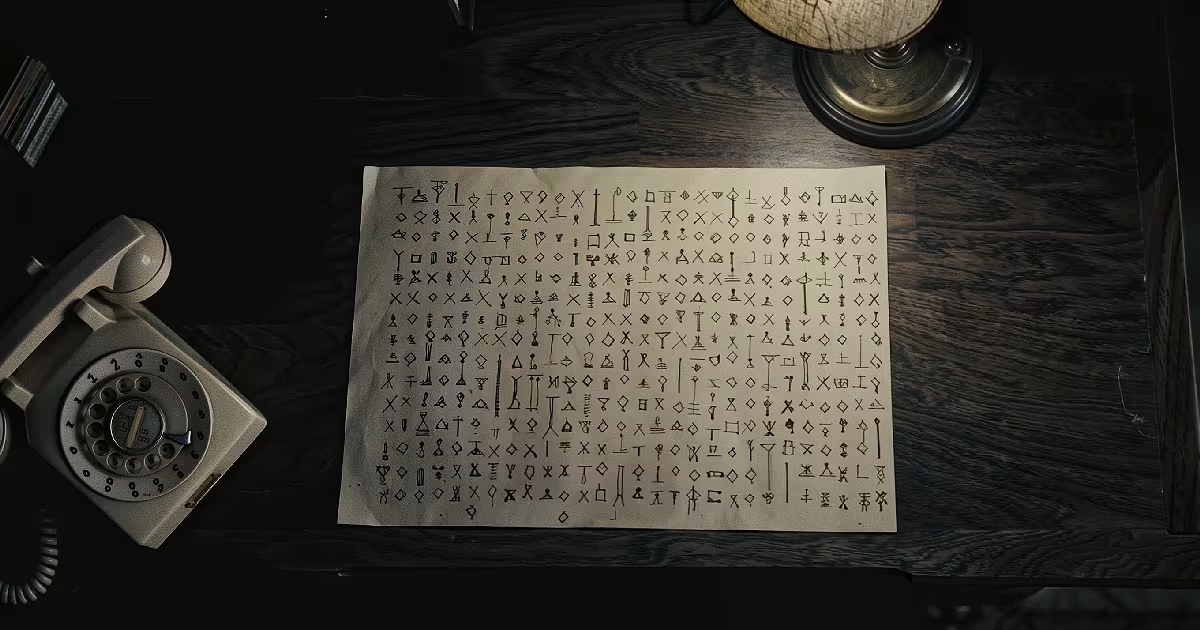
Zodiac 340-symbol cipher, solved 2020.
Illustration, not a period photograph.
Opening
Between December 1968 and October 1969, an unidentified killer shot five people, killing three, at scattered locations in Northern California, then began writing to Bay Area newspapers, coining his own name, taunting police, and enclosing encrypted ciphers he claimed would reveal his identity. Two of the four known ciphers were solved within weeks of being sent. A third sat unsolved for fifty-one years. The case remains, officially, open. It has also, on at least three separate occasions since 2020, been declared "solved" by different investigators using different methods, with each announcement subsequently disputed or rejected by the law enforcement agencies still formally responsible for the case.
Timeline
20 December 1968. Betty Lou Jensen, 16, and David Faraday, 17, are shot and killed on a rural road near Vallejo, California, in what is later identified as the killer's first confirmed attack.
4 July 1969. Darlene Ferrin, 22, and Michael Mageau, 19, are shot in the parking lot of Blue Rock Springs Park in Vallejo; Ferrin dies, Mageau survives and later provides a description.
1 August 1969. Letters arrive at three Bay Area newspapers, the San Francisco Chronicle, San Francisco Examiner, and Vallejo Times-Herald, each containing a third of a 408-symbol cipher and a demand that it be printed on the front page, with a threat of further killing if it is not.
8 August 1969. Schoolteachers Donald and Bettye Harden, working from a newspaper-published copy of the cipher, crack the 408-symbol cryptogram (Z408) within days, revealing a message in which the writer describes the thrill of killing as more exciting than shooting game, because "man is the most dangeroue anamal of all" (his own, misspelled phrasing), and states his intent to collect victims as slaves for his afterlife.
27 September 1969. Bryan Hartnell and Cecelia Shepard are attacked at Lake Berryessa by a hooded man wearing a symbol resembling a crosshair on his chest; Shepard dies of her wounds, Hartnell survives and gives a detailed description of the killer's costume and speech.
11 October 1969. Taxi driver Paul Stine is shot and killed in San Francisco; a partial fingerprint and eyewitness descriptions from the scene become part of the case's core physical evidence, though no confirmed suspect match to the print has ever been publicly established.
8 November 1969. The killer sends a 340-symbol cipher (Z340) to the San Francisco Chronicle, along with a piece of Stine's bloodied shirt as proof of the murder. Unlike the 408, this cipher resists every attempt at solution for over five decades.
Through 1974. The killer continues sending taunting letters periodically, self-reporting a rising victim count that eventually reaches a claimed 37, a figure law enforcement has never corroborated beyond the five confirmed attacks.
Following decades. The case draws sustained amateur and professional cryptographic attention, alongside a long list of proposed suspects, most prominently Arthur Leigh Allen, investigated extensively by the case's original lead detectives and popularized in Robert Graysmith's books and the 2007 film Zodiac, though Allen was never charged and DNA testing later conducted on available evidence did not confirm a match to him.
December 2020. A team of three independent cryptographers, American programmer David Oranchak, Australian mathematician Sam Blake, and Belgian applied mathematician Jarl Van Eycke, working collaboratively using custom-built code-breaking software, successfully solves the Z340 cipher, fifty-one years after it was sent. The decoded message contains no name or address, but reads in part, "I hope you are having lots of fun in trying to catch me," and reiterates the killer's stated belief that the afterlife requires servants. The FBI publicly confirms the solution's validity.
October 2021. The Case Breakers, a self-organized group of more than 40 former law enforcement investigators, journalists, and intelligence officers, announce they have identified the killer as Gary Francis Poste, an Air Force veteran who died in 2018, based on forehead scars they say match the 1969 police sketch, darkroom photographs, and, most specifically, a claim that decoding a portion of the killer's own letters using Poste's full name as a key reveals an embedded anagram message. The group separately proposes linking Poste to the unrelated 1966 murder of Cheri Jo Bates in Riverside, California, a case Riverside police have publicly stated they do not believe is connected to the Zodiac at all, particularly since a 1967 letter claiming responsibility for that murder was itself admitted by its actual author to be a hoax in 2016.
Following the Case Breakers announcement. Both the FBI and the San Francisco Police Department publicly state the case remains open and that they have not verified or endorsed the Poste identification. Independent cryptographers, including some of the same researchers responsible for the genuine 2020 Z340 solution, publicly express skepticism of the anagram-based name-decoding method the Case Breakers used, noting that a sufficiently flexible cipher-reading method applied to a name known in advance can often be made to appear to fit almost any candidate text.
Key figures
The Hardens are the case's first successful codebreakers, an ordinary California couple whose quick, independent solution of the Z408 cipher within days of its publication gave investigators their first, and for decades only, confirmed insight into the killer's own stated motive and self-mythology.
Oranchak, Blake, and Van Eycke are the case's most credentialed and independently verified cryptographic team, whose 2020 Z340 solution was confirmed by the FBI itself and represents the only fully validated cipher breakthrough in the case's history beyond the original 1969 solution.
The Case Breakers represent the case's most recent and most publicly disputed identification claim; their methodology, particularly the anagram-based decoding requiring advance knowledge of the suspect's name to work, has drawn specific, named technical criticism from cryptographers otherwise sympathetic to fresh investigative approaches to the case.
Allen remains the most extensively, formally investigated named suspect from within the original law enforcement effort itself, subjected to search warrants, interviews, and eventual DNA testing, none of which produced a confirmed match, though he also was never definitively cleared before his own 1992 death.
Physical and documentary trail
On the paper, this file has an unusually rich original evidentiary record for a case this old: four sent ciphers (two solved, one solved only in 2020, one, Z13, still unsolved), multiple survivor eyewitness accounts with consistent physical descriptions, a partial fingerprint from the Stine murder scene, physical evidence including Stine's bloodied shirt fragment mailed by the killer himself, and decades of formal police investigative files.
What it lacks, even after the genuine 2020 cipher breakthrough, is any content within the solved messages that names the killer directly. The Z340 solution, rigorously verified as it is, reveals motive and mindset, not identity, meaning the case's central mystery survives its most significant cryptographic breakthrough completely intact.
I hope you are having lots of fun in trying to catch me.
Competing explanations
Gary Francis Poste, per the Case Breakers. This identification rests on scar-pattern photo comparison and a specific anagram-decoding technique that requires the investigator to already know the candidate name being tested, a methodological weakness independent cryptographers have directly and specifically flagged, and it remains formally unendorsed by the FBI or SFPD, who both maintain the case as open following the announcement.
Arthur Leigh Allen, the case's longest-standing formally investigated suspect. This candidacy is supported by circumstantial behavioral and personal details that struck original investigators as compelling enough to pursue for years, but DNA testing conducted on available physical evidence did not confirm his involvement, and he was never charged before his death.
An unidentified individual never seriously investigated by name, given the five-decade gap and the volume of amateur speculation that has attached itself to numerous individuals without producing a confirmed match. This remains, functionally, the position of the agencies with actual jurisdiction over the case: officially open, with no publicly confirmed identification.
Later life of the case
The Zodiac case occupies a genuinely unusual position in unsolved-crime history: it has produced one of the very few fully solved historical ciphers of the internet era, the 2020 Z340 breakthrough, widely covered and independently confirmed, without that breakthrough actually closing the underlying identity question at all. The pattern of periodic "solved" announcements, Case Breakers in 2021 being only the most recent and widely covered, followed by formal law-enforcement non-confirmation, has itself become a recurring and somewhat predictable feature of the case's ongoing public life.
Finding
Two of the killer's four ciphers have been rigorously, independently solved, most recently and significantly in 2020 by a credentialed cryptographic team whose work the FBI itself confirmed, and both solved messages reveal motive and self-mythology without naming a suspect. Every subsequent identification claim, including the most recent and widely publicized Case Breakers announcement, has relied on methodology independent experts consider methodologically flawed and has been explicitly not endorsed by the agencies with actual jurisdiction over the case.
What still will not resolve: the Z13 cipher, the only one of the killer's four known ciphers that remains completely unsolved, and any identification meeting the evidentiary standard the FBI and SFPD themselves would need to formally close a fifty-plus-year-old open homicide investigation. Until one of those changes, this stays exactly what its own investigating agencies say it is: an open case, regardless of how many times someone else has announced it solved.