ELISA LAM
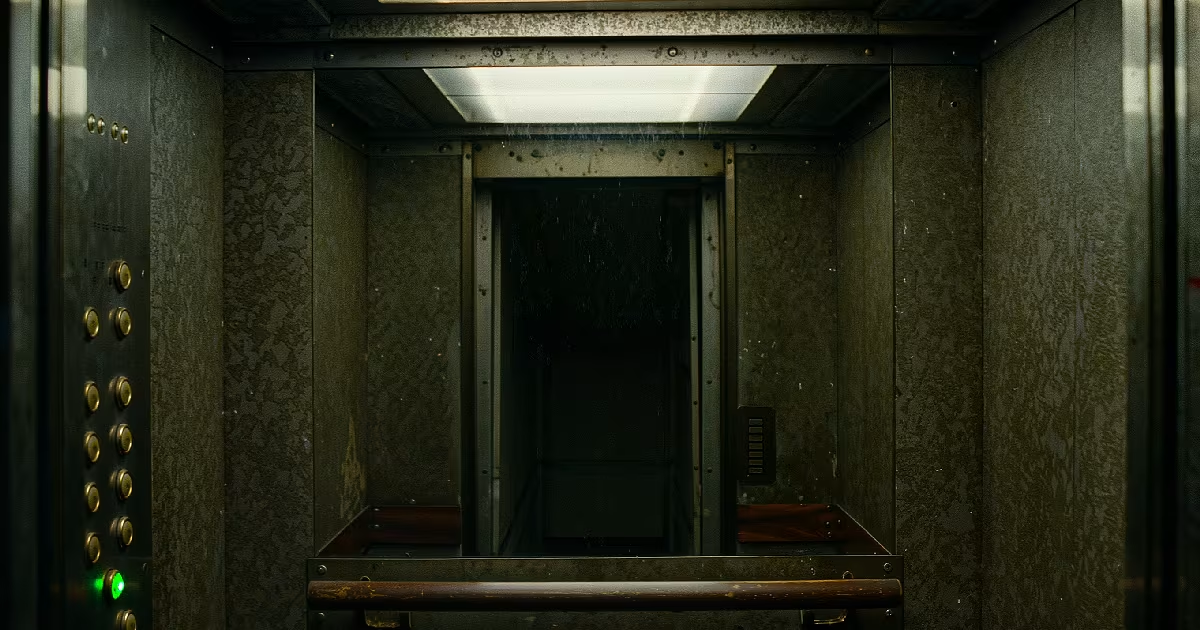
Cecil Hotel elevator security footage, Jan 31 2013, reconstructed.
Illustration, not a period photograph.
Opening
On 19 February 2013, a maintenance worker at the Cecil Hotel in downtown Los Angeles, responding to guest complaints about low water pressure and discolored, foul-tasting tap water, climbed to the roof and opened one of four large water cisterns. Inside, floating naked, was the decomposing body of Elisa Lam, a 21-year-old Canadian student from Vancouver who had been reported missing nineteen days earlier. Days before the discovery, the LAPD had released elevator security footage of her last known movements, roughly two and a half minutes of erratic, unexplained behavior, pressing every button, ducking in and out of the frame, gesturing at an apparently empty hallway, that went viral worldwide and remains one of the most-watched pieces of surveillance footage connected to any unsolved-feeling death in recent memory.
The Los Angeles County Coroner's office ultimately ruled the death an accident. That ruling, reached after real physical constraints that genuinely puzzled even outside forensic reviewers, has never fully settled the case in the public imagination, and for reasons that go beyond simple conspiracy-mindedness.
Timeline
26 January 2013. Lam, traveling alone on a solo trip down the West Coast after a break from her studies at the University of British Columbia, checks into the Cecil Hotel, by then rebranded Stay on Main in an attempt to distance itself from its notorious history in Los Angeles's Skid Row district.
Following days. Lam is initially roomed with other female guests in a shared hostel-style room; this arrangement ends after her roommates report unusual behavior, including giving out door passwords and then locking others out, and leaving strange notes.
31 January 2013. Lam is seen at The Last Bookstore, one of her last confirmed sightings before her disappearance.
1 February 2013. Surveillance footage, later released by police, captures Lam in one of the Cecil's elevators around this date: she presses multiple buttons including one that holds the doors, steps in and out of the frame repeatedly, peers down the hallway in both directions, and makes exaggerated hand gestures, all while the elevator itself appears to malfunction, with the doors failing to close for an extended period after she exits for the final time.
Early February 2013. Lam's parents report her missing after losing contact with her; LAPD searches the hotel, finding no trace of her in her room or common areas, and initially lacks probable cause for a more extensive search, a limitation Sergeant Rudy Lopez later explains publicly.
6 February 2013. With no leads after a week, LAPD escalates the search, distributing missing-person flyers and drawing initial media coverage.
13-14 February 2013. LAPD releases the elevator footage to the public in hopes of generating tips. The video spreads rapidly online, with widespread commentary describing it as deeply unsettling; explanations offered by viewers range immediately from paranormal encounter theories to straightforward psychiatric crisis to claims the footage itself had been edited or tampered with.
19 February 2013. Hotel maintenance worker Santiago Lopez, responding to persistent guest complaints about the water supply, discovers Lam's body in one of the rooftop cisterns. Her clothing and personal effects are found floating in the water near her; the body is described as having been in the tank for an extended period consistent with the length of her disappearance.
21 February 2013. An initial autopsy is performed but proves inconclusive on manner of death.
Following months, after repeated delays. The Los Angeles County Coroner's office takes roughly four months to release its full report, ultimately ruling the death accidental, specifically accidental drowning, with bipolar disorder, a condition for which Lam had been previously diagnosed, hospitalized once for a psychotic episode, and was taking multiple prescribed medications (including lamotrigine, quetiapine, venlafaxine, and bupropion), listed as a significant contributing factor. The report finds no evidence of physical trauma, sexual assault, or drugs in her system beyond her own prescriptions.
Following the ruling. Guests of the rebranded hotel sue over the incident; Lam's own parents file a separate lawsuit later in 2013, which is dismissed in 2015.
Later reviews. Forensic pathologist Dr. John Hiserodt, a former Pittsburgh deputy coroner reviewing the case publicly, states that while an "accident" ruling formally rules out both suicide and homicide, he believes real, unanswered questions remain before the accidental explanation can be considered fully settled, specifically around how Lam physically reached and entered the tank at all.
Key figures
Lam herself is the case's sole direct subject, and what is publicly documented about her mental health, her bipolar diagnosis, her medications, a prior hospitalization, and the roommate conflict in the days before her disappearance, comes from her own family's and the coroner's own public statements and reporting, not from speculation.
Lopez, the hotel maintenance worker, is the case's discovering witness, whose response to an entirely mundane guest complaint, bad-tasting water, led directly to the body's discovery nineteen days into the search.
Sergeant Rudy Lopez of LAPD represents the case's documented investigative constraints, explaining publicly that the department's early search limitations were governed by an actual legal probable-cause threshold rather than institutional indifference.
Hiserodt is the case's most notable outside forensic reviewer, and his position is a genuinely useful middle ground: he does not dispute the coroner's finding of no trauma or foul play, but specifically flags the physical access question as a real, still-open technical puzzle rather than dismissing public skepticism outright.
Physical and documentary trail
On the paper, this file has an unusually complete documentary record for a case of this kind: the full viral elevator footage itself, a formal, if delayed, coroner's report with a specific ruling and stated contributing factor, prior medical documentation of Lam's diagnosed condition and hospitalization, and direct, on-record statements from both LAPD and an independent forensic reviewer addressing the case's central physical puzzle.
That puzzle is genuinely well-documented rather than merely rumored: the roof access doors were locked and alarmed, accessible only to staff with a passcode, with no triggered alarm recorded; the only alternative route would have required climbing out a window onto an external platform, scaling a roughly ten-foot ladder, moving aside a lid described as weighing around twenty pounds, and then somehow closing that same heavy lid from inside the tank after entering it, a sequence multiple reviewers, not only conspiracy-minded commentators, have noted is difficult to reconcile with a straightforward, unassisted accidental entry.
In my mind, there are some questions that I think need to be answered before you can really determine that this is an accidental drowning.
Competing explanations
An accidental death during an acute psychiatric episode, exactly as the coroner ruled. This reading is directly supported by Lam's documented bipolar diagnosis, her behavior in the elevator footage consistent with the kind of disorganized, agitated presentation clinicians associate with mania or psychosis, and the coroner's formal finding of no trauma, assault, or third-party involvement. Its unresolved weak point is not medical but mechanical: the specific physical sequence required to reach and enter the tank remains genuinely difficult to fully explain even accepting an altered mental state.
Third-party involvement of some kind, given the locked, alarmed roof access and the physical difficulty of closing a twenty-pound lid from inside the tank unassisted. This reading has never been supported by any physical evidence, the coroner found no trauma or signs of struggle, and no suspect, motive, or opportunity has ever been identified, but it persists specifically because the access-mechanics question has never been fully, satisfyingly answered by the accidental-death ruling on its own.
Paranormal or supernatural involvement, connected to the Cecil's own well-documented history of prior deaths and violent incidents on the property. This reading has no evidentiary basis whatsoever and functions primarily as folklore built on the hotel's genuine, separately documented history rather than on anything specific to Lam's case.
Deliberate self-harm during a crisis, distinct from pure accident. Given Lam's own family stated she had no known history of suicidal ideation, this reading is not the one the coroner adopted, and the specific manner of the tank entry makes a deliberate, planned act somewhat awkward to reconcile with the disorganized, seemingly confused behavior visible in the elevator footage just before her disappearance.
Later life of the case
The elevator footage remains one of the most widely viewed and re-analyzed pieces of surveillance video connected to any modern death investigation, generating an enormous body of amateur analysis, documentary coverage, and a 2021 Netflix docuseries examining the case and the surrounding online obsession it generated in its own right. The case is also frequently cited in discussions of how viral internet speculation can outpace and outlast a formal, evidence-based official finding, particularly when that finding, however well-supported on the medical and toxicological side, leaves a genuine, unresolved physical logistics question sitting in plain view.
Finding
The Los Angeles County Coroner's formal ruling, accidental drowning with bipolar disorder as a significant contributing factor, rests on real medical documentation and a thorough autopsy finding no trauma, assault, or foul play. What that ruling does not fully close, and what even a sympathetic outside forensic reviewer has said publicly remains genuinely open, is the specific mechanical question of how Lam reached a locked, alarmed rooftop and entered, then apparently sealed, a heavy water tank without assistance.
What still will not resolve: a fully reconstructed, physically demonstrated sequence showing exactly how the tank's twenty-pound lid could have been closed from inside by someone alone, the one specific technical gap that keeps this case from feeling fully settled even to reviewers who do not dispute the coroner's broader medical conclusions.