PHAISTOS DISC
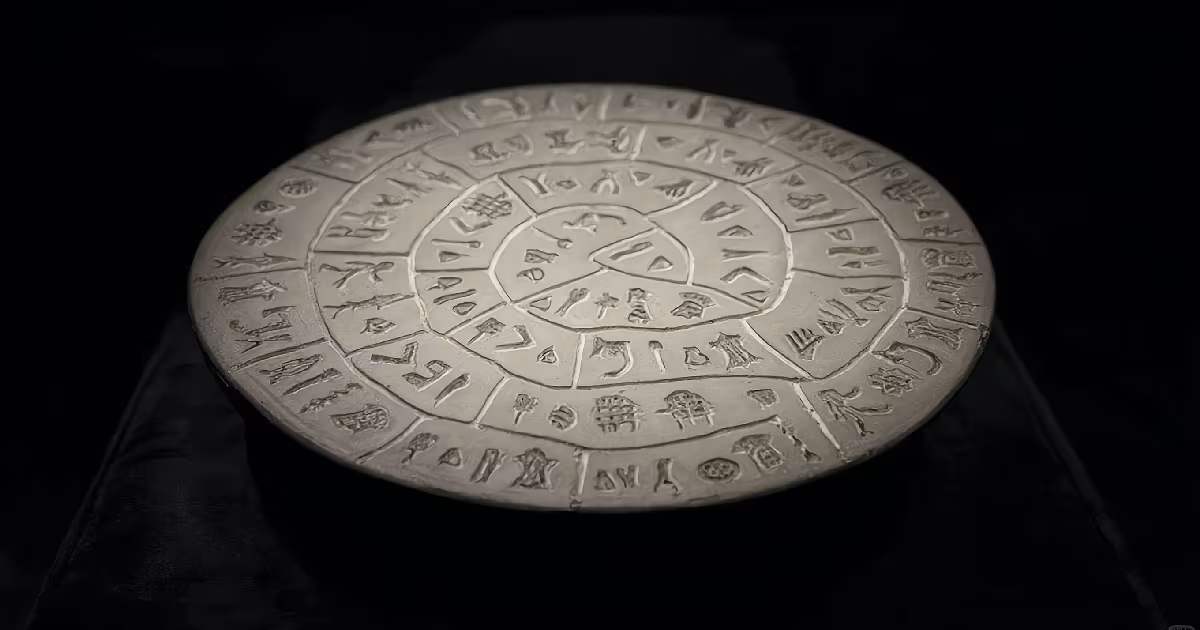
Phaistos Disc, Side A, Heraklion Archaeological Museum.
Illustration, not a period photograph.
Opening
On 3 July 1908, Italian archaeologist Luigi Pernier, excavating the ruined Minoan palace of Phaistos on the southern coast of Crete alongside his supervisor Federico Halbherr, uncovered a golden-brown clay disc roughly 16 centimeters across, buried in an underground deposit among charred bones and ash. Both faces were covered in 241 small pictorial symbols, stamped individually into the wet clay with what must have been a set of carved punches before the disc was fired, and arranged in a spiral running from the rim toward the center. No comparable object has ever been found anywhere else on Earth. The script does not match any other known writing system, ancient or modern. More than a century of attempted decipherment has produced no consensus reading, and a smaller but persistent scholarly current has spent the last several decades arguing the disc might not even be genuine.
Timeline
3 July 1908. Pernier, part of Halbherr's excavation team at Phaistos, retrieves the disc from a sealed basement cell containing charred bones and ashes, an undisturbed context that, if accurately reported, would place the object firmly within the Minoan Bronze Age palace's occupation period, roughly the first half of the second millennium BCE.
1909. Pernier publishes his find without attempting a decipherment himself. The same year, Arthur Evans, the archaeologist who discovered Knossos and pioneered the study of Minoan writing systems, includes detailed photographs and drawings of the disc in his own foundational volume on Minoan inscriptions, Scripta Minoa, giving the object early and serious scholarly circulation.
Following decades. Linguists and cryptographers attempt to classify and translate the script using every method available: comparison to Linear A and Linear B (the two genuine, separately deciphered Minoan-era scripts found at Knossos), statistical letter-frequency analysis, and comparison to scripts from Anatolia, Egypt, and the broader eastern Mediterranean. None produces a result other researchers accept as confirmed.
1970s onward. A small number of scholars begin publicly questioning the disc's authenticity, noting specific circumstantial concerns: Pernier was alone at the moment of discovery, without independent witnesses to the exact find context, and his own field notes from that day are described by later reviewers as unusually sparse for an object of this significance. The fact that no second example of the script has ever surfaced anywhere, in over a century of subsequent excavation across Crete and the wider Aegean, is cited by these skeptics as itself suspicious.
1999. Jerome Eisenberg, a specialist in identifying forged ancient art, publishes a detailed paper arguing the disc is a modern fake, proposing Pernier himself may have created or acquired it to boost his own professional standing, resting his case substantially on the object's total uniqueness and on his own stylistic analysis of the symbols and firing technique.
2014. Gareth Owens, of the Technological Educational Institute of Crete, announces he has identified the underlying language as an early form of Greek and offers a translation of portions of Side A, proposing references to a pregnant mother goddess. The claim receives substantial international press coverage.
Following Owens's announcement. Other Aegean linguists respond with considerable skepticism, noting specifically that his proposed readings depend on assumptions about the underlying language, assumptions that cannot themselves be independently verified using only the disc's own limited 241-symbol text, a methodological problem common to nearly every decipherment attempt the object has ever attracted.
Present day. The disc remains on public display at the Heraklion Archaeological Museum on Crete, its authenticity question and its decipherment question both formally unresolved among specialists, running as two separate, parallel scholarly disputes rather than one settled artifact with one open mystery.
Key figures
Pernier is the case's central and, given the authenticity dispute, doubly significant figure: either the archaeologist who made one of the twentieth century's most genuinely important undeciphered-script discoveries, or, per Eisenberg's specific and named accusation, the perpetrator of an elaborate personal-career hoax, with no independent witness able to settle which account is correct.
Evans is the case's earliest major scholarly validator, whose decision to include the disc prominently and seriously in his own foundational Minoan scholarship gave the object institutional credibility from within the first year of its announced discovery.
Eisenberg is the authenticity dispute's most specific and credentialed skeptical voice, a specialist whose entire professional expertise is identifying forged ancient artifacts, lending his argument weight beyond generic speculation, even though his case remains circumstantial rather than based on any confirmed material-science test proving fabrication.
Owens is the decipherment dispute's most recent and most publicly covered claimant, whose proposed Greek-language, mother-goddess reading drew wide media attention specifically because it offered the kind of definite, emotionally resonant answer the object had never previously produced, a claim other specialists in the same narrow field have directly and specifically challenged on methodological grounds.
Physical and documentary trail
On the paper, this file has the disc itself, preserved, photographed, and available for direct physical examination at the Heraklion museum, Pernier's original if reportedly sparse 1908 field notes, Evans's early independent photographic and scholarly documentation from 1909, and over a century of published, peer-reviewed attempted decipherments and counter-arguments.
What it lacks, on the authenticity question, is any confirmed modern material-science dating test (such as thermoluminescence dating of the fired clay) definitively settling the object's age published and broadly accepted by the field; and on the decipherment question, it lacks the single thing every serious script decipherment in history has required to move from speculation to confirmation, a second independent text in the same script, ideally a bilingual one, that would allow any proposed reading to be actually tested rather than merely argued for.
No other object like it has ever turned up in any excavation anywhere.
Competing explanations
A genuine, unique Minoan-era administrative, religious, or ceremonial document, whose script simply never appears elsewhere because it was an unusually rare or short-lived writing tradition, or because no second example has yet been excavated. This remains the default position of most Aegean archaeologists, and it is consistent with the disc's reported undisturbed burial context alongside charred bone and ash, a plausible ritual or funerary setting for a unique object.
A modern forgery created around the time of its announced discovery, per Eisenberg's specific argument. This reading accounts well for the object's total uniqueness (a forger would have no obligation to produce a second example) and for the reportedly thin contemporaneous documentation of its exact find circumstances, but it has never been confirmed by a definitive material-science test that the broader field accepts as settling the question, and it requires positing a level of technical sophistication, individually stamped symbols using a consistent, purpose-built set of punches, that a would-be early-twentieth-century forger would have needed real skill to execute convincingly.
A genuine object in an unidentified language, correctly read by Owens as an early form of Greek. This claim's specific weakness is methodological rather than a matter of general implausibility: any proposed underlying language for a script this short and singular requires assumptions the text itself cannot independently confirm, meaning the same 241 symbols could, in principle, be made to fit multiple different proposed languages depending on which starting assumptions a researcher brings to the analysis.
An object whose meaning may never be recoverable regardless of its authenticity, given the field's own standard requirement, a second text or a bilingual key, that no other discovery in over a century has supplied. This remains, functionally, the most cautious and widely shared position among specialists who neither fully endorse nor fully reject any single decipherment or authenticity claim.
Later life of the case
The Phaistos Disc remains one of the most frequently cited genuine, professionally unresolved decipherment puzzles in archaeology, distinct from more popularly mythologized "ancient mystery" objects specifically because its unresolved status is the field's own honest, published position rather than a manufactured air of mystery. Its parallel authenticity dispute, running since the 1970s and given its most detailed form by a named forgery specialist in 1999, adds a genuinely unusual second layer most undeciphered-script cases do not carry: even confirming the disc says something meaningful would not settle whether it is telling us something Minoan, or something about a twentieth-century archaeologist's career ambitions.
Finding
A unique clay disc bearing a script matched nowhere else on Earth has resisted over a century of professional decipherment attempts, each new claimed reading undermined by the same structural problem: a text this short and singular cannot be independently verified against any second example. Running alongside that unresolved linguistic question is a genuine, professionally argued authenticity dispute, never definitively settled by material-science testing accepted across the field, raised by a named specialist in identifying forged antiquities rather than by casual skepticism.
What still will not resolve: a second confirmed example of the same script anywhere in the archaeological record, which alone would let any proposed decipherment actually be tested, and a broadly accepted, published material-dating result settling the authenticity question definitively. Until either surfaces, the Phaistos Disc stays exactly what it has been since 1908: an object everyone can look at and nobody can fully explain.