GLOOMY SUNDAY
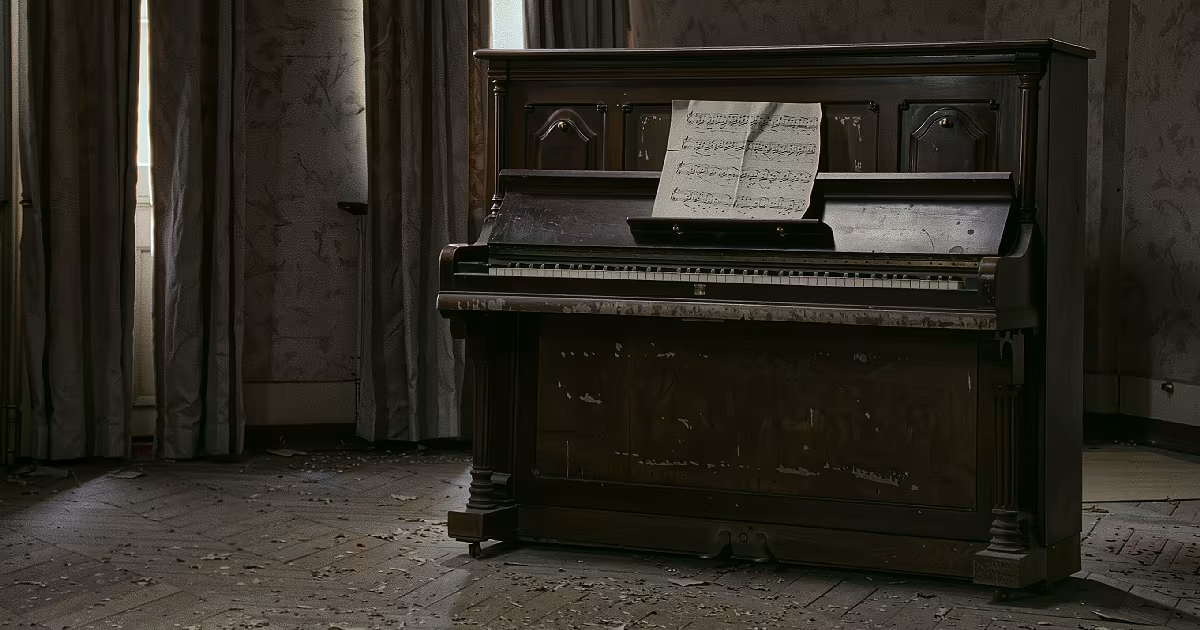
Szomoru Vasarnap sheet music, 1933.
Illustration, not a period photograph.
Opening
In 1933, Hungarian pianist and composer Rezső Seress wrote a mournful, minor-key melody, originally set to his own lyrics about war and apocalyptic despair, that his friend, poet László Jávor, rewrote as a ballad about a grieving lover contemplating suicide. Published as "Szomorú Vasárnap" ("Sad Sunday"), the song struggled to find a publisher at all, with one reportedly telling Seress, "there is a sort of terrible compelling despair about it. I don't think it would do anyone any good to hear a song like that." Within a few years, the song, now known internationally as "Gloomy Sunday," had acquired a reputation as the "Hungarian Suicide Song," linked in popular legend to over a hundred deaths, a banned radio playlist on two continents, and, eventually, its own composer's death by his own hand.
Nearly every specific claim in that legend has been individually examined by researchers, and what survives scrutiny turns out to be much narrower than the story as popularly told.
Timeline
1933. Seress, then a struggling 34-year-old songwriter, composes the melody; accounts differ on whether he was living in Paris or Budapest at the time, and on whether Jávor's lyrics were written independently as a poem first or specifically to replace Seress's own original war-themed verses. The song is eventually published after repeated rejection.
1935. The first recorded version appears, by Hungarian performer Pál Kálmár.
1936. English-language lyricist Sam M. Lewis's translation is recorded by Hal Kemp's orchestra with vocalist Bob Allen, becoming the version that would later see the widest circulation; a separate translation by Desmond Carter also circulates.
Mid-to-late 1930s. The core legend takes shape and spreads: that the song was directly connected to a wave of Hungarian suicides, that police in Budapest sought to have it banned as a public menace given a rising body count, and, in its most specific and dramatic form, that the woman who had inspired Jávor's or Seress's heartbreak died by poison shortly after the song reached her, leaving behind a note or a copy of the sheet music reading only the song's title.
1941. Billie Holiday records the song's best-known English version, adding a newly written third verse intended to soften its bleakness by framing the earlier lyrics as a dream. Despite this addition, the recording's association with the suicide legend persists, and it is reportedly kept off the air by the BBC, with the wartime-morale concern most commonly cited as the stated reason.
Following decades. The legend continues circulating largely unexamined, repeated in books, radio segments, and eventually online, gathering additional unverified deaths (a teenager in Vienna said to have drowned herself clutching the sheet music, a London woman said to have overdosed while playing the record on repeat) with each retelling, none independently sourced to a named, checkable original report.
January 1968. Seress dies by suicide, jumping from his Budapest apartment. Some retellings attribute this directly to lifelong despair over never producing another hit to match "Gloomy Sunday"; this specific causal claim is itself an embellishment layered onto a real death rather than a documented statement from Seress himself.
1999. The German-Hungarian film Gloomy Sunday, directed by Rolf Schubel and based on a novel by Nick Barkow, dramatizes a fictionalized version of the song's origin story, further cementing the legend in popular culture independent of any new factual investigation.
2007. Fact-checking outlet Snopes formally reviews the cluster of claims making up the legend, rating the overall status "undetermined" given the near-total absence of verifiable primary sourcing for the specific individual suicide anecdotes, while confirming the song's real, documented 1933 composition history and Seress's own genuine 1968 suicide.
Subsequent academic review. Sociologist Steven Stack, studying suicide statistics and media effects professionally, examines the "Gloomy Sunday" legend specifically as a test case for whether a single song could plausibly be shown, using actual period suicide data, to have caused a measurable spike in deaths; his analysis finds no reliable statistical evidence supporting a genuine "suicide epidemic" tied to the song's release or airplay, treating the popular version of the story as substantially a media-amplified myth rather than a demonstrated public health event.
Key figures
Seress is the legend's central and most solidly documented figure: his authorship, his difficulty getting the song published, and his own eventual 1968 suicide are all real, dated, verifiable facts. What is not independently verifiable is any specific causal chain tying his death directly and solely to the song's legacy rather than to the ordinary, multifaceted reasons any person's life might end that way.
Jávor is the song's lyricist, and the competing accounts of whose heartbreak actually inspired the final, published lyrics, his own or Seress's, have never been definitively resolved, a small but genuine authorship ambiguity sitting underneath the much larger and less verifiable suicide legend built on top of it.
The unnamed former girlfriend, central to the story's most emotionally striking version, is the legend's weakest sourced element: no version of the story locates her by name, date, or any independently checkable record, making her the single most load-bearing and least evidenced figure in the entire mythology.
Stack is the case's key debunking figure, notable specifically for applying his own professional statistical expertise directly to the legend's core factual claim, a media-caused suicide spike, rather than simply expressing general skepticism, and finding the claim unsupported by the actual data.
Physical and documentary trail
On the paper, this file has solid documentation for the song's own composition, publication struggles, and major recorded versions, along with Seress's genuine, dated 1968 death. It has real, if informally sourced, contemporary reports that some radio stations and the BBC did decline to air certain versions, whatever their specific stated reasoning.
What it conspicuously lacks is primary sourcing for almost every individual suicide anecdote that gives the legend its emotional weight: no named coroner's report, no cited period newspaper article, and no verifiable original source has been produced for the poisoned girlfriend, the Vienna drowning, or the London overdose, despite the story circulating in print for nearly ninety years.
It is not that the song is sad, there is a sort of terrible compelling despair about it. I don't think it would do anyone any good to hear a song like that.
Competing explanations
A media-amplified urban legend built around one real, genuinely tragic composer's death, with the surrounding suicide anecdotes accumulated and embellished through decades of retelling rather than documented at the time. This reading is directly supported by Stack's statistical review finding no measurable suicide-rate effect, and by the total absence of primary sourcing for the legend's most specific individual claims.
A genuine, if modest, contributing cultural factor in a small number of real deaths, given that vulnerable individuals experiencing serious depression have, in documented cases across many contexts, referenced specific media, songs, films, books, in their final communications, without that media having caused the underlying crisis. This reading would not require the song to have caused a broad "epidemic," only to have occasionally appeared, as any deeply melancholic and widely circulated work of art plausibly might, in the final moments of people who were already in serious distress for unrelated reasons.
Straightforward radio-industry caution during wartime, rather than any confirmed suicide connection, explaining the BBC's and other broadcasters' reluctance to air certain versions. Given the period's genuine, well-documented concern with wartime civilian morale, a bleak, minor-key ballad about ending one's life is a plausible candidate for informal programming avoidance without requiring any confirmed causal link to actual deaths at all.
Later life of the case
"Gloomy Sunday" remains one of the most durable examples of a song acquiring a cursed reputation that outlives any actual verification of its central claims, cited frequently alongside other supposedly "cursed" recordings in popular retrospectives despite, unusually for this genre of story, having actually been subjected to real academic and fact-checking scrutiny rather than only circulating unexamined. The 1999 film adaptation and continued periodic media retrospectives have kept the legend, rather than the more measured Snopes and Stack findings, as the version most people encounter first.
Finding
What is solidly documented: Seress and Jávor wrote a genuinely bleak, minor-key song in 1933 that struggled to find a publisher, it became internationally famous through several major recordings including Billie Holiday's, some broadcasters did decline to air certain versions, and Seress himself died by suicide in 1968. What is not documented: any of the specific individual suicide anecdotes that give the "Hungarian Suicide Song" legend its emotional force, and, per direct statistical review, any measurable population-level suicide effect attributable to the song's release or airplay at all.
What still will not resolve: the true origin of any of the legend's specific, uncredited suicide stories, none of which have ever been traced to a named primary source across nearly nine decades of retelling. This is a case where the myth has proven considerably more durable than any of the facts it claims to be built on.
This entry discusses suicide in a historical and statistical context. If you or someone you know is struggling, help is available: in the US, call or text 988 (Suicide & Crisis Lifeline); in the UK and Ireland, Samaritans can be reached at 116 123; internationally, the International Association for Suicide Prevention maintains a directory of crisis centers at findahelpline.com.
Please talk to someone. Please.