ATLAS VAMPIRE
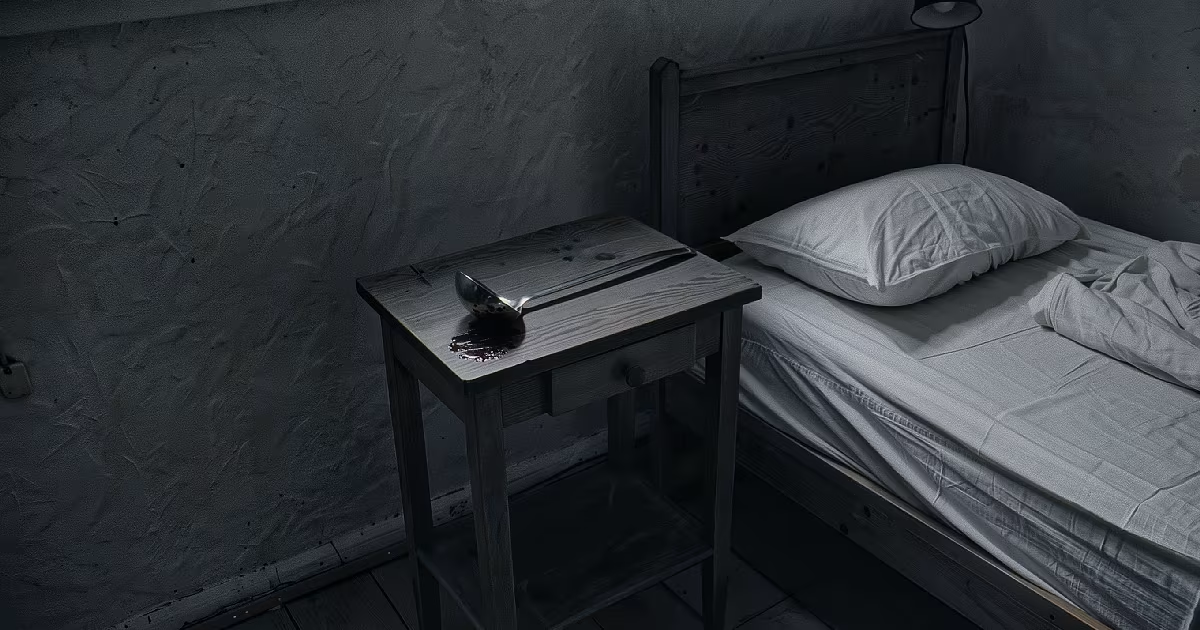
Vampirmordet 1932 crime scene sketch, Polismuseet.
Illustration, not a period photograph.
Opening
On 4 May 1932, Stockholm police forced open the door of a small apartment in the Atlas district, near Sankt Eriksplan, after a neighbor reported not hearing from her friend in several days. Inside they found Lilly Lindeström, a 32-year-old call girl, dead on her bed, naked, killed by blunt force trauma to the head, and dead for two to three days already. Beside the body lay a bloodstained gravy ladle. Investigators concluded her body had been almost entirely drained of blood, with very little found at the scene relative to the violence of the wound, and floated the theory that the ladle had been used by her killer to drink it. The Swedish press seized on the detail immediately. Nearly a century later, the case, still unsolved, is remembered as the Atlas Vampire.
Timeline
Early May 1932, before the 4th. Lindeström, working from her own apartment rather than soliciting on the street, an arrangement that made her something of a novelty in 1932 Stockholm, is last confirmed seen by neighbor and fellow sex worker Millie Jansson, from whom she had gone to borrow condoms, reportedly on or around Walpurgis Night (30 April).
Following day(s). Jansson, not hearing from Lindeström, contacts police out of concern; some accounts describe her as a friend named Minnie rather than Millie, a minor naming discrepancy across period and later retellings.
4 May 1932. Police conduct a welfare check and force entry into the apartment, finding Lindeström already dead for two to three days. She is found naked and face-down (some retellings describe her on her side atop an ottoman with her head resting on her arm, another inconsistency between sources). A large wound is visible on the right side of her head. A condom is found lodged in her anus, indicating sexual activity had taken place at or near the time of death.
Same investigation. Detectives note the bloodstained gravy ladle at the scene and, observing that remarkably little blood was present given the severity of the head wound, conclude the body had been substantially drained, giving rise to the theory that the ladle had been used to collect and drink her blood. Saliva is also reportedly found on her neck and body.
Following the discovery. The case becomes a national sensation, with the "Atlas Vampire" nickname coined and widely circulated by the Swedish press based directly on the drained-blood and blood-drinking theories.
Following weeks and months. Police interview roughly nine men known to have been clients or acquaintances of Lindeström's; none are named publicly, and all are eventually cleared or released without charge after failing to produce a viable case against any of them. Detectives faced a genuine practical difficulty common to sex-worker homicide investigations of the era: a wide, poorly documented client pool with no reliable appointment records to work from.
Ongoing, never resolved. No suspect is ever charged. The murder weapon that caused the head wound is never recovered. The case is formally closed as unsolved, and physical evidence collected at the time, including hair samples, saliva samples, and condoms, is preserved and remains held at the Swedish Police Museum.
Key figures
Lindeström is the case's central and, in the surviving documentary record, curiously underexplored figure beyond the circumstances of her death; her own life, background, and relationships receive far less attention in period and later coverage than the sensational forensic details of the crime scene itself, a pattern common to historical sex-worker homicide cases.
Jansson (or Minnie, depending on the source) is the case's key discovering witness, whose concern over an unusual silence from a friend and neighbor, rather than any formal investigative process, is what actually brought police to the apartment at all.
The roughly nine interviewed clients represent the case's central investigative dead end: a pool of men with plausible access and opportunity, none of whom were ever named publicly or successfully tied to the crime, leaving the investigation's most obvious lead permanently unresolved.
Physical and documentary trail
On the paper, this file has a formal period police investigation, preserved physical evidence still held at the Swedish Police Museum, and consistent core facts across nearly a century of retelling: the date, the location, the blunt-force head wound, the ladle, and the unsolved status.
What it lacks, and what later, more forensically minded reviewers have specifically flagged, is any contemporary or modern re-examination of the central "drained of blood" claim using the forensic science actually available. Postmortem lividity, the settling of blood by gravity into the lowest portions of a body after death, and the natural blood loss patterns of severe head wounds, can both produce a scene with far less visible surface blood than the wound's apparent severity would suggest, without requiring any blood to have been actively removed or consumed by anyone. No period forensic report addressing this specific alternative explanation for the low blood volume observed has surfaced in later retellings of the case.
Despite the brutality of the crime scene, very little blood was actually discovered, thus convincing many that the killer had either drunk it all up or somehow stored it in some kind of container.
Competing explanations
A conventional, if brutal, client homicide, with the "drained of blood" element explained by ordinary postmortem lividity and wound-pattern blood loss rather than deliberate exsanguination. This reading requires no exotic mechanism at all, treats the ladle as a coincidental or opportunistically grabbed household object rather than confirmed drinking apparatus, and is consistent with the far more mundane reality that most sex-worker homicides of this era, however brutal, involved an angry or violent client rather than any ritual element.
A genuine blood-drinking assailant, exhibiting what modern clinical literature sometimes informally calls Renfield's syndrome, a real if rare psychological fixation on blood consumption, distinct from any supernatural claim. This reading takes the ladle and the low blood volume at face value as evidence of deliberate collection and consumption, a pattern with some genuine, if rare, documented precedent among other identified murderers with a specific blood fixation.
An unidentified client among the roughly nine interviewed and released, never definitively cleared so much as simply not proven guilty with the investigative tools 1930s Stockholm police had available. Given the era's limited forensic capability, particularly around blood typing and any form of trace evidence analysis beyond basic hair and saliva collection, this reading holds that the actual killer may well have been questioned and let go for lack of provable evidence rather than genuine innocence.
Later life of the case
The Atlas Vampire remains one of Scandinavia's most frequently retold unsolved historical murders, particularly within true-crime podcast and listicle coverage, where the vampire framing, largely a product of 1932 tabloid sensationalism rather than any confirmed ritual element, continues to dominate retellings over the century-old investigation's more mundane and unresolved practical failures: an unnamed suspect pool, a never-recovered weapon, and forensic tools far too limited for the era to have definitively cleared or convicted anyone.
Finding
Lilly Lindeström was murdered in her own Stockholm apartment in 1932, and her killer was never identified despite a genuine, if period-limited, police investigation covering roughly nine known clients. The case's enduring "vampire" nickname rests substantially on a low observed blood volume that later forensic understanding, specifically postmortem lividity and wound-pattern blood loss, can plausibly explain without requiring any deliberate blood collection or consumption at all, a specific technical alternative that does not appear to have been seriously tested against the original 1932 findings in any subsequent retelling of the case.
What still will not resolve: the identity of Lindeström's killer, the fate of the actual murder weapon, and, more narrowly, whether the case's signature forensic detail, the near-total blood drainage, reflects something genuinely unusual about the crime or simply an untrained period reading of an entirely ordinary postmortem process. Until either is examined with modern forensic method against the surviving preserved evidence, the Atlas Vampire stays exactly as unresolved as it was in 1932.