MARY REESER
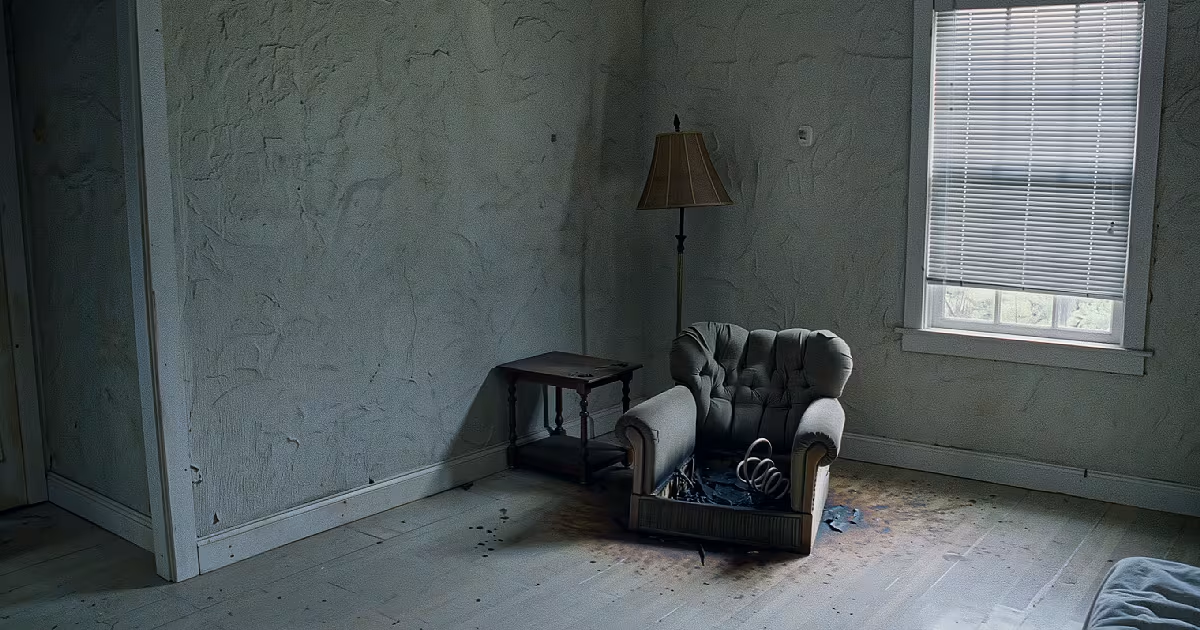
A burned-out armchair on a scorched floor in an empty room.
Illustration, not a photograph.

Opening
At about eight o'clock on the morning of 2 July 1951, the landlady of an apartment building at 1200 Cherry Street NE in St. Petersburg, Florida, Pansy Carpenter, went to deliver a telegram to a tenant. She found the doorknob uncomfortably warm. She called the police.
Inside, Mary Hardy Reeser, aged 67, had been reduced almost entirely to ashes in the remains of the armchair she had been sitting in. What survived was part of her left foot, still in a slipper, a length of backbone, and what was described as a shrunken skull. The newspapers called her the Cinder Lady. Reports said the fire had done little damage to the rest of the room, and the case became the best-known modern example of what was called spontaneous human combustion.
Timeline
8 March 1884Mary Hardy is born in Columbia, Pennsylvania.
The evening of 1 July 1951Her son visits briefly at about eight o'clock, according to popular accounts. Carpenter talks to her and Reeser says she has taken two Seconal sleeping tablets and plans to take two more. She is wearing a rayon nightgown and black satin slippers.
About 5 a.m., 2 JulyCarpenter later recalls a dull thud and a faint smell of smoke. Her electric clock stops at 4:20, according to accounts of the scene.
About 8 a.mThe telegram arrives. The door is hot. Two men go in, one sees a lower leg and a black slipper, and Assistant Fire Chief James G. Hunter damps a smouldering mass with a hand pump.
7 July 1951The police chief, J. R. Reichert, sends J. Edgar Hoover a box of evidence for the FBI.
31 July 1951The FBI concludes that she fell asleep while smoking, according to local coverage. The death certificate lists the cause as accidental.
Key figures
Mary Reeser, a widow, lived alone in the apartment. Her son was born in 1910 and she was buried in Pennsylvania.
Pansy Carpenter, the landlady, made the discovery and spoke to her that evening.
J. R. Reichert, the police chief, sent evidence to Hoover and asked for outside help.
Wilton M. Krogman, a physical anthropologist, was consulted at Reichert's request. His notes cannot be found. Local coverage says he was apparently sceptical of the accidental-death conclusion, and that he later walked back some of his views.
The FBI, which received the evidence, supplied the explanation that became standard.
Physical and documentary trail
The record: newspaper reports of the time, local histories, and the FBI's summary, which I have not read in its original form. The evidence sent to Washington included fragments of glass, six small objects thought to be teeth, bone, chair springs, fibres, a section of carpet with a greasy residue, and the surviving shoe. The FBI found no sign of an accelerant and identified the residue as body fat.
Many scene details come from popular retellings rather than a published police report, so I treat them as reported, not established. They say the chair was stuffed with cotton batting; a light switch near it melted while sockets lower down still worked; candles by the window liquefied but their wicks stood upright; newspapers on the water heater inches from the burned area were undamaged; and the bed sheets were untouched. Plastic objects at a distance from the chair were softened and had lost their shape.
The unusual reported detail is the skull, said to have shrunk to the size of a teacup. A fire researcher who viewed the scene disputed that description. What is missing is an original scene report and any photograph that settles what the room looked like that morning.
Things you might not know
- Dickens wrote about it a century earlier. In Bleak House, published in 1852 and 1853, the character Krook dies of spontaneous combustion, and Dickens defended it in a preface against critics.
- The clock is a famous detail. Her electric clock is said to have stopped at 4:20 a.m. and to have worked when plugged in elsewhere, which would suggest the fire began hours before she was found.
- She took sleeping pills. She told her landlady she had taken two Seconal tablets, and planned more. Investigators thought that made it likely she fell asleep with a cigarette.
- The FBI had a name for it. The wick effect describes a body burning slowly, with clothing acting as a wick and the body's own fat as fuel. The bureau said fat and other flammable material could allow near-complete combustion once alight.
- The anthropologist's notes are missing. Krogman, who was asked to help, left no surviving notes on his conclusions.
- Fire experts have reproduced a version. Forensic fire investigators have burned pig carcasses wrapped in cloth, and a small flame consumed most of the body over hours.
Competing explanations
A cigarette and the wick effect. This is the FBI's reading and the one most fire investigators accept. A sedated smoker's clothing ignites, the fire smoulders slowly and very hot at one spot, and the fat feeds it. A daughter-in-law told a local paper that nothing nearby was flammable. In a 2009 column a former Tampa Bay Times columnist, Jerry Blizin, backed the FBI's account.
Something unexplained. Some writers argue that no ordinary fire destroys a body that completely without spreading, and point to details such as the melted switch and the intact newspapers. The reply is the wick effect, which is itself an inference from such cases and not something anyone watched happen.
Another cause. Other theories, from a lamp fault to foul play, appear in popular accounts. I have not found a documentary basis for them.
Later life of the case
Reeser's death is still the standard example in books on spontaneous human combustion, and the wick effect is still how fire investigators describe such cases. Local coverage notes that it was one of the first such cases to be examined by national law enforcement. Reported cases since then have mostly involved elderly people, living alone, near an ignition source.
Finding
A woman died in a fire that destroyed most of her body and left most of the room standing. The FBI's wick-effect explanation fits the known facts better than any alternative, and the experiments back it. It does not account easily for every reported detail, and many of those details come from retellings, not from a published police file.
What still will not resolve: what Krogman concluded, since his notes are lost, and what exactly the first officers saw in the room.
Evidence signature
3/9 Thin
- Witnesses
- one person, or a tradition
- Instruments
- nothing on record
- Paper
- official records at the time
How well documented the case is, not whether it's true. A strong record can still have an ordinary answer, and a thin one can still be real.
You decide · MARY REESER
What do you think happened?
One vote per case, anonymous. You'll see how other readers voted once you've voted.