MARY TOFT
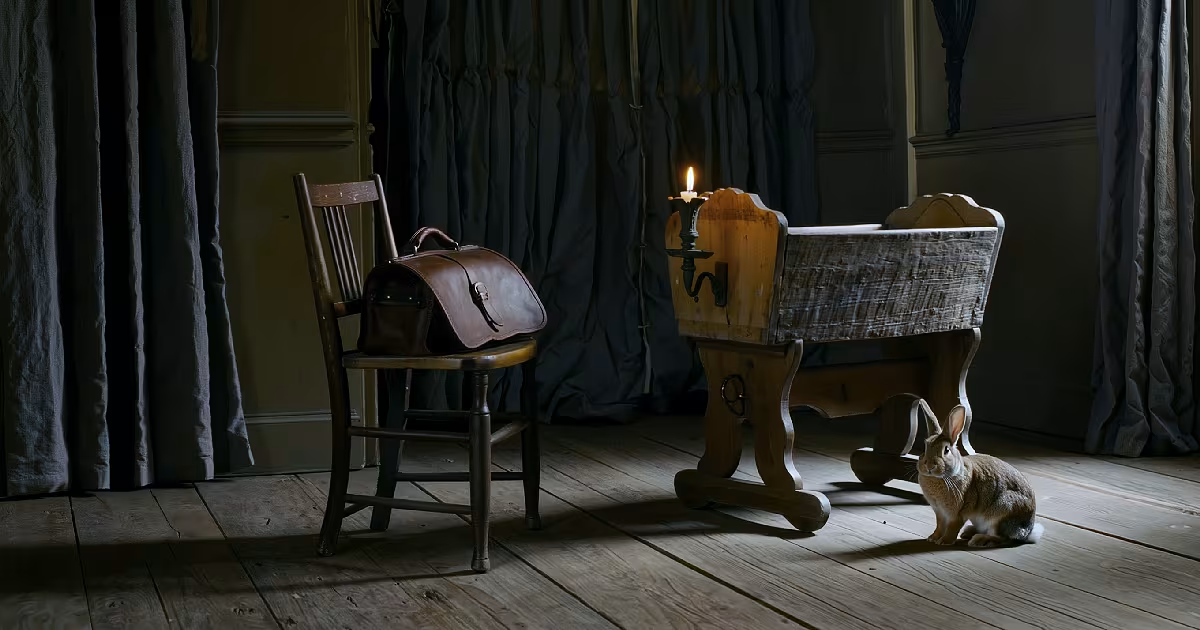
An old wooden cradle in a candlelit Georgian room, a rabbit beside it.
Illustration, not a photograph.

Opening
In the autumn of 1726, news reached London from Godalming in Surrey that a poor farm labourer's wife, Mary Toft, aged about 23, was giving birth to rabbits. A local surgeon, John Howard, said he had delivered them himself, piece by piece. The story was taken seriously enough that King George I sent his own surgeon-anatomist to see.
The king's man believed it. Within weeks, Toft had been brought to London and put under observation, a porter had been caught smuggling a rabbit into her room, and she had confessed. The episode became one of the great embarrassments of eighteenth-century medicine, and William Hogarth made sure no one forgot it.
Timeline
Spring 1726Mary Toft, born Mary Denyer and baptised in Godalming in February 1703, suffers a miscarriage. She later says that while working in a field she was startled by a rabbit and could not stop thinking about them.
September to October 1726John Howard, a surgeon from nearby Guildford, is called and reports delivering parts of animals, then whole rabbits. He writes to physicians in London.
4 November 1726Henry Davenant, a member of the court, visits Toft.
15 November 1726Nathaniel St. André, the king's surgeon-anatomist, arrives with the king's secretary Samuel Molyneux. St. André later says he delivered parts of a rabbit himself and is convinced.
19 November 1726Mist's Weekly Journal reports that nine rabbits have been delivered, all of which died.
20 to 21 November 1726A second royal surgeon, Cyriacus Ahlers, examines Toft and judges it a fraud. He notices her pressing her knees and thighs together as if to stop something dropping, finds cuts in the rabbit pieces that look made by an instrument, and finds straw and grain in their droppings: animals that had supposedly never left the womb had been eating hay. To avoid a scene he says he believes her, leaves with specimens, and reports to the king the next day.
26 November 1726St. André defends the case before the king.
29 November 1726Toft is moved to London and lodged at Lacey's Bagnio, a bathhouse in Leicester Fields, under the watch of physicians including Sir Richard Manningham.
3 December 1726St. André publishes A Short Narrative of an Extraordinary Delivery of Rabbets.
4 December 1726The bagnio's porter, Thomas Howard, confesses that Toft's sister-in-law Margaret paid him to bring in a rabbit. The same day, Lord Onslow reports that Toft's husband had been buying young rabbits.
7 December 1726Questioned by Manningham and others, and threatened with a painful operation, Toft confesses that she had inserted the animal parts herself. She is sent to Tothill Fields Bridewell as a "vile cheat and impostor".
9 December 1726St. André publicly takes back his support.
December 1726 to early 1727Crowds gather at the Bridewell for months hoping to see her. While held there she sits for a portrait by the artist John Laguerre. The physicians publish rival accounts: Manningham's An Exact Diary of his observations, a reply from the anatomist James Douglas, and Douglas's mocking pamphlet The Sooterkin Dissected.
8 April 1727Toft is released without trial.
Key figures
Mary Toft was a poor woman in her early twenties who had lost a pregnancy, and who either devised the hoax or was drawn into it by others; her own confessions shifted blame between herself and the people around her. John Howard was the local surgeon who first reported it and was fined £800 for his part.
Nathaniel St. André was the royal surgeon who staked his reputation on it and lost it. Cyriacus Ahlers was the royal surgeon who saw through it. Sir Richard Manningham was the obstetrician who extracted the confession. James Douglas, one of the leading anatomists in London, doubted the story from the start and kept away from it.
In her confessions, which were never published in her lifetime, Toft said that after her miscarriage parts of animals had been inserted into her body, and she named others as involved, including her mother-in-law, Ann Toft, and John Howard. She also said a travelling woman had taught her the trick and promised she would never want for anything as long as she lived.
Physical and documentary trail
The record is detailed and immediate: St. André's pamphlet, published days before the collapse; the reports of Ahlers and Manningham; newspaper coverage week by week; the porter's confession; Toft's own confessions; court records; and the satirical prints and verses that followed. What is missing is a full account from Toft herself that she did not later contradict.
Things you might not know
- The king sent two surgeons. One was fooled, the other was not.
- A bathhouse was the lab. Toft was watched round the clock at Lacey's Bagnio in Leicester Fields, now Leicester Square.
- The rabbits had eaten hay. Ahlers found straw and grain in their droppings, which no animal born from a womb could have eaten.
- London went off rabbit. During the affair, rabbit stew and jugged hare reportedly disappeared from dinner tables.
- Hogarth drew it twice, with labels. His print Cunicularii, or The Wise Men of Godliman in Consultation (1726) shows Toft in labour surrounded by the men of the case, each marked with a letter: St. André is A, Howard D, her husband E and Toft herself F. He used her again in Credulity, Superstition, and Fanaticism in 1762.
- Alexander Pope joined in. He and William Pulteney wrote a mocking ballad, The Discovery, aimed at the king's secretary Samuel Molyneux.
- The royal surgeon lived to 96. St. André's career never recovered, but he lived until 1776.
- Her life after was hard. Toft had a daughter in 1728, was jailed for receiving stolen goods in 1740, and died in Godalming in 1763.
Competing explanations
A hoax. Toft confessed, the porter confessed, her husband was buying rabbits, and the "births" stopped once she was watched. This is the full explanation.
A hoax with others behind it. Historians have debated how much was Toft's idea and how much her family's or Howard's, given the money a famous case could bring. Her own accounts named others.
Maternal impression. The theory St. André and others relied on: that what a pregnant woman saw, dreamed or craved could shape her child, an idea going back to ancient writers. Only a few years earlier the physician John Maubray had written that women could give birth to a creature he called a "sooterkin", and warned that pets could make babies resemble them. It was a respected idea in 1726, and it is the reason clever men believed something impossible.
Later life of the case
The Toft affair helped discredit the theory of maternal impression and became a standard lesson in medical credulity. For a later case where respected men were fooled by a planted specimen, see the Piltdown Man.
Finding
Mary Toft did not give birth to rabbits. She confessed in December 1726, and the evidence from the porter and her husband's purchases confirms it. What the case really documents is how the king's own surgeon came to believe it, and how quickly London stopped.
What still will not resolve: whose idea it was, since Toft's confessions blamed different people and the others involved never told their side.
Evidence signature
7/9 Strong
- Witnesses
- trained, independent witnesses
- Instruments
- photo, film or physical traces
- Paper
- formal investigation, court or declassified file
How well documented the case is, not whether it's true. A strong record can still have an ordinary answer, and a thin one can still be real.
You decide · MARY TOFT
What do you think happened?
One vote per case, anonymous. You'll see how other readers voted once you've voted.