PILTDOWN MAN
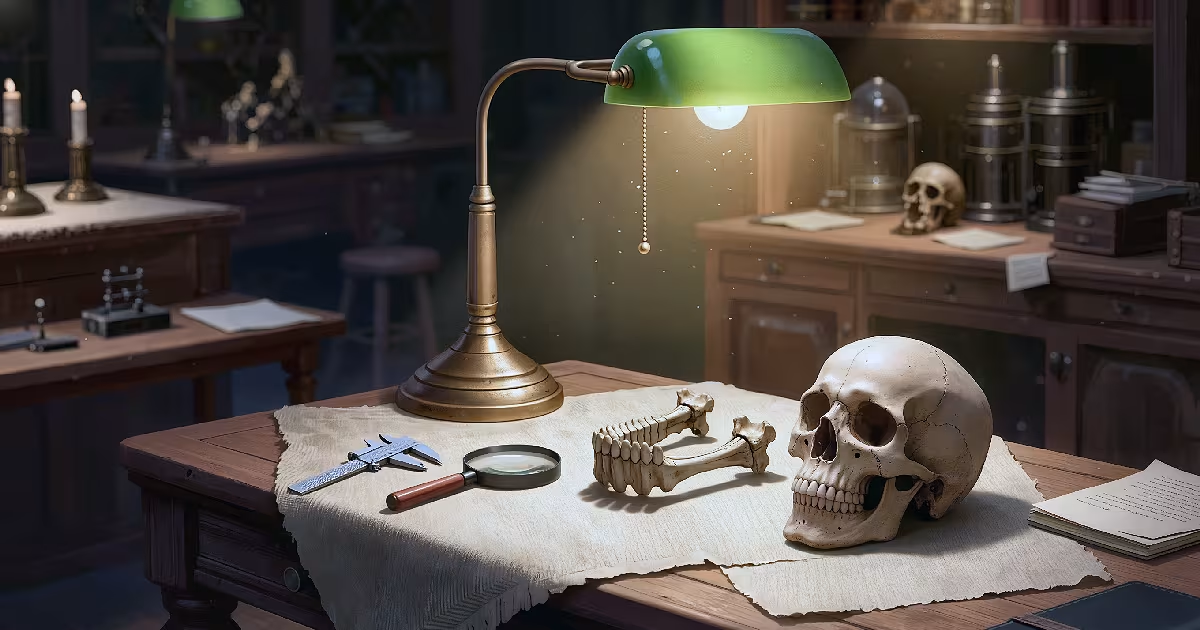
A skull and a jaw on a cloth under a green desk lamp.
Illustration, not a photograph.

Opening
On 18 December 1912, at the Geological Society of London, Arthur Smith Woodward of the Natural History Museum announced what looked like the missing link between apes and humans: a human-like skull with an ape-like jaw, dug from a gravel pit at Piltdown in Sussex by the amateur archaeologist Charles Dawson. It was named Eoanthropus dawsoni, dawn man of Dawson, and dated to about half a million years.
It was a forgery. The skull was a medieval human skull, the jaw came from an orangutan, and the teeth had been filed. It was accepted by much of British science for decades and exposed in 1953, so the fraud lasted forty-one years. A 2016 study concluded that one person made it, and that the person was Dawson.
Timeline
1908Dawson says a workman gave him a skull fragment, which workers had broken up believing it to be a fossilised coconut.
February to September 1912Dawson contacts Woodward. They dig at the gravel pit from June to September, joined by Pierre Teilhard de Chardin. In June an elephant molar and a skull fragment are found. Dawson alone recovers more skull fragments, molar teeth and half of the lower jaw.
18 December 1912The find is announced.
August 1913Teilhard finds a canine tooth that Woodward says fits the jaw. Arthur Keith disputes it on dental wear grounds. Grafton Elliot Smith defends Woodward, and the disagreement leads to a public falling-out.
1913 to 1923Doubts are voiced by David Waterston in Nature in 1913, by Marcellin Boule in 1915 and Gerrit Smith Miller Jr. in 1915, who each judge the jaw to be an ape's, and by Franz Weidenreich in 1923, who calls it a modern human skull with an orangutan jaw and filed teeth.
1915Dawson claims three fragments of a second skull, Piltdown II, a frontal piece, an occipital fragment and a lower molar, at a site about two miles away at Sheffield Park that was never identified. A fossil elephant bone shaped into a crude tool, the so-called cricket bat, is also accepted at the time. Dawson dies in August 1916.
1925Edmonds reports a geology error in the Piltdown account. The report is ignored.
23 July 1938Keith unveils a memorial stone at Barkham Manor, Piltdown.
1948Woodward's book The Earliest Englishman is published after his death.
1949 to 1953Fluorine absorption tests developed by Kenneth Oakley show the jaw and teeth have much less fluorine than the skull. With Wilfrid Le Gros Clark and Joseph Weiner, Oakley proves the fraud. Time magazine reports it in November 1953.
1970A trunk left by Martin Hinton at the museum is found to contain carved and stained animal bones and teeth similar to the Piltdown finds.
2003 and 2016The Natural History Museum marks fifty years since the exposure with an exhibition in November 2003. In 2016 Isabelle De Groote and colleagues, working with the museum and Liverpool John Moores University, publish their analysis.
Key figures
Charles Dawson was the amateur archaeologist, a Fellow of the Society of Antiquaries, who found the material. Arthur Smith Woodward was the museum's Keeper of Geology and described it. Arthur Keith favoured a rival reconstruction, Homo piltdownensis. Pierre Teilhard de Chardin took part in the digs and found the canine. Joseph Weiner, Kenneth Oakley and Wilfrid Le Gros Clark exposed it, and Weiner told the story in his book The Piltdown Forgery.
Suspects over the years have included Dawson, Teilhard, Keith, Martin Hinton and Arthur Conan Doyle. Stephen Jay Gould argued Teilhard conspired with Dawson, which others rejected. Phillip Tobias implicated Keith. Richard Milner proposed Doyle, and later DNA work did not support that. Miles Russell found at least thirty-eight fakes in Dawson's collection, including the filed teeth called Plagiaulax dawsoni, the Hastings Castle shadow figures, the Bexhill boat and the Brighton Toad in the Hole.
Physical and documentary trail
The record: the specimens themselves, the 1953 tests, and the 2016 re-examination. The skull was a medieval human skull and the jaw an orangutan jaw about five hundred years old, with the teeth filed down. The bones were stained with an iron solution and chromic acid, and microscopic file marks showed the teeth had been modified.
The 2016 study found the same preparation in both Piltdown sites: staining, packing with local gravel and fixing the teeth with dentist's putty. DNA and shape analysis showed the teeth from both came from the same orangutan. A tooth Dawson found in 1915 at another site came from the same jaw. The authors concluded that one person made the forgeries, that Dawson was the only person linked to Piltdown II, and that Teilhard and Doyle could be excluded. They did not fully rule out an outside supplier of the material.
Things you might not know
- It lasted forty-one years. From the 1912 announcement to the 1953 exposure.
- It had a stone memorial. Keith unveiled it at Barkham Manor in 1938, fifteen years before the exposure.
- It came with a tool. The cricket-bat bone, a shaped fossil elephant bone, was accepted alongside the skull.
- An early geology warning was ignored. Edmonds reported an error in 1925.
- It was tested with fluorine. The jaw had far less than the skull.
- A trunk turned up in 1970. Martin Hinton's trunk at the museum held stained and carved bones.
- It delayed real finds. Discoveries such as the Taung Child were initially overlooked.
Competing explanations
A single forger. The 2016 conclusion, and the strongest reading: Dawson alone, with a collection of at least thirty-eight fakes found in his name.
A conspiracy. Teilhard, Keith, Hinton and Doyle have all been named. The 2016 work excludes Teilhard and Doyle, and the others are not supported by the physical evidence. The Hinton trunk shows he kept fakes of the same kind, which is not proof that he made Piltdown.
A wider failure. The hoax was accepted for decades, and some historians read that as a failure of the experts as well as a crime by one man. Doubts were raised in 1913, 1915, 1923 and 1925 and none carried the day. That is a reading of the history, not a competing account of who made the bones.
Later life of the case
Piltdown is still used in training on research misconduct, as the standard example of a hoax that science exposed itself. It stands in the archive beside the Kensington Runestone, another object that was accepted by some and rejected by others.
Finding
Piltdown Man was a deliberate forgery, assembled from a medieval skull, an orangutan jaw with filed orangutan teeth, and exposed by tests. The best explanation is that Charles Dawson made it, and the 2016 study reached the same conclusion on the physical evidence.
What still will not resolve: whether Dawson had help or supplies from anyone else, since the study did not fully rule out an outside source for the materials, and why he did it.
Evidence signature
6/9 Solid
- Witnesses
- nothing on record
- Instruments
- more than one sensor agrees
- Paper
- formal investigation, court or declassified file
How well documented the case is, not whether it's true. A strong record can still have an ordinary answer, and a thin one can still be real.
You decide · PILTDOWN MAN
What do you think happened?
One vote per case, anonymous. You'll see how other readers voted once you've voted.