SHROUD OF TURIN
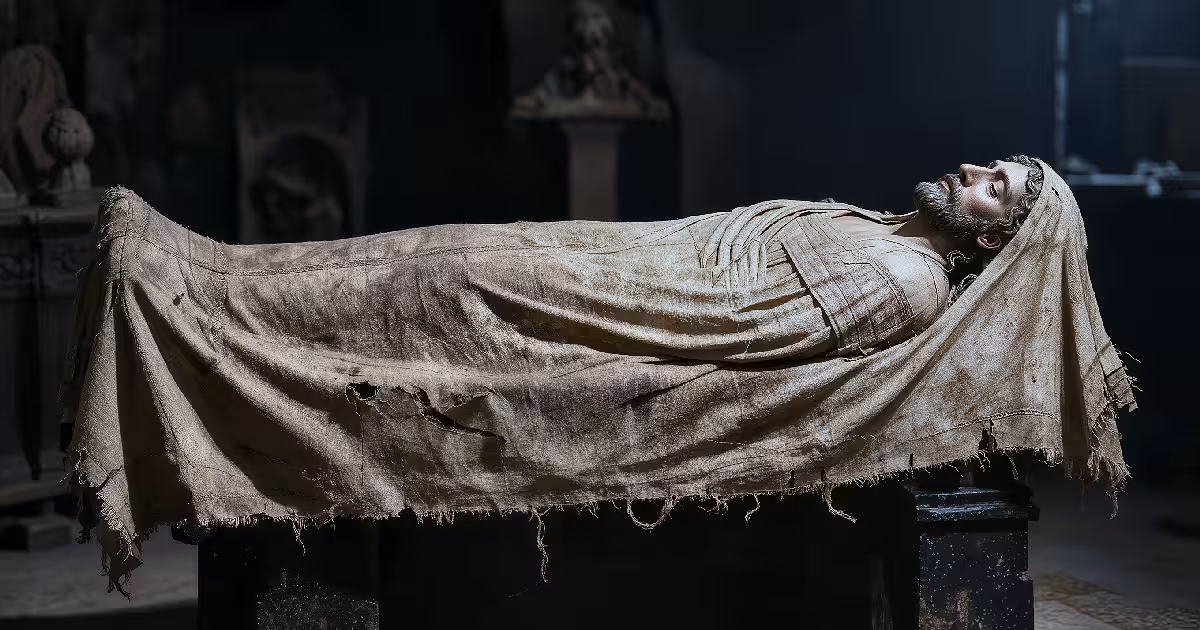
A figure lying under a worn linen cloth on a dark stone table.
Illustration, not a photograph.

Opening
The Shroud of Turin is a linen cloth about 4.4 metres long and 1.1 metres wide, woven in a three-to-one herringbone twill, which carries a faint brownish image of the front and back of a naked, bearded man with his hands folded over the groin. Many believers hold it to be the burial cloth of Jesus. It has been kept in Turin since 1578 and belongs to the Holy See.
It is the most studied relic in the world, and the arguments are not simple. A radiocarbon test in 1988 dated the cloth to between 1260 and 1390. The Catholic Church has never declared the cloth authentic and allows veneration. Nobody has yet shown, to general agreement, how the image was made.
Timeline
1353 to 1355Geoffroi de Charny endows a church at Lirey in France. The cloth is exhibited there from about 1354 or 1355. No definite record of this cloth exists before the fourteenth century.
1389 or 1390Bishop Pierre d'Arcis of Troyes calls it a forgery and says it was painted. Pope Clement VII allows its display only as a representation, not a true relic.
1453Marguerite de Charny deeds it to Louis, Duke of Savoy.
1506Pope Julius II permits veneration of it as a true relic.
1532A fire at Chambéry damages it. Poor Clare nuns later sew patches over the burn holes.
1578It is moved to Turin.
28 May 1898Secondo Pia photographs it and finds that the negative shows a clearer image than the cloth.
27 August to 8 October 1978The cloth is displayed in Turin, with about three million visitors. For the next five days the Shroud of Turin Research Project, STURP, examines it around the clock at the royal palace beside the cathedral. In October 32 tape samples are taken, 18 from image areas and 14 from non-image areas.
June 1980Walter McCrone resigns from the project and gives his samples to Raymond Rogers.
1981STURP's final report says the image is not the work of an artist and calls it an ongoing mystery.
1983Umberto II's will leaves the cloth to the Holy See.
1986 to April 1988The Turin protocol and its revisions cut the radiocarbon labs to three and drop the blind test, because the herringbone weave could not be matched in control samples. The final protocol, published in April 1988, specifies one sampling site and one 40 mg sample per lab.
April 1988Samples are cut in Turin Cathedral, with Michael Tite of the British Museum present. Oxford, Arizona and ETH Zurich date a corner swatch to AD 1260 to 1390 with 95 per cent confidence. The result is published in Nature in 1989.
2013Pope Francis speaks on a live broadcast of the cloth, calling it an icon of a scourged and crucified man and stopping short of asserting authenticity.
Key figures
Geoffroi de Charny and Marguerite de Charny are the first named owners. Pierre d'Arcis is the bishop who called it a forgery. Secondo Pia made the first photograph. In the 1978 team, John Jackson and Eric Jumper of the US Air Force Academy, Raymond Rogers of Los Alamos, John Heller and Alan Adler were leading members, among 33 listed for that year. Walter McCrone, a microscopist and the one agnostic in a group mostly of believers, concluded the image was red ochre in a gelatin medium and the blood was vermilion tempera paint. Heller and Adler agreed the cloth contains iron oxide but attributed it to the retting of the flax. Other members rejected McCrone's reading.
Raymond Rogers argued that the 1988 sample came from a medieval repair, and he later published criticisms of the dating, with the statisticians Benford and Marino taking a similar line. Joe Nickell made a bas-relief image with pigment in 1979, and Luigi Garlaschelli published a life-size reproduction in 2010. Jacques di Costanzo and Thibault Heimburger tried other ways of reproducing the image. Mechthild Flury-Lemberg, a textile expert, and Harry Gove, a physicist, rejected the repair theory. Christopher Ramsey's Oxford lab tested the carbon monoxide idea and found no significant reaction.
Physical and documentary trail
The record: the cloth, the 1988 laboratory results published by Damon and colleagues in Nature in 1989, the STURP findings and a documentary history that begins in the 1350s. Claims that the cloth is the Mandylion of Edessa or was lost in the sack of Constantinople in 1204 are not established, and the source I read finds no evidence linking the cloth to them.
The image is a superficial yellowing on the topmost fibrils, only two or three fibres per thread point, penetrating about 200 nanometres into the outer layer, and it is absent under crossing threads. It reads as a halftone, with darkness reflecting how many fibres are yellowed, not the hue. Estimates of the man's height run from 1.70 to 1.88 metres. Whether the image encodes three-dimensional information, as some say, is disputed, and Andrea Nicolotti argues it is flat. Rogers' tests found no proteins or body fluids in the image areas.
The blood is the second argument. STURP's final report said the stains contain haemoglobin and test positive for serum albumin. Sceptics reply that the blood could come from a handler and that the flows look unrealistically neat, and as of 2025 the source I read says a human origin has not been demonstrated. A 2018 bloodstain pattern study by Matteo Borrini argued the stains were handmade. On the biology, Barcaccia and colleagues in 2015 found DNA from 19 plant taxa and several human mitochondrial haplogroups, which they read as the result of handling over centuries, not of age or origin. Marzia Boi argued the dominant pollen was Helichrysum, possibly from burial balms, while researchers who studied pollen directly identified Gundelia tournefortii. A digital study by Lorusso and colleagues in 2011 found no coins, flowers or writing. A study by Cicero Moraes in Archaeometry in 2025 argued the image is an artistic creation, not the imprint of a body. That is a single study.
The radiocarbon numbers are worth seeing. The uncalibrated results were 646 years plus or minus 31 for Arizona, 750 plus or minus 30 for Oxford and 676 plus or minus 24 for Zurich, with a mean of 691 plus or minus 31. That calibrates to 1260 to 1390. Later statistical reanalyses by Riani and colleagues in 2013, Casabianca and colleagues in 2019 and Walsh and Schwalbe in 2020 found the three labs' results more varied than they should be, and the last pair found that shifting all results by about 88 radiocarbon years would bring them into agreement, with differing cleaning methods as one possible cause. Rogers reported finding cotton and coatings in the sample, but in 2016 Jull and Freer-Waters found only low levels of cotton and no evidence of dye or treatment. Proposed bacterial contamination was tested and not found. Claims that a fire raised the carbon were not replicated, and the papers behind one version were shown to contain fabricated sources. A 2013 claim by Giulio Fanti of a first-century date is widely doubted because of how the fibres were obtained. No radiocarbon specialist has said the 1988 dating is substantially unreliable, and the former Nature editor Philip Ball wrote in 2019 that no published work shows it was substantially wrong, though it was not definitive either. The Vatican has not released samples for further study since 1989.
Things you might not know
- A bishop called it a fake in 1389. His memo is one of the earliest documents about it.
- The photograph came before the debate. Pia's 1898 negative first showed the image clearly.
- The test was trimmed. The plan was changed after 1986: the labs were cut to three and the blind test was dropped.
- The sample was tiny. One 40 mg piece per lab, from a single corner.
- The Church takes no side. It neither endorses nor rejects authenticity, and its stated view is that authenticity does not affect Christian doctrine.
- It survived a fire. The 1532 blaze at Chambéry damaged it.
- Crowds are real. About three million came in 1978, and the Church said more than two million came in 2010.
Competing explanations
A medieval object. The strongest reading from the evidence: the earliest records are from the 1350s, a bishop called it a forgery, and the radiocarbon result agrees. Nickell and Garlaschelli showed that comparable images can be made with simple methods.
An ancient cloth. The case made by defenders: the sample was unrepresentative, the data were inconsistent, and the image has features that no one has reproduced. Statistical reanalyses of the 1988 data lend this some support, because they show the labs agreed less well than reported. It needs the radiocarbon result to be wrong, and that has not been shown. Its defenders also have to explain the lack of any record before the fourteenth century.
A devotional image that outgrew its purpose. Some Catholic writers value the cloth as an icon without claiming it as the burial cloth, which is close to the Church's own position.
Later life of the case
The cloth is still studied, and each new paper is quoted by both sides. It belongs with the other disputed relics and objects in the archive, such as Piltdown Man, though unlike Piltdown nobody has shown who made it, or when. Its public displays continue, with a Turin Cathedral exhibition from 19 April to 24 June 2015 by appointment.
Finding
The documented history of the Shroud begins in the 1350s, and the radiocarbon test dates the cloth to the thirteenth or fourteenth century. The strongest reading is that it is a medieval object. Objections to the 1988 sample and its statistics are still argued in print, and no one has produced a method that reproduces the image to everyone's satisfaction.
What still will not resolve: how the image was formed, and whether the small corner tested in 1988 stands for the whole cloth, since the cloth belongs to the Holy See and any new sampling is its decision.
Evidence signature
4/9 Solid
- Witnesses
- nothing on record
- Instruments
- radar or measured data
- Paper
- official records at the time
How well documented the case is, not whether it's true. A strong record can still have an ordinary answer, and a thin one can still be real.
You decide · SHROUD OF TURIN
What do you think happened?
One vote per case, anonymous. You'll see how other readers voted once you've voted.