COSO ARTIFACT
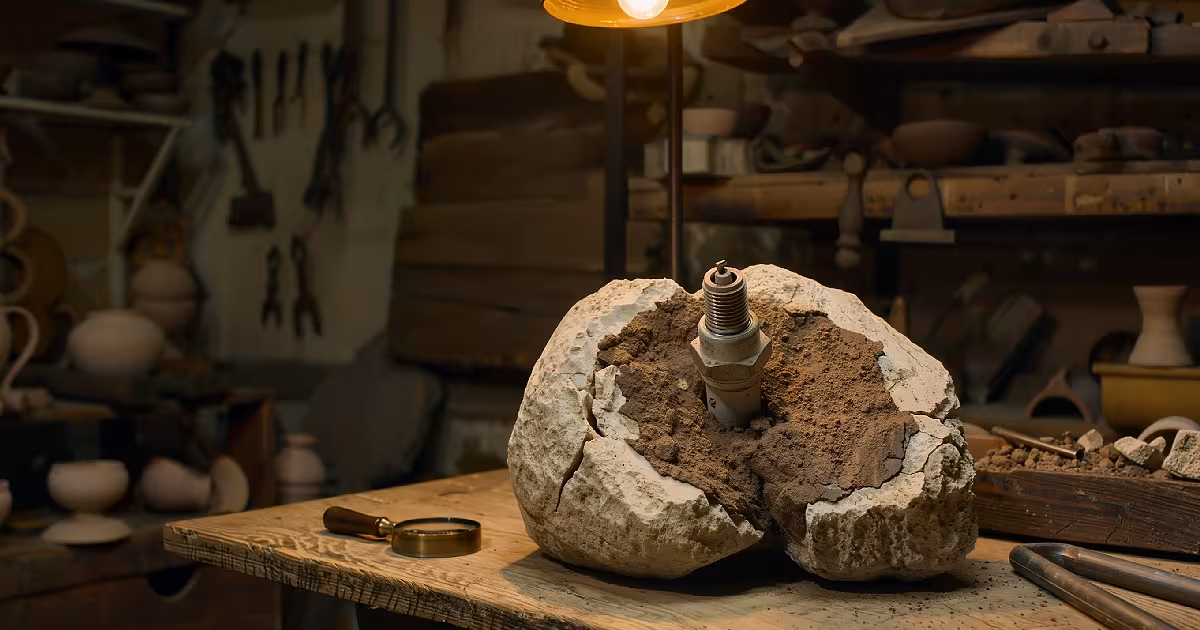
A cracked open stone with an old spark plug set inside it.
Illustration, not a photograph.

Opening
On 13 February 1961, three rock hunters, Wallace Lane, Virginia Maxey and Mike Mikesell, were collecting geodes in the hills near Olancha, California, when they picked up a stone that would not cut cleanly. When they sawed it open, inside they found a porcelain cylinder with a metal core, set in a crust encrusted with what they took for fossil shells.
A letter in Desert Magazine that May claimed a geologist had dated the nodule to at least half a million years old. The "Coso Artifact" became a classic of the out-of-place-objects literature: proof, some said, of a lost technology or visitors from elsewhere. In the late 1990s two researchers took X-rays of it to the Spark Plug Collectors of America. They knew exactly what it was.
Timeline
13 February 1961Lane, Maxey and Mikesell find the object while prospecting for geodes near the Coso Range, north-east of Olancha. Back home, Mikesell ruins a diamond-edged saw blade cutting through the hard outer crust. Inside is a porcelain cylinder around a two-millimetre shaft of bright metal, which later proves to be magnetic.
May 1961A reader's letter to Desert Magazine says a trained geologist has dated the nodule to "at least 500,000 years old". The geologist is never named, and no dating method is ever published.
The 1960s and 1970sThe object is displayed and written up in fringe magazines and books on ancient mysteries as an impossible artefact.
The late 1990sPierre Stromberg and Paul Heinrich study the published X-rays and photographs, with help from the Spark Plug Collectors of America. They identify the object as a 1920s Champion spark plug inside an iron-oxide concretion. Chad Windham, president of the collectors' society, agrees.
12 April 2018Contacted by the family of one of the finders, Stromberg examines the object in person, and arranges for a geologist from the University of Washington's Earth and Space Sciences department to inspect it. Both confirm the identification and find no evidence of the claimed fossil shells.
2019The artefact is on display at the Pacific Science Center in Seattle, in an exhibition called What Is Reality?
Key figures
Wallace Lane, Virginia Maxey and Mike Mikesell found it. Pierre Stromberg and Paul Heinrich solved it. Chad Windham and the Spark Plug Collectors of America supplied the specialist knowledge. The geologist who supposedly dated it has never been identified.
Physical and documentary trail
The record: the object itself, which survives; the original photographs and X-rays; the 1961 magazine letter making the age claim; the identification from X-rays; and the 2018 physical examination. What has never existed is any published geological dating of the nodule, or any record of who did the dating described in the 1961 letter. No method existed at the time that could have dated a concretion like this one, which raises its own questions about the claim.
Champion plugs were widely used in the Ford Model T and Model A, the most common cars in America in the 1920s. Iron from the rusting plug bound sand and clay around it into a hard crust, which is why it felt like a stone and resisted the saw.
Things you might not know
- Collectors solved it. The decisive experts were spark plug enthusiasts, who could match the shape of the porcelain and the metal parts to a known 1920s Champion design.
- It isn't a geode. The "stone" is a concretion of iron oxide and clay that formed around the plug, the kind of crust that can build up on buried metal in a matter of decades.
- The half-million-year date had no source. It came from a letter quoting an unnamed geologist.
- The fossils weren't fossils. The 2018 examination found nothing to support the shells described in the early accounts.
- It broke a diamond saw. The rust crust was hard enough to ruin the blade used to cut it open, which helped convince the finders it was ancient rock.
- Its plug type powered the Model T. Champion plugs were standard in Ford's Model T and Model A engines, millions of which travelled America's back roads.
- A fringe journal guessed right. Paul Willis, editor of the Fortean magazine INFO Journal, speculated early on that the object was some sort of spark plug.
- It ended up in a science museum. In 2019 it was shown in Seattle in an exhibition about how people tell what's real.
Competing explanations
A 1920s spark plug. The identification made from the X-rays and confirmed by direct examination. The area was mined and travelled by vehicles in the early twentieth century, so a lost plug is unremarkable.
An ancient or alien artefact. The original claim. It rested entirely on the unsourced 500,000-year date and on the assumption that the crust was a geode, both of which have fallen away.
Later life of the case
The Coso Artifact still appears in lists of "out-of-place" objects, usually without the spark plug. For an ancient object that really is as remarkable as it looks, see the Antikythera mechanism.
Finding
The Coso Artifact is a 1920s Champion spark plug wrapped in a crust of rust and mud. Specialists identified it from X-rays in the late 1990s, and an in-person examination in 2018 confirmed it. The 500,000-year age was never more than a claim in a letter.
What still will not resolve: how the plug came to be lying in those hills, though a car or mining engine of the 1920s is the obvious answer.
Evidence signature
6/9 Solid
- Witnesses
- several people
- Instruments
- radar or measured data
- Paper
- official records at the time
How well documented the case is, not whether it's true. A strong record can still have an ordinary answer, and a thin one can still be real.
You decide · COSO ARTIFACT
What do you think happened?
One vote per case, anonymous. You'll see how other readers voted once you've voted.