DYATLOV PASS INCIDENT
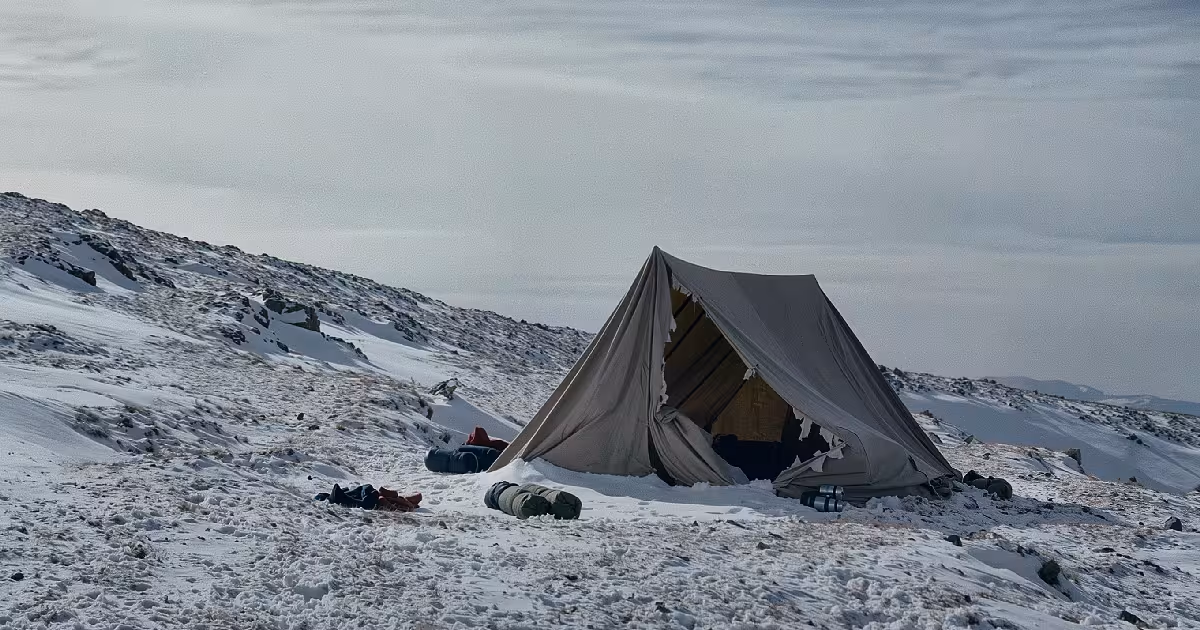
Dyatlov Pass tent and search site.
Illustration, not a period photograph.
Opening
On 23 January 1959 a skiing party left Sverdlovsk for the northern Urals. Most of them were students or recent graduates of the Ural Polytechnic Institute. Igor Dyatlov, 23, led. Yuri Yudin turned back because of pain. The other nine went on: seven men and two women, headed for Mount Otorten. On 1 February they pitched a tent on the eastern slope of Kholat Syakhl, a Mansi-named height the maps treated as 1079. They did not come off that slope alive.
Searchers found the tent on 26 February, half buried, slashed from the inside. Boots and coats were still in it. Tracks went down toward the trees. First bodies lay by a cedar more than a kilometer below. Others lay on the way back up. Four were found in May under snow in a creek ravine, with injuries that did not look like a simple freeze. The Sverdlovsk prosecutor closed the file on 28 May 1959: a compelling natural force the hikers could not overcome.
The spine of the file is the cut tent and the walk downhill without kit. Every later theory has to pass those two facts. The pass now carries Dyatlov’s name because the group did not.
Timeline
23 January 1959. The group leaves. Diaries and film, recovered later, carry them through villages and toward the ridge.
28 January. Yudin turns back. He is the only member who will talk to a living investigator.
1 February. They cut a platform in the slope and raise the tent above the tree line. Last photographs show a working camp, not a rout.
Night of 1-2 February. Something puts them out through slashes in the canvas. They go downslope toward a cedar, some in socks, some barefoot, in temperatures later reconstructed well below minus 20 C, with wind. No second tent. No fire at the canvas.
26 February. Student searcher Mikhail Sharavin and others find the tent. Order inside. Cuts from within. A line of prints down to the trees, not a scramble of strangers.
27 February onward. Yuri Doroshenko and Yuri Krivonischenko at the cedar, fire remnants, burned hands. Then Dyatlov, Zinaida Kolmogorova, and Rustem Slobodin on the slope as if walking back toward the tent. Slobodin has a skull fracture that is not, in the forensic papers, a rifle wound.
May 1959. The last four come out of a ravine under snow: Lyudmila Dubinina, Alexander Kolevatov, Nicolai Thibeaux-Brignolle, Semyon Zolotaryov. Thibeaux-Brignolle, a fatal skull fracture. Dubinina and Zolotaryov, crushed chests. Soft tissue on some faces is missing after months of water and thaw. Clothes on the last bodies include items taken from the first dead.
27-28 May 1959. Radiologist A.F. Levashov reports elevated beta counts on some garments from the ravine group. Lev Nikitich Ivanov closes the criminal file with the natural-force line. The district is restricted for a time.
Key figures
Igor Dyatlov is the leader who does not write a last note that survives. He dies on the slope between cedar and tent.
Yuri Yudin is the living hinge. He identifies kit. He is not on the mountain for the night.
The cedar pair, Doroshenko and Krivonischenko, are the fire-builders. The slope three look like a return attempt. The ravine four are the injury problem the hypothermia reading has to swallow.
Lev Ivanov is the prosecutor who writes “compelling natural force” and later, in retirement interviews, talks about orange spheres and pressure to keep the file dull. Those later talks are not the 1959 stamp. Boris Vozrozhdenny is the forensic voice who says the chest and skull blows are not fists and not a Mansi quarrel.
Mikhail Sharavin finds the tent. He is why the canvas exists as a described object and not as a rumor.
Physical and documentary trail
On the paper, 1959 gives you four hard objects.
One: the tent. Cut from inside. Kit left. Pitched on a slope that later avalanche papers will argue about. Photographed by the search.
Two: the body map. Cedar, slope, ravine. Six deaths listed as hypothermia. Two chest. One skull. Footprints of the nine, not of a tenth party, on the snow that still held them.
Three: the forensic sheets. No soft-tissue fight damage that reads as a brawl. Force on the ravine chests described as beyond a man’s hands. Paradoxical undressing sits in the hypothermia literature for the half-clothed.
Four: the 28 May 1959 close and the May radiation note on some clothes. The counts are above Sverdlovsk street background and far below a reactor floor. Thorium in lantern mantles and the 1957 Mayak plume are later proposed sources. They are not named in Ivanov’s one-line cause.
There is no surviving witness of the night. There is no second camp. There is no bullet. There is no official 1959 UFO folder that identifies an object over Kholat Syakhl. Diaries stop being a running log when the tent goes quiet.
The cause of death of the tourists was a compelling natural force which the hikers were unable to overcome.
Competing explanations
Slab avalanche, delayed. This is the 2021 reading from Gaume and Puzrin in Communications Earth & Environment, and the line the Russian prosecutor’s office also favored in a later review. A small slab, cut by their own platform, can hit a tent hours after the slope was worked, shove bodies, and send the rest downhill. It accounts for the cut-and-run and for crush injuries without a human attacker. It has to live with a slope that looks mild on a tourist map and with searchers who did not log a classic debris tongue in February.
Katabatic wind and panic. A falling wall of air can flatten a tent and empty a mind. It accounts for flight in poor clothes. It does not, by itself, break those ravine ribs.
Military test. Missiles, parachute mines, a stray orange sphere. This reading uses the radiation counts and Ivanov’s later sphere talk. It has no 1959 range log on that ridge and no fragment in the tent.
Other people. Mansi hunters were searched and dropped. A fight among friends does not match Vozrozhdenny’s force-without-soft-tissue. A yeti is a poster, not a 1959 exhibit.
Later life of the case
The pass becomes a name and then a publishing industry. Orange orbs, infrasound, secret weapons, and stolen tongues travel well. I keep missing eyes and a missing tongue in the thaw and water column unless a 1959 doctor wrote them as wounds of assault. The sheets do not give you a clean assault.
The 2021 slab paper is the first later document that changes the file with mechanics instead of atmosphere. It does not photograph the slab. It shows how a slab could exist on that slope after a cut. The 2019-2020 official Russian review lands near the same weather-and-snow family.
Yudin died in 2013 still answering questions. He never claimed a craft. If a 1959 military incident report for that night is ever posted with coordinates, the finding moves. The public file is still a tent, nine bodies, and a one-line close.
Finding
Nine skiers pitched a tent on Kholat Syakhl on 1 February 1959 and did not walk down. The tent was cut from the inside. Bodies were found in stages, some far from the canvas, some with injuries a fall on snow does not easily write. Yuri Yudin had turned back and lived. Believe the slope. Those nine were not a legend when they left Sverdlovsk. Something on that mountain took a trained party apart.
What still will not resolve: a cause that accounts for the inside cuts, the distances, and the worst of the trauma in one mechanism a pathologist will sign. A recovered instrument from the tent that logged the hour, or a second party's tracks that are not the nine, would finish the only job the file has ever had. The mountain kept them. It has not yet named what did it.