LEAD MASKS CASE
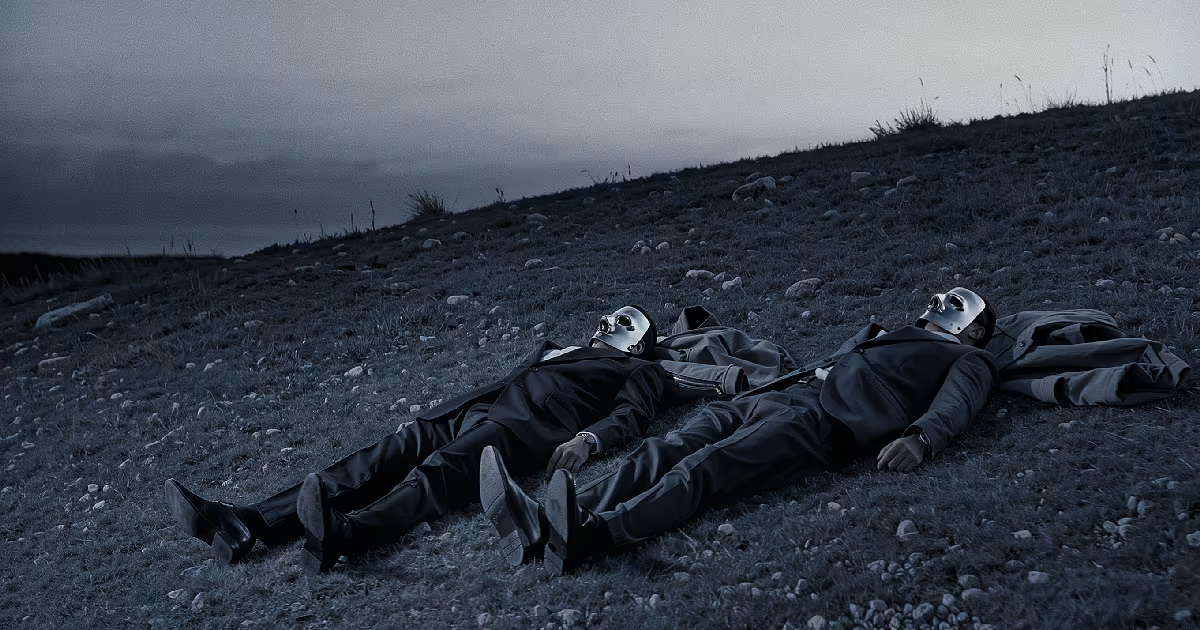
Lead masks and scene materials. Vintém Hill.
Illustration, not a period photograph.
Opening
On the afternoon of 20 August 1966 an eighteen-year-old named Jorge da Costa Alves was flying a kite on Morro do Vintém, a hill in Niterói, across the bay from Rio de Janeiro. In the brush he found two dead men. They were dressed in suits and raincoats. Over their eyes they wore homemade masks cut from lead, shaped like heavy spectacles. Beside them: an empty water bottle, two towels, a little cash, and a notebook.
The men were Manoel Pereira da Cruz, 32, and Miguel José Viana, 34, electronics technicians from Campos dos Goytacazes, a city hours up the coast. They had left home on 17 August telling their wives they were going to São Paulo for work parts. They bought tickets toward Niterói instead. Firefighters brought the bodies down on 21 August. The Instituto Médico Legal in Niterói later wrote the deaths down as undetermined. There were no gunshot wounds and no knife work. Decomposition had already wrecked the useful chemistry.
The spine of the file is the notebook line and the masks. Everything else is a reconstruction of a Wednesday afternoon that no living witness watched on the hill.
Timeline
12 August 1966. A neighbor later tells police the two men cut the lead masks at home from pipe, with a hammer. The work is ordinary shop work. The material is not.
Sunday through Tuesday before the trip. Another notebook page lists a capsule schedule: after a meal, fasting, after a meal, at bedtime. Wednesday 17 August is the day they leave. That page does not name the drug.
17 August, morning. Cruz and Viana leave Campos with a large cash amount later described as on the order of two million cruzeiros. They say São Paulo. They do not go there.
17 August, about 14:30. They arrive at the Niterói bus station. They visit an electronics shop. They buy waterproof coats. They buy a bottle of mineral water at a bar near the hill. A bartender later remembers two men in suits, one of them nervous, looking at a watch.
17 August, 16:30 to 18:30, on the page. The notebook says be at the determined place at 16:30. It says ingest a capsule at 18:30, and after the effect protect metals and wait for a mask signal. No one on the hill files a 17 August report. The men are not seen alive again in a statement that holds.
20 August. Jorge finds the bodies. The hill is not a street. Recovery waits.
21 August. Firefighters reach the site. Police from Niterói, including Idovan Ferreira and José Venâncio Bittencourt in later accounts, take over. The men still wear the lead eye pieces. They are lying on cut leaves. There is no apparatus, no radio, no second bottle of pills in the grass.
Autumn 1966. The IML report comes back after weeks, not days. Cause: undetermined. No external violence. Toxicology, such as it is, does not close the case. Organs were not handled as a modern poisoning file would demand.
1966 to 1969. The inquiry runs and is archived. The name that sticks is mistério das máscaras de chumbo.
Key figures
Manoel Pereira da Cruz is the married technician from Campos. His wife, Neli, is the one who has to explain a São Paulo trip that ended on a Niterói hill. She is also the one who points police at the spiritualist friend.
Miguel José Viana is the other technician, also married. The notebook hand is later attributed to him. His home workshop holds mask scrap and, in police telling, printed matter about intense luminosity and spirits.
Élcio Gomes is the friend who talks. He tells police the three of them ran as “scientific spiritualists,” that they had built devices aimed at contact, and that an earlier gadget had blown in a yard. He is the hinge between a hill death and a séance-and-Mars story. He is also a man who gave shifting versions. Treat him as a source, not as a clerk of the hill.
Jorge da Costa Alves is the finder. He is not a suspect in any serious paper. He is a kite.
Idovan Ferreira is the police voice who later writes the case toward experiment and poisoning: capsules, unconsciousness, parapsychology, mineral water as the vehicle. That is a closing theory from the file, not a lab result.
Hamilton Bezani later claims a robbery-murder, poison at gunpoint, a spiritualist-center lure. Confessions of that type arrived after the fact and did not give the case a convicted killer. I keep him on the later-life shelf.
Physical and documentary trail
On the paper, August 1966 gives you four hard objects.
One: the bodies as found. Suits, raincoats, lead eye masks, no battlefield trauma. Towels. An empty water bottle. Cut leaves under them. Cash reduced from what they left Campos with.
Two: the notebook. Valve codes and ohm math on one page, a capsule calendar on another, and the timed instruction on a third. The instruction is in Portuguese and in a living hand. It is the only document that tells you what they thought they were doing at 18:30.
Three: the masks themselves. Cut at home from lead. Shaped to cover eyes, not faces. A neighbor dates the cutting to 12 August. Lead as eye metal is a choice that wants a bright source in the wearer’s head. It is not a welding job left on a bench.
Four: the IML sheet. Undetermined death. No external violence. Delayed recovery on a warm hill. That delay is why the chemistry never became a sentence.
There is no photograph of the men alive on Vintém at 18:30. There are no capsules in the grass. There is no device on the hill to match Gomes’s Mars-machine story. There is no completed toxicology that names a molecule. There is no convicted second party.
16:30 Hs. está local determinado. 18:30 Hs. ingerir cápsula após efeito, proteger metais aguardar sinal máscara.
Competing explanations
Capsule death, self-administered. This is the reading that follows the page. Two men go to a determined place, swallow something at 18:30, wait for a signal, and die on the leaves. A spiritualist diet of capsules, possibly a psychedelic or a sedative, plus a bright-light belief that justifies lead over the eyes, accounts for the costumes and the note. It does not name the drug. The lab did not name it either.
Homicide. Money left Campos and did not all sit with the bodies. Bezani’s later story puts a revolver and forced poison on the hill. This reading accounts for the missing cash. It has to drag two willing-looking costumes and a handwritten timetable into a robbery. Possible. Not proved. No conviction.
Medical accident without intent. Heart, asthma, a shared bad bottle. This reading dies on the masks. People do not cut lead spectacles on 12 August for a random collapse on 17 August.
Contact event. This is the reading the masks and the “aguardar sinal” line invite: a light, a craft, a signal, metals as cover. It accounts for the gear only if you already want that story. It leaves two dead technicians and no trace of a landing that a 1966 policeman could have photographed. Gomes’s Mars talk is later speech about a group hobby. It is not a 17 August field note from the hill.
Later life of the case
Brazilian television, especially Linha Direta, is why the world outside Rio still knows the lead masks. Those programs collect Gomes, the wives, the bartender, and the IML delay into a single night of film. They do not add a molecule.
Charles Bowen and the English-language UFO press folded the deaths into a contact-cult story in the late 1960s. That export is how the case sits next to flying-disc files. The hill itself produced no disc report from a named officer on 17 August.
Later true-crime writeups add barbiturate sentences that the original IML file does not cleanly support. I do not promote a named drug the autopsy did not stand behind. The archived police conclusion already said poisoning by unidentified capsules. That is as far as the paper goes.
Finding
Jorge da Costa Alves found two men dead on Morro do Vintem in suits and raincoats, lead masks over their eyes, a notebook beside them. That hill is not a rumour. Niteroi police walked it. Two electrical technicians had dressed for a job that ended in the brush, and the masks were real objects in a real clearing. Believe the scene as the boy found it.
What still will not resolve: a finished reading of the notebook that names the appointment, or a living person who sent them up there. A matched identity for the ritual they thought they were performing, tied to a second party who will speak, would turn two careful corpses into a completed meeting. Until then the proving object is still the other half of that notebook.