SKINWALKER RANCH
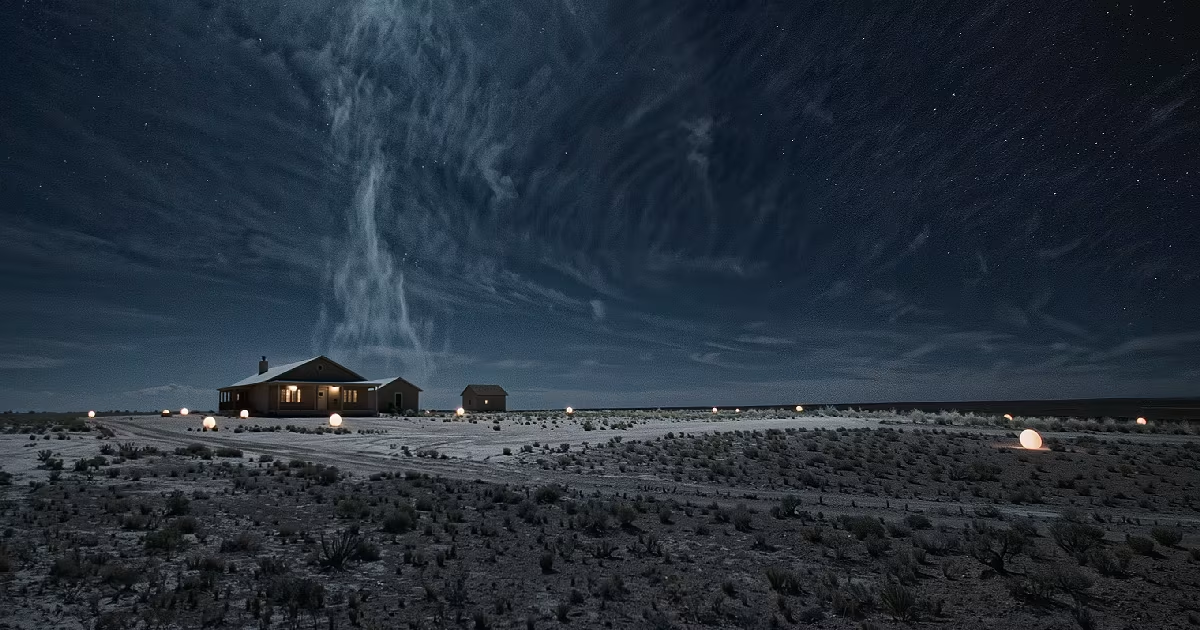
Skinwalker Ranch. Uintah Basin perimeter.
Illustration, not a period photograph.
Opening
In the spring of 1994 Terry and Gwen Sherman bought a working cattle ranch in the Uintah Basin of northeastern Utah, a few miles from Ballard and Randlett in Uintah County. The parcel is about 512 acres of pasture, ridge, and cottonwood bottom along a stretch of country the Ute have long treated as a bad road to walk. The Shermans moved in with two teenage children and a herd. They lasted about eighteen months.
What they told the paper later was not one object in one field. It was a stack: lights over the pasture, circular openings that seemed to hang in air, cattle found cut in ways that did not look like coyotes, a few animals that simply were not there in the morning, and a night in 1996 when three ranch dogs ran after a bright mass and did not come back. On 30 June 1996 the Deseret News put their account on the front of the Utah conversation. Robert Bigelow read it, flew to Vernal, and bought the place that September for about $200,000.
The spine of the file is occupancy. The Shermans’ eighteen months are the first concentrated modern record. Everything after that is an institute, a Pentagon contractor, a television lease, and a ranch that will not sit still long enough to give a lab a clean sheet.
Timeline
1934 to 1994. Kenneth and Edith Myers hold the ranch for six decades. Later tellings load those years with lights and animals. The public paper for the modern case does not start with the Myers. It starts when the Shermans write checks.
1994. The Shermans take possession. Within weeks, by their later interviews, they are watching lights and losing stock. Terry describes a wolf-like animal far larger than a basin wolf, close enough to a calf that he can see the head in the bars. He says he shot it. He says it walked off.
1995 to early 1996. Three cattle are found dead with cuts the family will not call predator work: a hole in a left eye, a cored rectum, no obvious blood pool, no tracks that satisfy them. Other animals are listed as missing. Circles of flattened grass show in a pasture. Neighbors, including John Garcia to the east, report their own cut cows to the Uintah County Sheriff.
May or early summer 1996. Terry is outside with three dogs when a bright mass comes in. The dogs chase it. The dogs do not return. The Shermans decide to sell.
30 June 1996. Zack Van Eyck’s Deseret News piece names the ranch and the family. Linda Moulton Howe puts Terry on national radio. Bigelow’s National Institute for Discovery Science, formed the previous autumn in Las Vegas, takes notice.
September 1996. The sale closes. Bigelow puts NIDS people on the ground around the clock. Colm Kelleher becomes the scientific manager of the stay. Terry remains for a time as a caretaker under a nondisclosure agreement.
27 April 1997. The Deseret News goes back. A NIDS spokesman says the team has not yet seen the craft, the mutilations, or the dog-killing light the Shermans described. Uintah County Sgt. Steve Hatzidakis says the sheriff’s office has no new ranch reports since the sale, and notes two neighboring mutilations from the previous summer.
March 1997, in later NIDS telling. Kelleher and others describe a large figure in a tree with yellow eyes, watched and then gone. That incident lives in the institute’s internal lore and in the 2005 book. It does not live in a 1997 sheriff supplement.
2005. Kelleher and George Knapp publish Hunt for the Skinwalker. The Shermans appear under the name Gorman. The book is the document that turns a Utah ranch sale into a national case file.
2008 to 2010. Bigelow Aerospace Advanced Space Studies works a Defense Intelligence Agency contract later discussed as AAWSAP. The ranch is one site inside that program. The public still does not have the raw instrument take from those years.
2016. Bigelow sells. Brandon Fugal takes title through Adamantium Real Estate LLC. History’s The Secret of Skinwalker Ranch begins filming in 2019. The property is now a show set as much as a pasture.
Key figures
Terry Sherman is the first modern narrator. He is a cattleman, not a lab tech. His 1996 interviews are the only long statements he gives before the nondisclosure. After the sale he is quieter in print. Later books still lean on him. The 1996 Terry and the post-contract Terry are not the same source quality.
Gwen Sherman and the children are in the house for the same eighteen months. They are named less often. The file still treats the ranch as a family occupancy, not a lone-watcher tale.
Robert Bigelow is the buyer who turns a private pasture into an instrumented claim. He founds NIDS. He later runs BAASS. He does not publish a clean, peer-reviewed ranch paper. He does spend real money and real years.
Colm Kelleher is the scientist who lives the NIDS deployment. He co-writes the 2005 book. He later appears in the AAWSAP conversation. His own admission, carried in that literature, is that hard data good enough for a journal was scarce.
George Knapp is the journalist who keeps the ranch on television and in print from the Las Vegas side. John B. Alexander, retired Army, sits with NIDS and later calls the method an attempt at ordinary scientific collection. Brandon Fugal is the current owner. His cameras are a different kind of record: produced, weekly, and built to return next season.
Uintah County deputies are the civilian hinge the file often skips. They logged neighboring mutilations. They did not, in the April 1997 paper, confirm a post-sale surge on the ranch itself.
Physical and documentary trail
On the paper, the ranch gives you four hard objects that do not depend on a cable episode.
One: the 30 June 1996 Deseret News interview. Lights, doorways in air, three mutilated cows, missing stock, grass circles. That is the public start. Without it Bigelow does not fly in.
Two: the September 1996 deed. A Las Vegas businessman paid about $200,000 for a 512-acre cattle ranch because of those interviews. Money moved. Title moved. That is not folklore.
Three: the 27 April 1997 follow-up. NIDS is on site and, by its own spokesman that week, has not reproduced the Sherman list. The sheriff has neighboring cuts, not a new ranch log. The gap between purchase and published catch is part of the trail, not a footnote.
Four: Hunt for the Skinwalker (2005). It is the first long NIDS-side narrative. It is also a book. Incident counts near one hundred, bulletproof animals, magnetic damage, and the tree figure all arrive here as authored reconstruction, not as a 1996 evidence bag.
There is no public, complete NIDS instrument archive. There is no released AAWSAP ranch take that a stranger can audit. There is no 1994-1996 photograph of a craft on the Sherman pasture that the family put in the paper with the first interviews. Cattle carcasses were described. They were not, in the public file, worked up as a published necropsy series with chain of custody.
Ute oral history about a path of the skinwalker is real as tradition. It is not a 1994 police report. I keep it in the later-life shelf when a program uses it as wallpaper, and in the opening only as the name the ranch now carries.
We’ve seen the UFOs enough and we know pretty much what the craft look like, and I think it’s definitely associated with the cattle mutilations. When we see the crafts and then the cattle, we have problems.
Competing explanations
Misattribution on a hard ranch. Predators, rustling, weather, and night-vision mistakes can eat a herd and a night’s sleep. This reading accounts for some missing animals and some lights on a basin that already had a 1970s UFO habit. It does not account for why a careful buyer spent $200,000 and staffed the place for years, or for the specific cut descriptions the family gave while the cows were still their livelihood.
Secret project. Terry himself floated this early: maybe the lights were ours. Dugway and other Utah ranges exist. A classified test can look like a doorway in air to a man who has never been read in. It does not explain the dog chase as told, or the neighbor mutilations, unless the project also includes livestock work the public has never seen documented.
Localized unknown. This is the NIDS and later BAASS reading: the ranch sits on a persistent anomaly, call it a ranch-sized laboratory that does not care about journals. It accounts for the variety (air, animal, house) without forcing every light to be a craft. It fails the thing Kelleher already admitted. The team could not bag a result that survives ordinary scientific publication.
Performance after 2016. Once cameras lease the ridge, incentives change. This reading is unfair to the 1994-1996 occupancy. It is fair to treat a History series as entertainment first and as a field notebook second.
Later life of the case
Knapp and Kelleher’s book is the document that exported the Gorman years. Without it the ranch is a 1996 Utah story that sold to a rich man. With it the ranch becomes a portal story with a Native name attached for atmosphere.
The AAWSAP/BAASS years matter only as they change the file: a DIA-linked contractor put people back on the same ground. The raw take is still not on the public desk. Congressional UAP talk after 2017 sometimes waves at Skinwalker as a data site. A wave is not a release.
Fugal’s series keeps the property famous and fenced. I do not mine episode order for 1995 facts. The Sherman interviews and the 1996-1997 papers remain the floor.
Finding
Terry and Gwen Sherman bought a working ranch in the Uintah Basin and lasted about eighteen months. Lights over the pasture, cattle cut and gone, a dog that did not come back: they told the Deseret News that was why they left, and Bigelow believed them enough to buy the place and staff it. Believe the family for the time they lived there. A herd is not a television set. Something on that 512 acres made a working outfit walk away.
What still will not resolve: an instrument series from those eighteen months, before the institute arrived. A night of video that shows the thing over the cattle, or a veterinary write-up of a cut that a lab will still own, would pin the Shermans' stay to a catchable event. The later hundred-incident tally cannot do that work. The proving object is still a 1994-96 record from the years the family slept there.