ENFIELD POLTERGEIST
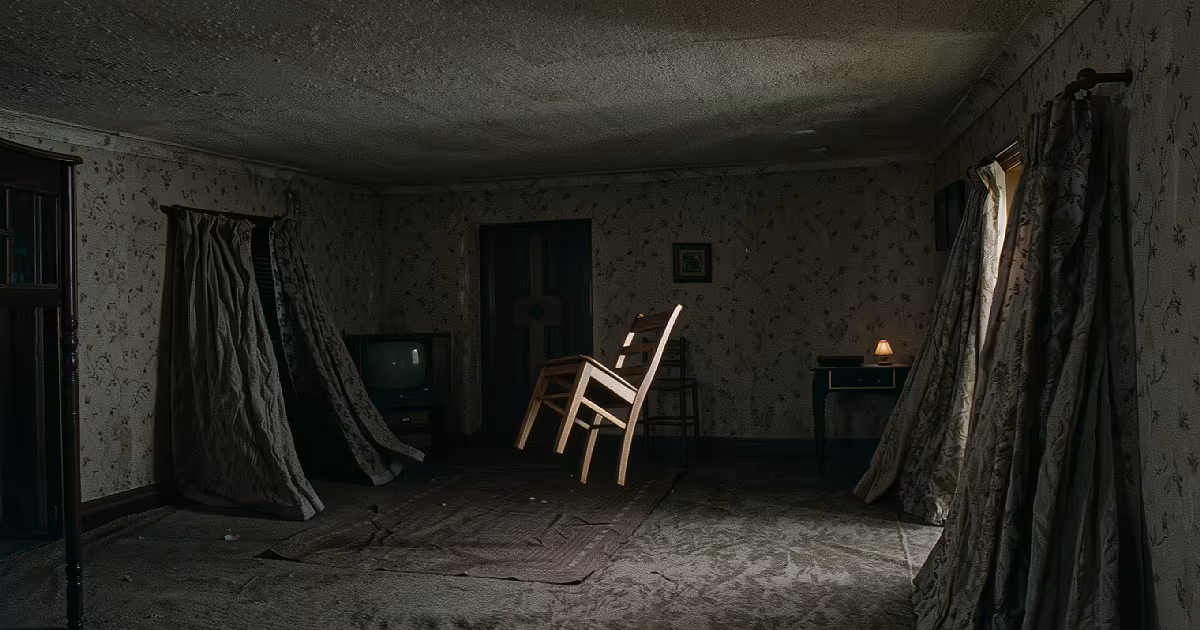
Enfield house and investigation materials.
Illustration, not a period photograph.
Opening
On the night of 31 August 1977 Peggy Hodgson, a divorced mother of four, went into a bedroom at 284 Green Street, a council semi in Brimsdown, Enfield, and found a chest of drawers moving. She pushed it back. It came again. She could not hold it. The children had already talked about a shaking bed the night before. She called the Metropolitan Police, then neighbours, then the papers.
What followed, into 1978 and toward 1979, was eighteen months of a house that would not stay still in the logs: knocks, sliding furniture, thrown Lego and marbles, a kitchen that lost objects across a room, and, from December 1977, a deep male voice that seemed to use eleven-year-old Janet Hodgson’s mouth and called itself Bill. Maurice Grosse of the Society for Psychical Research arrived in September. Guy Lyon Playfair joined him on 12 September. They made scores of visits. The Daily Mirror sat in the rooms and printed what the camera caught.
The spine of the file is a long occupancy with police, press, and SPR in the same narrow house, and a split that never healed. Grosse and Playfair thought they had a case. Anita Gregory and John Beloff, also of the SPR world, thought they had children performing for adults who wanted a haunting.
Timeline
30 August 1977. Beds shake. Peggy tells the children to stop.
31 August, about 21:30. Shuffles, knocks, the chest of drawers. Police attend. At least one officer later says a chair moved. That visit is why the night is not only a family row.
Early September. Neighbours in. Mirror photographer Graham Morris takes a hit from a flying pan, in the paper’s own telling. The house becomes a desk.
5-12 September. Grosse first, then Playfair and a BBC radio producer. The SPR occupancy begins. Playfair will later count on the order of two thousand incidents in notes. That number is his tally, not a lab printout.
Autumn 1977. Knocking, objects, a bed that does not stay wired when they try to pin it. Grosse describes hot marbles after they land. Temperature claims sit in his interviews. Cameras miss more than they catch.
December 1977. The voice. Gruff, adult, coming from Janet’s direction. It gives the name Bill Wilkins and a story of dying in the chair downstairs. A man named Wilkins had lived and died connected to the house. That match is real as a public record. It is not, by itself, a throat.
Spring 1978. The rate drops. Other visitors cycle through, including mediums. Gregory films moments she reads as cheating. The family stays in the house.
1979. Press heat cools. The case goes from a daily to a book.
1980. Playfair publishes This House Is Haunted. That book is the long form most later files copy.
Key figures
Peggy Hodgson is the adult who called the police. She is not a stage mother in the first week. She is a woman in a council house with four children and a chest of drawers she could not hold. Later fame is later.
Janet Hodgson is the younger daughter the voice attaches to. She is eleven when it starts. Some events happen when she is in the room. Some, in Grosse’s notes, happen when she is not the only body present. I do not build a character study of a child. I log that she is the named focus and that she later said some of it was games.
Margaret Hodgson is the older sister. Johnny and Billy are the brothers. They live the same rooms. They are cited less because the voice and the camera preferred Janet.
Maurice Grosse is the SPR man who stays. He has a recent family grief that later writers use against his judgment. He also has nights in the house and a cardboard box in the face after he asked if something was playing a game. That night is his statement, not a proof of an entity.
Guy Playfair is the writer on the second chair. His book is the dossier. His doubt about tricks, written into that same book, is also the dossier.
Anita Gregory is the SPR skeptic who watches and is not sold. John Beloff stands with her. Wicks and other police names appear in the first days and then leave the story to the investigators.
Physical and documentary trail
On the paper, 1977-79 gives you four hard objects.
One: the first police attendance and Peggy’s drawer statement. A chair an officer would not keep still is in some of those early tellings. That is the official door opening.
Two: Mirror photographs and copy from the rooms. A girl in mid-air. A chair on its side. These are press pictures, not lab stereo. They show what the paper was willing to print while the house was a story.
Three: Grosse and Playfair’s visit log, tapes of knocks and the voice, and Playfair’s 1980 book. Hundreds of hours. Uneven control. The voice tapes exist. Linguists and magicians have argued since about a child’s false-cord trick.
Four: Gregory’s contrary notes inside the same society. Caught fakery on some incidents is part of the SPR file, not only a later debunking blog.
There is no instrument that logs a mass in the hall. There is no thermal series a lab signed. There is no conviction for public-mischief against the children. There is also no SPR consensus. The house is still a house. The book is still a book.
I just couldn’t believe it. In fact I pushed it back twice, and a third time I couldn’t move it.
Competing explanations
Play for attention. Two girls, a single mother, reporters in the kitchen, a society man who wants a case. This reading accounts for the voice, the mid-air photographs that look like a jump, and Janet’s later admission that some of it was games. It has to work for the first police night, before the Mirror circus, and for events Grosse logged when he said the girls were not in position to throw.
Poltergeist as living-house effect. Grosse and Playfair’s reading: recurrent spontaneous psychokinesis, a troubled occupancy, an “entity” only as a working name. It accounts for duration and for adult witnesses. It does not give you a meter trace that a physicist has to keep.
Dead man in the chair. Bill Wilkins as named discarnate. The historical Wilkins is a fact of the address. The voice using that biography is a performance or a contact, and the file does not have a third option with evidence. Matching a death certificate is not the same as identifying a speaker.
Contaminated investigation. Too many visitors, too much reward for a good night, too little sealed protocol. This reading is fair to both sides. It explains why the same society produced believers and dissenters from the same staircase.
Later life of the case
Playfair’s book is the document the later industry eats. The Conjuring 2 is a Hollywood occupancy that borrows the address and invents a demon the 1977 police did not book. I do not take plot points from that film back into 1977.
BBC radio reunions and later interviews with Janet are useful when they shrink the case (“some of it we made up”) and when they refuse to throw the first nights away. Both sentences can sit in one mouth. The file has to carry that.
If the raw Grosse tapes are ever posted as a complete, dated set with who was in each room, the finding can tighten. The public set is still selected clips plus a book.
Finding
Peggy Hodgson found a chest of drawers moving in a bedroom at 284 Green Street and could not hold it. She called the police. For months after that the house knocked, threw, and put a male voice on Janet. Neighbours, Mirror staff, and investigators sat through nights that were not all a child's game, even if some of them were. Believe Peggy's first night. A council house mother does not invent a drawer for the papers.
What still will not resolve: a clean instrument log from a night Grosse said no child in the room could have thrown what hit him, or a recording of the voice made when Janet's mouth can be seen still. Either one would separate the house from the performance. Enfield has a crowd. It still needs one sealed hour that play cannot reach.