MACKENZIE POLTERGEIST
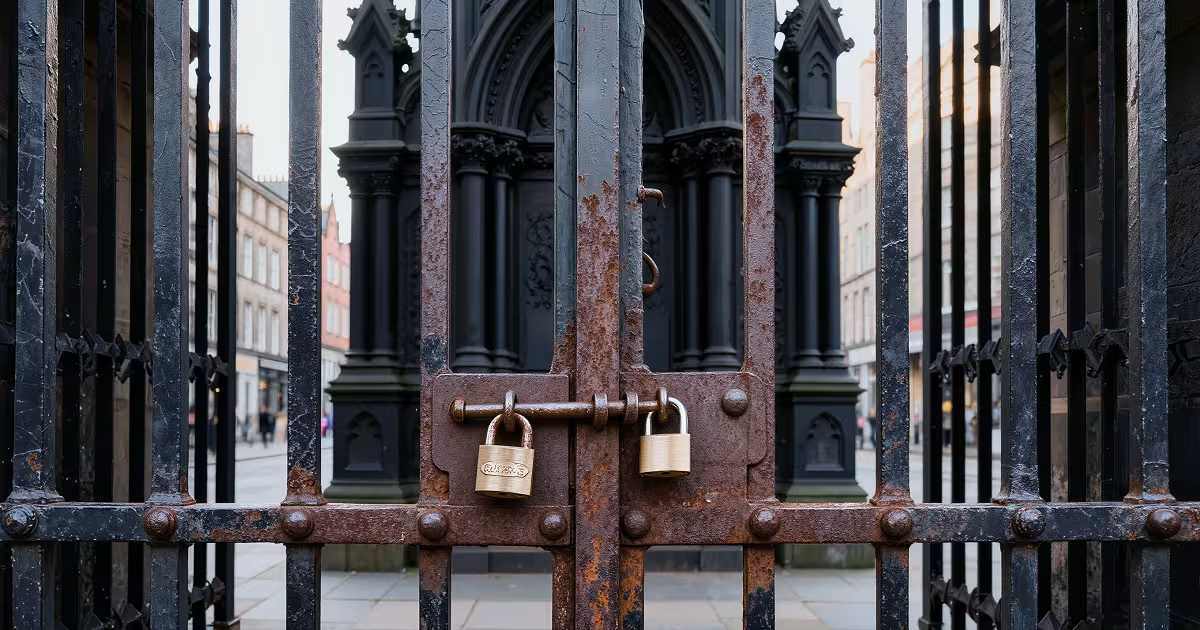
Padlocked iron gates before a black stone mausoleum in a kirkyard.
Illustration, not a period photograph.

Archive / Paranormal / BOT313-0134
PAR-1998ParanormalFOLKLORE
THE POLTERGEIST IN GREYFRIARS KIRKYARD
Fig. 01 Padlocked iron gates before a black stone mausoleum in a kirkyard. Illustration, not a period photograph.
Opening
Sir George Mackenzie, Lord Advocate under Charles II, prosecuted the Covenanters so hard that Edinburgh remembered him as Bluidy Mackenzie. He died in 1691 and lies in a domed mausoleum in Greyfriars Kirkyard, a few yards from the Covenanters' Prison, where prisoners taken after Bothwell Bridge in 1679 were held in the open. For generations, local children dared each other to shout through his keyhole.
The modern story begins, as told by the tour operator and author Jan-Andrew Henderson, with a homeless man who broke into the mausoleum one night in 1998, fell through the floor into a pit of bones and fled. From 1999 visitors to the locked Covenanters' Prison, and especially to a tomb there called the Black Mausoleum, reported cold blasts, collapses, scratches and bruises. Henderson's company now counts hundreds of attacks.
Timeline
1679After the Battle of Bothwell Bridge some 1,200 Covenanters are brought to Edinburgh; several hundred are held in a field south of the kirkyard, later called the Covenanters' Prison.
1691Mackenzie dies and is buried in the mausoleum designed by James Smith.
About 1700 onwardsThe prison field becomes a burial ground of enclosed vaults. The vaults were never used as cells.
1868In the revised edition of his Traditions of Edinburgh, first published in the 1820s, Robert Chambers records the belief that Mackenzie's spirit could get no rest, and the boys' keyhole dare.
Around 1990The City of Edinburgh Council locks the Covenanters' Prison against vandalism and drug use, according to the kirkyard's history. Henderson's account says it was locked after the first poltergeist reports.
1998The homeless man's break-in, in Henderson's telling. No contemporary report of it has been found.
1999The first recorded attacks, by Henderson's account. His City of the Dead Tours gains permission to take groups into the locked area.
2000A Spiritualist medium, Colin Grant, attempts to cleanse the site and dies of a heart attack weeks later, according to later retellings.
2001Henderson publishes The Ghost That Haunted Itself.
30 June 2003Two teenage boys force the doors of Mackenzie's mausoleum and cut the head off a mummified corpse in the lower vault. In April 2004 they are put on probation for violation of sepulchre.
Key figures
Sir George Mackenzie of Rosehaugh (1636 to 1691), lawyer, essayist and founder of the Advocates Library, later the National Library of Scotland.
Jan-Andrew Henderson, author and founder of City of the Dead Tours, the main collector of reports.
The unnamed homeless man of the origin story.
Tour guides and visitors, whose reports make up almost all the evidence.
Physical and documentary trail
The evidence is witness statements and photographs of injuries gathered by City of the Dead Tours, which Henderson says were partly lost when his house and office burned, plus his books and press stories that quote him. There is no independent investigation, no medical record in the public domain linking an injury to the site, and no contemporary record of the 1998 break-in. The older belief in Mackenzie's restless spirit is documented.
This monument was an object of horror to the good people of Edinburgh, as it was almost universally believed that the spirit of the persecutor could get no rest in its superb but gloomy tenement.
Corrections to the earlier version of this report. The man in the tomb is Sir George Mackenzie, not "Black Tom". The attacks are reported chiefly at the Black Mausoleum in the Covenanters' Prison, not in Mackenzie's own vault, where the break-in is said to have happened. The claim that staff kept an incident log from December 1998 and that visitors were hospitalised could not be confirmed and has been dropped.
Things you might not know
- The rhyme survives. Chambers recorded the boys' cry at the keyhole: "Bluidy Mackingie, come out if ye daur, Lift the sneck, and draw the bar!"
- The poltergeist and the tomb are apart. The break-in story is set in Mackenzie's domed mausoleum. The attacks cluster several yards away, at a different tomb behind locked gates.
- The real desecration came later. The only documented break-in was in 2003, by teenagers challenged by a ghost-tour operator who saw them carrying something in a blanket.
- The collector is open about the theories. Henderson has said he does not know whether it is a spirit, a demon, a pheromone cloud or psychosomatic and hysterical reactions.
- The prison never held prisoners in vaults. The vaults were built after the field's use as a prison, so tales of Covenanters dying in them are mistaken.
Competing explanations
A malevolent entity tied to Mackenzie. This is the tour story, supported by the volume of reports. It depends on an origin event that is undocumented, and on reports gathered by the company that sells the tour.
Suggestion in a frightening setting. Groups primed by stories, at night, in a locked graveyard, report faintness, cold, touches and later find scratches. This accounts for the pattern of reports, which come almost entirely from tour parties.
Deliberate staging. Nothing shows that guides fake attacks, and no one has alleged it with evidence.
Later life of the case
The Mackenzie Poltergeist is one of Edinburgh's best-known ghost stories and a fixture of Halloween coverage, with City of the Dead still posting visitors' injuries. Henderson now lives in Australia.
Finding
A modern legend has been grafted onto an old one. The belief that Bluidy Mackenzie could not rest is centuries old and documented. The poltergeist itself rests on an undocumented origin story and on reports gathered almost entirely by the tour company that takes people into the locked area. No independent investigation has examined a single attack.
What still will not resolve: whether the homeless man existed. A police log, a newspaper paragraph or a named witness from 1998 would settle where the modern story begins.
Evidence signature
4/9 Solid
- Witnesses
- one person, or a tradition
- Instruments
- photo, film or physical traces
- Paper
- official records at the time
How well documented the case is, not whether it's true. A strong record can still have an ordinary answer, and a thin one can still be real.
You decide · MACKENZIE POLTERGEIST
What do you think happened?
One vote per case, anonymous. You'll see how other readers voted once you've voted.