BATTERSEA POLTERGEIST
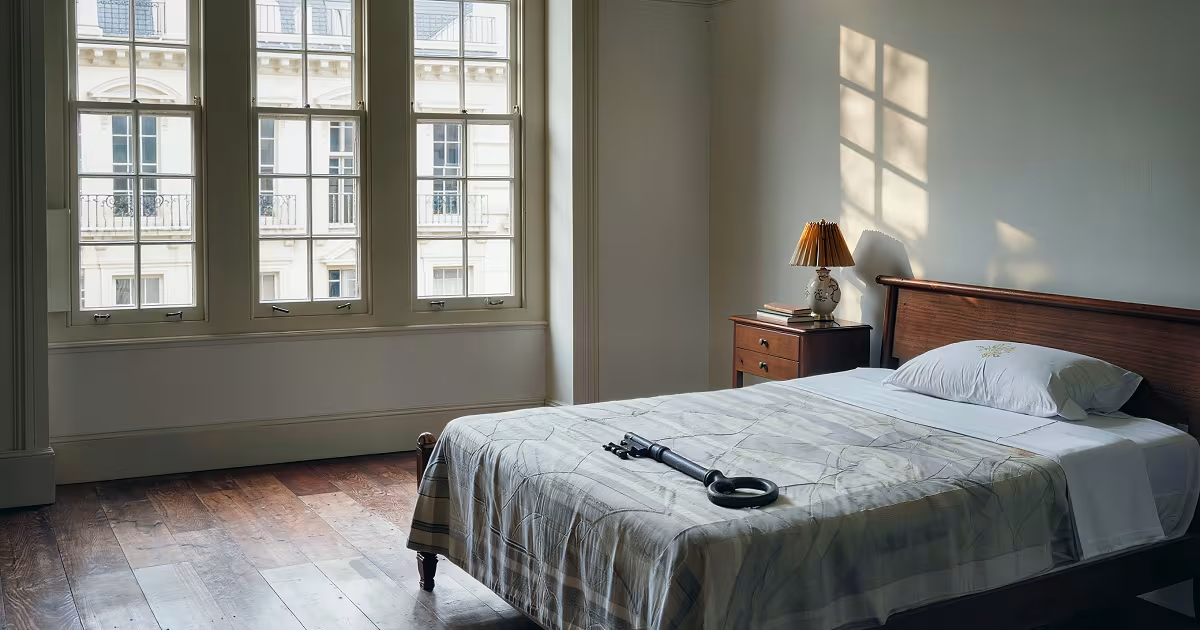
1950s London terrace bedroom. Iron key on a coverlet, no people.
Illustration, not a period photograph.
Opening
In 1956 a house on Wycliffe Road, Battersea, took in the Hitchings family and then took in a story: knocks, objects, a key that fitted nothing, a presence they called Donald. Shirley Hitchings was the girl in the room. Later books and a stage version made the key a motif. Contemporary paper is thinner than the later novel. Police and neighbours sat in a London terrace that would not stay quiet.
A key that fits no lock is a good object if it is dated. Much of what the later book sells is reconstructed. Keep the terrace first and the adaptation on the later shelf.
The spine of the file is a Battersea house and a key that would not open a door. Wycliffe Road is a 1950s terrace. It is not a West End plot.
Timeline
1956 the Hitchings household reports disturbances. Neighbours and police come.
The key and the name Donald sit in the family telling. Press takes a London poltergeist.
Later books and a play thicken the dialogue. Those are later life.
The terrace is first. The script is not.
Wycliffe Road in Battersea put keys and knocks on a household that later investigators sat with. A key that fits nothing is the cheap object. No charge sheet closed the house as a known trick both camps signed.
A London terrace can hold a long noise file. The key is why it is not only a slamming-door story.
Key figures
Shirley Hitchings owns the girlhood in the rooms.
The Hitchings adults own the house that asked for help.
Police and neighbours own the contemporary look.
Later authors own the reconstructed talk.
Physical and documentary trail
On the paper, 1956 gives you four hard objects and no lock the key opened.
One: household accounts of knocks and moving objects on Wycliffe Road.
Two: the key that fitted nothing, as the family told it.
Three: police and neighbour attention.
Four: later books that add dialogue. Contemporary accounts of the Hitchings house, Battersea, 1956, are the originating tray.
There is no instrument log. There is no key in a lab chain. There is no conviction.
A named terrace and a key that fits nothing are the stay-behinds. A charge sheet both camps sign would finish the house. A trick shown in the year would finish the other door.
The key fitted nothing in the house.
Competing explanations
A poltergeist that left a key. This is the later book. It has a terrace. It has reconstructed talk.
A girl and a house that wanted an audience. The mundane door. Has to carry neighbours who came in.
A story written backward from a play. Risk on the dialogue. Less risk on the address.
Hybrid caution. A Battersea terrace sounded. A later script talked. Morning had no lock for the key.
Later life of the case
Books and stage. I keep those on the later-life shelf. The 1956 house stays first.
Finding
The Hitchings house on Wycliffe Road spent 1956 with knocks and a key that fitted nothing, and neighbours came in. Believe the terrace. A London street does not invent police for a later play.
What still will not resolve: that key in a chain, or a contemporaneous diary that matches the later dialogue. Either one would pin Donald. The proving object is still that key, held as prop or as leftover by more than a reconstructed scene.