MORTON CASE
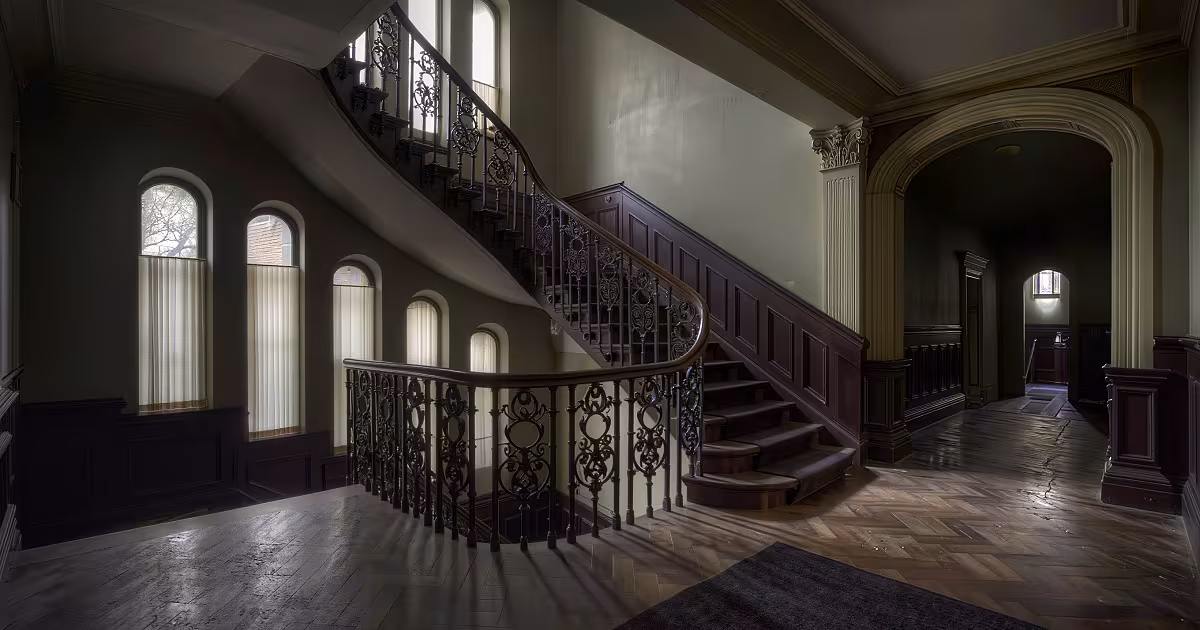
Victorian stair landing. Empty, with dress only in shadow.
Illustration, not a period photograph.
Opening
From 1882 Rosina Despard, writing as Miss R. C. Morton, recorded a figure in her Cheltenham house on Pittville Circus Road: a woman in widow's black who passed the banisters and left a handkerchief feeling in the air. The Society for Psychical Research printed the case. Rosina was a medical student with a habit of notes. Other members of the household saw less, or saw enough to keep her from being a lone girl in a corridor. The house already had a story about a dead resident. That story is older water. The handkerchief figure is 1882-89 paper.
Andrew MacKenzie and later SPR writers kept Morton as a type-case because the notes are dated and dry. Sceptics later offered expectation in a known house. No photograph of the figure exists. The banisters are the stage.
The spine of the file is a student's notes and a widow on the stairs. Morton is Cheltenham paper. It is not a named grave the notes open.
Timeline
1882 first appearances in Rosina's notes. Other household mentions follow.
1880s the figure thins. SPR publication follows the notes.
Later writers return to Pittville Circus Road. The house changes hands.
Every later English apparition list keeps Morton. That list is later life. The notes are first.
Key figures
Rosina Despard owns the notes and the medical student's eye.
Other household members own the lesser sightings.
The SPR owns the print that made the case a type.
The dead woman of the older house story owns a name the notes do not prove.
Physical and documentary trail
On the paper, 1882-89 give you four hard objects and no plate.
One: Rosina's dated notes of a widow figure on the stairs.
Two: other household corroboration, thinner than hers.
Three: SPR publication of the Morton case.
Four: the absence of a photograph. Miss R. C. Morton case in SPR Proceedings, Cheltenham, is the originating tray.
There is no 1880s exposure. There is no inquest the notes settle. There is no handkerchief in a case.
She passed the banisters as a living woman would, and the air felt of a handkerchief.
Competing explanations
An apparition in a known house. This is the SPR type-case. It has notes. It has no plate.
Expectation in a house that already had a dead woman in talk. The mundane door. Has to carry a student who dated her pages.
A literary ghost. Weak against notes that read like a ward book.
Hybrid caution. A student wrote a widow on the stairs. Morning had no grave the notes could open.
Later life of the case
SPR reprints and later ghost walks. I keep those on the later-life shelf. The 1882 notes stay first.
Finding
Rosina Despard wrote dated notes of a widow figure on the Pittville Circus Road stairs in the 1880s, and the SPR printed them as the Morton case. Believe the notes as notes. A medical student does not invent banisters for a later walk.
What still will not resolve: a photograph from those years, or a name the notes can open in a graveyard. Either one would pin the widow. The proving object is still that figure on the stairs, held as expectation or as guest by more than a later chapter.