GOBEKLI TEPE
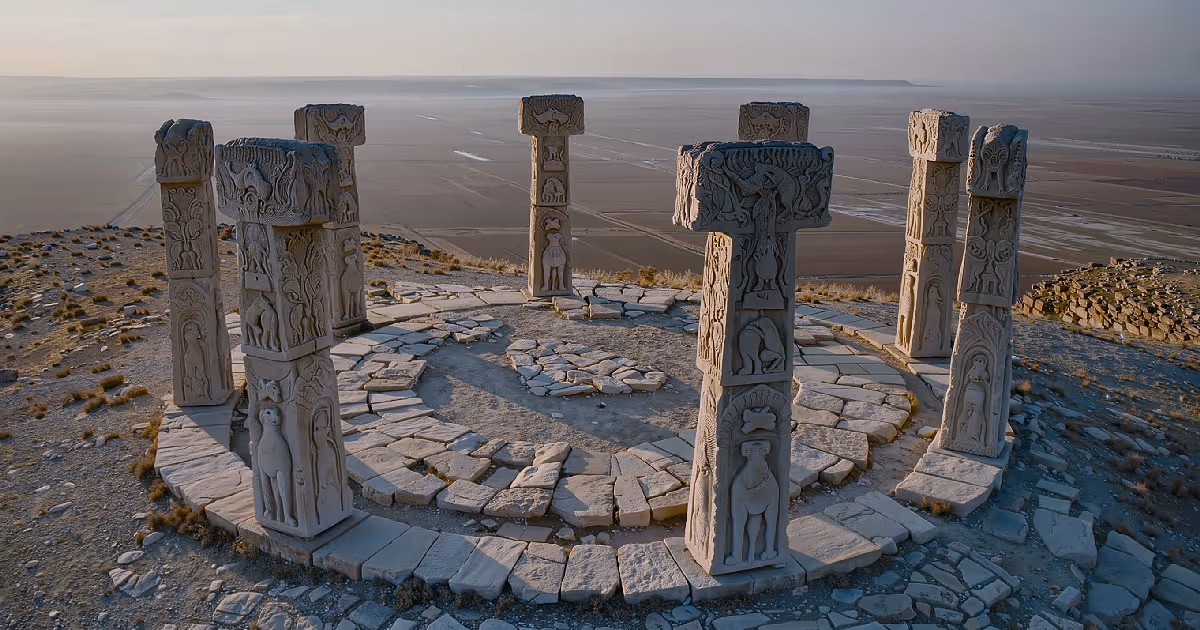
Tall carved stone pillars standing in a ring on a dry hilltop.
Illustration, not a photograph.

Opening
On a limestone hill near the city of Şanlıurfa in south-eastern Turkey stand circles of huge T-shaped stone pillars, carved with foxes, boars, snakes, scorpions and vultures. They were put up around 9500 BC, some 6,000 years before Stonehenge and before people in the region had pottery, writing or, as far as anyone knew, farming. The site is called Göbekli Tepe, "Potbelly Hill".
Its excavator, the German archaeologist Klaus Schmidt, called it the world's first temple, built by hunter-gatherers, and argued it turned the story of civilisation upside down. That claim made the site famous, and made it a favourite of writers who say an advanced lost civilisation came before ours. The archaeology since has been less dramatic, and more interesting.
Timeline
About 9500 to 8000 BCPeople build and rebuild the site over at least 1,500 years, in at least eight phases. The earliest structures date to about 9500 to 9000 BC.
1963A survey led by Halet Çambel and Robert Braidwood notes the mound. A team member takes the tops of the pillars for medieval grave markers.
October 1994Klaus Schmidt visits and recognises that the site is far older and more important.
1995Excavations begin under Schmidt, with the German Archaeological Institute and the Şanlıurfa Museum.
Autumn 2010Excavators find a carved "totem pole", a stone column stacked with figures of people and animals.
2014Schmidt dies. Work continues under Necmi Karul and Lee Clare.
2017Fragments of human skulls deliberately carved with grooves are found, interpreted as part of a skull cult.
2017Martin Sweatman and Dimitrios Tsikritsis of the University of Edinburgh argue that carvings on Pillar 43, the "Vulture Stone", are a star map recording a comet strike around 10,950 BC, the event some scientists think triggered a sudden cold period, the Younger Dryas. The Göbekli Tepe team replies the same year in a paper titled "More than a vulture", pointing out that many pillars are no longer in their original positions, which makes reading them as an exact sky map unsafe.
2018Göbekli Tepe becomes a UNESCO World Heritage Site.
2022Netflix's Ancient Apocalypse, presented by Graham Hancock, features the site as evidence of a lost Ice Age civilisation. Archaeologists widely criticise the series.
Autumn 2023Excavations announce two firsts in the same week. At Göbekli Tepe, a carved boar with traces of red, black and white paint, which Karul calls the first coloured sculpture known from the period. At nearby Karahan Tepe, a seated stone figure of a man about 2.3 metres tall, found broken in three pieces.
Key figures
Klaus Schmidt excavated the site for nearly twenty years and gave it its "first temple" reputation. Lee Clare and Necmi Karul lead the work now, and have revised much of Schmidt's picture. Martin Sweatman proposed the comet reading. Graham Hancock made the site the centrepiece of the lost-civilisation case for a mass audience.
Physical and documentary trail
The site itself is the evidence: at least four excavated circular enclosures, 10 to 30 metres across, with pairs of tall central pillars, some carved with arms and belts to show they represent people; geophysical surveys suggesting at least 16 more enclosures and nearly 200 pillars; quarries on the hill where the pillars were cut with flint tools; more than 7,000 grinding stones; channels and cisterns for collecting rainwater; and radiocarbon dates. As of 2021 only about a tenth of the site had been excavated.
Things you might not know
- It was first mistaken for a graveyard. The 1963 survey thought the pillar tops were medieval gravestones.
- The pillars are people. The central pillars in one enclosure have carved arms, hands and belts.
- Someone was making a lot of bread. More than 7,000 grinding stones point to cereal processing on a large scale.
- It had a water supply. Rainwater channels fed cisterns holding at least 150 cubic metres, which suggests people lived there, not just visited.
- It has a neighbour. Karahan Tepe, in the same hills, has similar pillars and carvings, and is one of several related sites in the region.
- It had colour. The painted boar found in 2023 shows the carvings were not always bare stone.
- Most of it is still underground. About 90 per cent remains unexcavated.
Competing explanations
A ritual centre of hunter-gatherers. Schmidt's view: mobile foragers gathered here for feasts and ceremonies, and the effort of building it helped push them towards farming.
A settlement with monumental buildings. The current excavators' view: people lived here, with houses, water storage and food processing, alongside the great enclosures. That still makes it extraordinary for its age, but not a temple in the middle of nowhere.
A record of catastrophe. Sweatman's reading: that the carvings encode a comet impact and the sky at the time. It depends on treating the animals as constellations and the pillars as undisturbed. The excavators say neither holds, and that the carvings are better read as part of a shared imagery found across the region's sites.
A lost advanced civilisation. The view of Hancock and others: that the site's builders inherited knowledge from an earlier, technologically advanced people destroyed at the end of the Ice Age. There are no traces of such a people, no metal, no writing and no tools beyond stone, and the excavators reject the idea.
Later life of the case
Göbekli Tepe is now one of Turkey's best-known archaeological sites, and part of the Taş Tepeler ("Stone Hills") project, which covers about 20 related sites in the region, with around nine under excavation. Each new site makes Göbekli Tepe look less like a lone wonder and more like the best-known part of a whole culture. For a stone monument that attracted a different kind of myth, see the Coral Castle.
Finding
Göbekli Tepe is real, very old and genuinely remarkable: monumental architecture built by people with stone tools around 11,500 years ago. It does not need a lost civilisation to explain it, and the evidence found there does not point to one.
What still will not resolve: what the enclosures were for, since 90 per cent of the site is still buried and the people who built it left no writing.
Evidence signature
7/9 Strong
- Witnesses
- several people
- Instruments
- more than one sensor agrees
- Paper
- official records at the time
How well documented the case is, not whether it's true. A strong record can still have an ordinary answer, and a thin one can still be real.
You decide · GOBEKLI TEPE
What do you think happened?
One vote per case, anonymous. You'll see how other readers voted once you've voted.