STONEHENGE
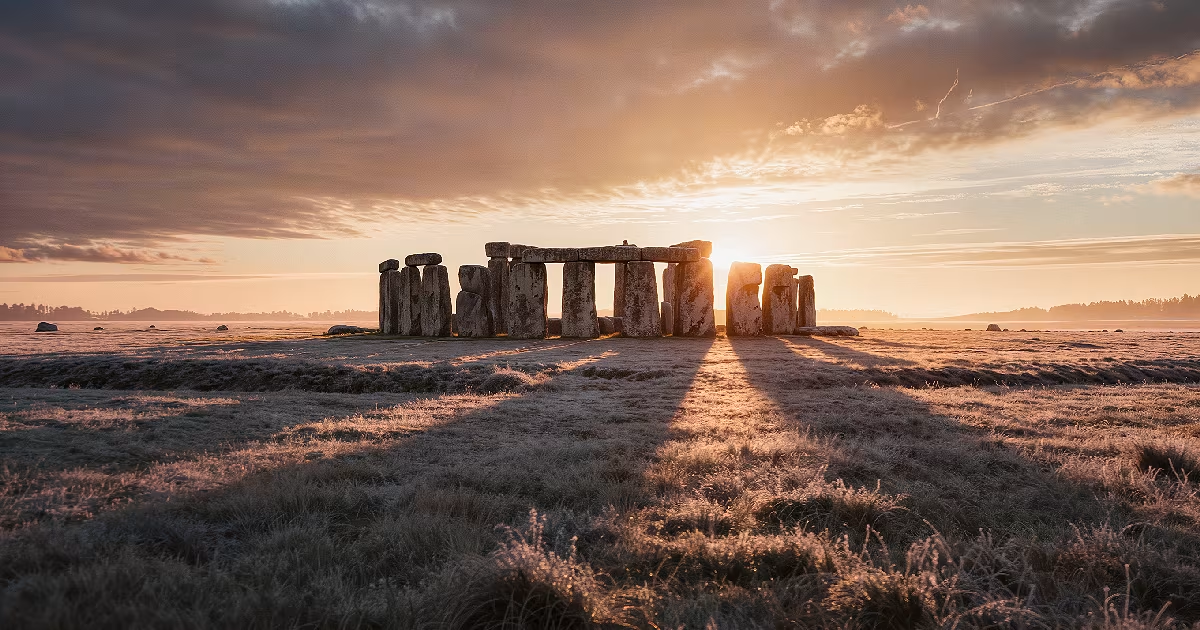
The great stone circle on an empty plain under a low winter sun.
Illustration, not a photograph.

Opening
Stonehenge, on Salisbury Plain in Wiltshire, is the most famous prehistoric monument in the world, and one of the most explained. In the twelfth century it was the work of Merlin, who flew the stones from Ireland. In the eighteenth it was a Druid temple. In the twentieth it was an ancient computer, a landing site and an alien beacon.
The archaeology has its own story, and it is stranger than most of the myths. The site was built and rebuilt over some 1,500 years from about 3000 BC. Its great sarsen stones came from about 25 kilometres away. Its smaller bluestones were dragged from the hills of west Wales, about 225 kilometres off. And its central Altar Stone, scientists found in 2024, came from the far north-east of Scotland.
Timeline
About 8000 BCMesolithic people raise large timber posts nearby, in what is now the site's old car park.
About 3000 BCThe first monument: a circular bank and ditch, with cremation burials.
About 2600 to 2400 BCThe great sarsen circle and the trilithons are raised. The bluestones may have been on site since 3000 BC, and are set in their present positions around 2400 to 2200 BC.
About 1600 BCThe last construction, the rings of pits known as the Y and Z Holes.
About 1136 ADGeoffrey of Monmouth, in his History of the Kings of Britain, says the wizard Merlin took down a stone circle called the Giants' Dance on Mount Killaraus in Ireland and brought it to Wiltshire as a memorial.
17th centuryThe architect Inigo Jones argues the monument is Roman.
18th centuryThe antiquarian William Stukeley links it to the Druids, a connection that becomes popular and has lasted, although the monument is far older than any Druid.
1960sThe astronomer Gerald Hawkins argues the stones are aligned to the sun and moon and could predict eclipses, calling it a computer.
2011Archaeologists identify a bluestone quarry at Craig Rhos-y-felin in the Preseli Hills of Wales, supporting the idea that people, not glaciers, moved the bluestones.
2017 to 2018Excavations at Waun Mawn in Pembrokeshire suggest a stone circle there once held stones later taken to Stonehenge, an echo of Geoffrey's story of a circle moved from the west.
2020A study led by David Nash matches 50 of the 52 surviving sarsens to West Woods, about 26 kilometres north, using a core drilled from one of the stones in 1958 and returned decades later.
2024A study led from Curtin University in Australia matches the six-tonne Altar Stone to the Orcadian Basin in north-east Scotland, about 690 kilometres away.
Key figures
Geoffrey of Monmouth gave Stonehenge its first origin story. William Stukeley tied it to the Druids. Gerald Hawkins made it an observatory. Mike Parker Pearson, Timothy Darvill and Geoffrey Wainwright are among the archaeologists whose excavations have reshaped the picture since the 2000s, with Parker Pearson arguing it was a monument to the dead and Darvill and Wainwright arguing for a place of healing.
Physical and documentary trail
The monument itself, studied for centuries, is the evidence: radiocarbon dates, cremated human remains from dozens of individuals, stone geochemistry tracing each type of stone to its source, the quarries in Wales, the solstice alignment of its main axis, and the wider landscape of burial mounds and the great timber circle at Durrington Walls nearby. What the record cannot say, because the builders left no writing, is what the people who built it believed it was for.
Things you might not know
- Geoffrey was half right. Merlin didn't fly the stones from Ireland, but some did come from far to the west, from Wales, possibly from an earlier circle that was taken down.
- The altar came from Scotland. The Altar Stone was hauled about 690 kilometres from north-east Scotland, the longest journey of any of the stones.
- The bluestones ring. Researchers found that some bluestones ring when struck, which may be why people went to the trouble of moving them so far.
- The core came home. A piece drilled out of a sarsen in 1958 was later returned, and it let scientists trace the stones to West Woods.
- Moving the stones has been tested. In a 1995 experiment, a 40-tonne slab was moved about 18 miles on a wooden sledge.
- The Druids came later. Stonehenge was finished long before the Iron Age Druids existed.
Competing explanations
A monument to the ancestors. The cremations, the burials and the link to the dead at nearby Durrington Walls support a ceremonial site for the dead.
A place of healing. The idea, first suggested by Geoffrey himself, that the bluestones were believed to have healing power, revived by Darvill and Wainwright.
A calendar or observatory. The solstice alignment is real. Claims that it was a precise astronomical computer go well beyond the evidence.
Supernatural or alien builders. Merlin, giants and visitors from elsewhere. Experiments show people with ropes, sledges and timber could move the stones, and the quarries in Wales show where they started.
Later life of the case
Stonehenge is a UNESCO World Heritage Site, cared for by English Heritage, and draws thousands at the summer solstice. For the nearby circle at Avebury and its own legends, see Avebury; for another monument older than its myths, see Göbekli Tepe.
Finding
Stonehenge was built by people over about 1,500 years, with stones dragged from as far as Wales and Scotland. That is now well established by the archaeology. What it was for is still argued, and the honest answer may be several things at different times.
What still will not resolve: why the builders went to such lengths to bring particular stones from so far away, since they left no account of what the monument meant.
Evidence signature
5/9 Solid
- Witnesses
- nothing on record
- Instruments
- more than one sensor agrees
- Paper
- official records at the time
How well documented the case is, not whether it's true. A strong record can still have an ordinary answer, and a thin one can still be real.
You decide · STONEHENGE
What do you think happened?
One vote per case, anonymous. You'll see how other readers voted once you've voted.