NAN MADOL
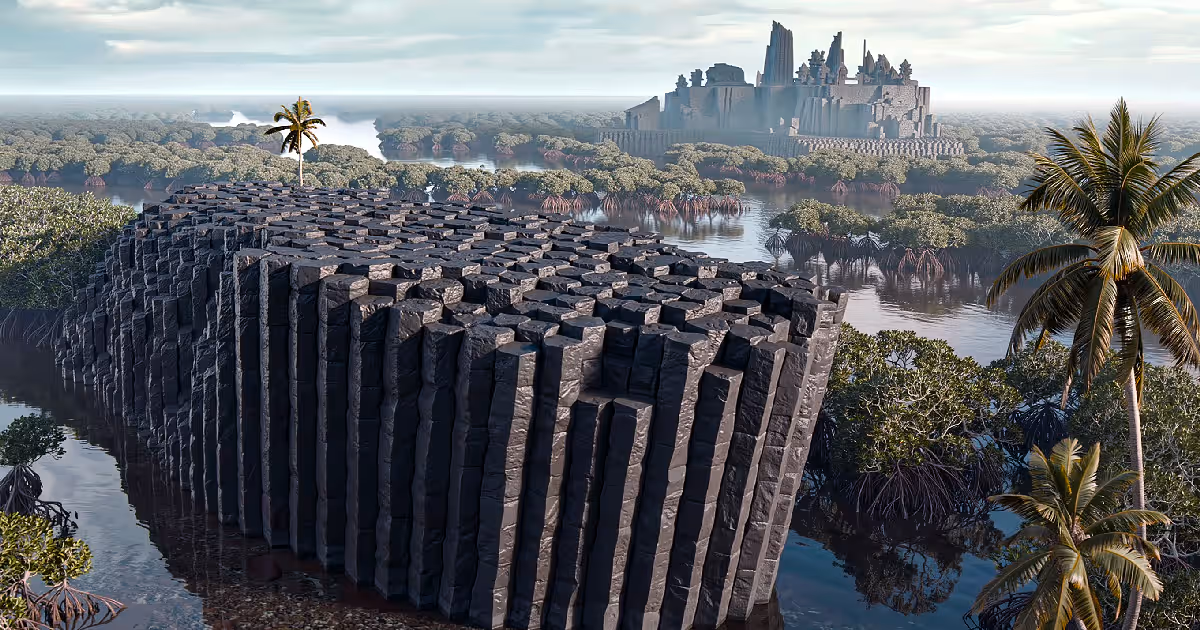
Walls of stacked black basalt columns among mangroves and still water.
Illustration, not a photograph.

Opening
Off the eastern shore of the island of Pohnpei, in the Federated States of Micronesia, lie the ruins of Nan Madol: a city of 92 artificial islets built on a coral reef, connected by canals, with walls of black basalt columns stacked like logs up to several metres high. It covers about one and a half kilometres by half a kilometre, and it was the seat of a dynasty that ruled the island for centuries.
Local legend says it was built by two sorcerers, the brothers Olisihpa and Olosohpa, who levitated the stones into place with the help of a flying dragon. Twentieth-century writers turned it into a relic of the lost continent of Mu. Archaeology has its own answer: people built it, over hundreds of years, from stone quarried on the other side of the island.
Timeline
1st or 2nd century ADPeople are living in the area.
8th or 9th centuryConstruction of the artificial islets begins.
About 1180 to 1200Megalithic building begins, with the great basalt walls.
To about 1628Nan Madol is the ceremonial and political centre of the Saudeleur dynasty, which unites an estimated 25,000 people on Pohnpei under one ruler.
About 1628The Saudeleurs are overthrown by Isokelekel, remembered as a semi-divine hero. The early Saudeleur rulers are remembered as kind, the later ones for ever-heavier demands on their subjects. Isokelekel lives at Nan Madol, but his successors leave, and the city is gradually abandoned.
1874The Polish ethnographer Jan Kubary makes the first detailed description of the ruins.
30 April 1907Victor Berg, the German governor of Pohnpei, dies after taking a keen interest in the ruins. German records blame sunstroke and exhaustion from surveying the site. Pohnpeians say he died for disturbing the tombs.
1910The German explorer Paul Hambruch makes the first full map of the site.
1918A. Merritt's novel The Moon Pool uses the ruins as the gateway to a lost world.
1926James Churchward claims Nan Madol as a remnant of Mu, a sunken Pacific continent.
1974 and 1985The site is added to the US National Register of Historic Places and later named a National Historic Landmark, from the period when Micronesia was a US-administered trust territory.
1978 to 1979Underwater surveys by Arthur Saxe report stone pillars more than 25 metres down. Later surveys find no sign they are man-made, and identify a "blue hole" as a natural sinkhole.
2016Nan Madol becomes a UNESCO World Heritage Site.
2022Netflix's Ancient Apocalypse features the site; archaeologists criticise its claims about the site's age.
Key figures
The Saudeleur rulers built and held the city. Isokelekel, who overthrew them, is the founding hero of later Pohnpeian society. Olisihpa and Olosohpa are the legendary sorcerer-builders. James Churchward and, later, Graham Hancock are the writers who pulled Nan Madol into lost-civilisation theories.
Physical and documentary trail
The site is the record: the islets, the canals, the walls of columnar basalt, the burial enclosures, and radiocarbon dates showing building over centuries. Analysis of the basalt traces it to a volcanic plug on the opposite side of Pohnpei, which means the builders moved the stone across or around the island. How they moved it is not known for certain. Oral history on Pohnpei preserves the story of the Saudeleur and their fall.
The city is divided into sectors. Madol Powe, the mortuary sector, holds 58 islets in the north-east, most of them once home to priests. Its centrepiece is Nandauwas, the royal tomb islet, whose walls rise 5.5 to 7.5 metres around the central tomb built for the first Saudeleur. A 2016 study dated coral from the site with uranium-thorium methods and traced the basalt geochemically, confirming that the megalithic building began around 1180 to 1200.
Estimates of the total weight of basalt and coral moved run to about 750,000 tonnes. The heaviest single stones, such as the great corner blocks at Nandauwas, are estimated at up to around 50 tonnes, though most columns weigh only a few tonnes each. Nan Madol had no fresh water and grew no food: everything its rulers ate was brought in by canoe.
Things you might not know
- It's called the Venice of the Pacific. Its islets are linked by canals, and it has also been called the Eighth Wonder of the World.
- The stone came from across the island. The basalt was quarried on the far side of Pohnpei.
- The walls are built like a log cabin. Long six-sided basalt columns, formed naturally as lava cooled, were stacked in alternating layers, with rubble filling the gaps.
- It ruled 25,000 people. The Saudeleur dynasty united the whole island from its stone city.
- The sunken pillars weren't built. The underwater "pillars" reported in 1978 turned out to be natural.
- It has its own curse story. The German governor Victor Berg died in 1907 after surveying the ruins. Officially it was sunstroke; on Pohnpei it is remembered as the price of disturbing the dead.
- The city couldn't feed itself. With no fresh water and no farmland, every meal for the Saudeleur arrived by boat.
- It inspired fantasy. A. Merritt's 1918 novel The Moon Pool set a lost world beneath it.
Competing explanations
A city built by the Saudeleur. The archaeological view: generations of Pohnpeians moving stone by raft or along the reef, using the island's own basalt, over centuries, to build a centre of power and burial.
Sorcery. The legend of Olisihpa and Olosohpa and the flying dragon. It is Pohnpei's own story of the city's origin, and part of its heritage, not a historical account.
A lost civilisation. Churchward's Mu and later claims that the site is far older than the dates show. The radiocarbon dates and the quarries contradict both, and no evidence of Mu has ever been found.
Later life of the case
Nan Madol is protected as a World Heritage Site, and it is threatened by mangroves, silting and the sea. For another monument pulled into lost-civilisation theories, see Göbekli Tepe.
Finding
Nan Madol was built by Pohnpeians, from the 8th century onwards, as the capital of a powerful dynasty, using basalt from their own island. The legend of the flying sorcerers is a story the island tells about itself, and the lost-continent theories have no evidence behind them.
What still will not resolve: exactly how the builders moved the heaviest columns from the far side of the island, since no account of the method survives.
Evidence signature
4/9 Solid
- Witnesses
- nothing on record
- Instruments
- radar or measured data
- Paper
- official records at the time
How well documented the case is, not whether it's true. A strong record can still have an ordinary answer, and a thin one can still be real.
You decide · NAN MADOL
What do you think happened?
One vote per case, anonymous. You'll see how other readers voted once you've voted.