MIN MIN LIGHTS
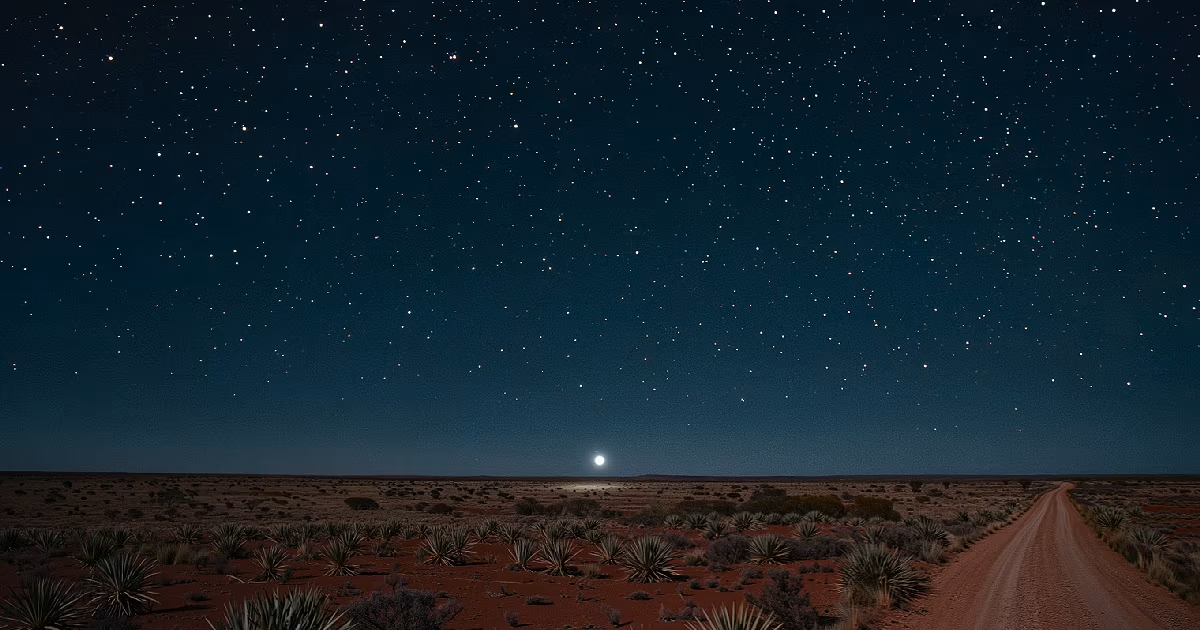
A single glowing light hovering over a flat outback plain at night.
Illustration, not a photograph.

Opening
In the far outback of Australia, from western New South Wales to Boulia in western Queensland, travellers have long reported strange lights at night: fuzzy, glowing discs hovering just above the horizon, usually white, sometimes changing colour, sometimes bright enough to light up the ground. The lights are said to follow people, keep pace with moving cars, vanish when approached and reappear behind. They are called the Min Min lights.
Aboriginal stories about the lights are older than European settlement. Folklore says that anyone who chases the lights and catches them will never come back to tell the tale. In 2003 a neuroscientist offered a natural explanation, an outback mirage that can carry light from far beyond the horizon. It explains a great deal. It has never been proven for every case.
Timeline
Before European settlementAboriginal Australians have stories about the lights. Some Indigenous people believe sightings increased as Europeans moved into the outback.
1838A book called Six Months in South Australia describes a strange light; it is sometimes claimed as the first recorded sighting, though it may describe something else.
1918A stockman is said to see the light near the Min Min Hotel, in the settlement of Min Min in Queensland, one possible source of the name. Another is a word from an Aboriginal language of the Cloncurry area. Neither origin has been confirmed.
20th centuryReports gather across the Channel Country of western Queensland, the main area of sightings, and from other remote areas, including claims from South Australia and Western Australia.
March 2003Jack Pettigrew, a neuroscientist at the University of Queensland, publishes "The Min Min light and the Fata Morgana" in the journal Clinical and Experimental Optometry. He proposes that the lights are a mirage in which a cold, dense layer of air next to the ground bends light, letting people see lights from tens or even hundreds of kilometres away, beyond the horizon, such as campfires or car headlights.
The field testPettigrew's work includes a demonstration in western Queensland. According to accounts of it, a car with its headlights on was driven about ten kilometres away, behind higher ground and out of direct sight, and the observers still saw its lights as a single glow hovering above the horizon.
Key figures
The Aboriginal people of the region are the first keepers of the stories. Outback stockmen, drivers and residents are the witnesses of modern times. Jack Pettigrew is the scientist whose mirage explanation is the leading natural account, and who also considered other ideas, such as glowing insects or owls.
Physical and documentary trail
The record: Aboriginal oral tradition, many individual accounts from the nineteenth century onwards, local histories, and Pettigrew's published explanation. Pettigrew's paper is the one scientific study, and its field test showed that distant headlights can produce the effect, not that every sighting was headlights. Some Aboriginal people hold that sightings increased as Europeans settled the outback, which would fit more fires and, later, more cars. There is no reliable photograph or recording of a Min Min light, no instrumental measurement, and no single location where the lights can be reliably seen and studied.
Things you might not know
- The lights keep their distance. A common feature of the stories is a light that stays the same distance away no matter how fast you move, which fits a mirage of something far away.
- They're said to follow cars. Witnesses describe lights pacing a moving vehicle across the plain.
- Catching one is bad luck. Folklore warns that whoever catches a light will never return to tell of it.
- The name is uncertain. It may come from a hotel in a town called Min Min, or from an Aboriginal word.
- The landscape suits mirages. The Channel Country is flat and open, the kind of terrain where layers of cold and warm air form and bend light.
- Bullets don't stop them. In some stories the lights vanish when fired upon, then come back later.
- The old lights and the new lights may differ. Pettigrew suggested that early, stationary lights were distant campfires and that later, moving lights were car headlights.
- Glowing owls were considered. One idea was owls dusted with glowing fungus. No such bird has ever been found.
Competing explanations
A mirage of distant lights. Pettigrew's Fata Morgana: car headlights, campfires or other lights hundreds of kilometres away, carried over the horizon by bent light, appearing to hover and to move as the viewer moves. The science writer Brian Dunning of Skeptoid has argued that a full Fata Morgana is more complex than the lights need, and that a simpler superior mirage, the same bending of light over a cold layer of air, fits them better.
Living light. Glowing insects, owls carrying luminous fungus, or other bioluminescence. No source bright enough has ever been found.
Earth lights. Light produced by stress in rock or by marsh gas. The lights are often seen where the geology doesn't support either.
Something unexplained. The view of witnesses whose lights seemed to behave in ways no mirage could.
Later life of the case
The Min Min lights are part of outback lore and a draw for visitors to Boulia. For another set of ghost lights with a natural explanation proposed, see the Marfa lights in Texas, where a 2004 study matched the lights it recorded to car headlights, and for a long-studied series in Norway, Hessdalen.
Finding
People have seen strange lights in the Australian outback for as long as there are stories, and a mirage of distant lights is the best natural explanation offered. It fits the way the lights hover and keep their distance, but it has not been demonstrated for any particular sighting, and the lights have never been measured.
What still will not resolve: whether every Min Min light has a distant source, since no one has yet caught one on camera and traced it back.
Evidence signature
3/9 Thin
- Witnesses
- several people
- Instruments
- nothing on record
- Paper
- press and later accounts
How well documented the case is, not whether it's true. A strong record can still have an ordinary answer, and a thin one can still be real.
You decide · MIN MIN LIGHTS
What do you think happened?
One vote per case, anonymous. You'll see how other readers voted once you've voted.