TOYNBEE TILES
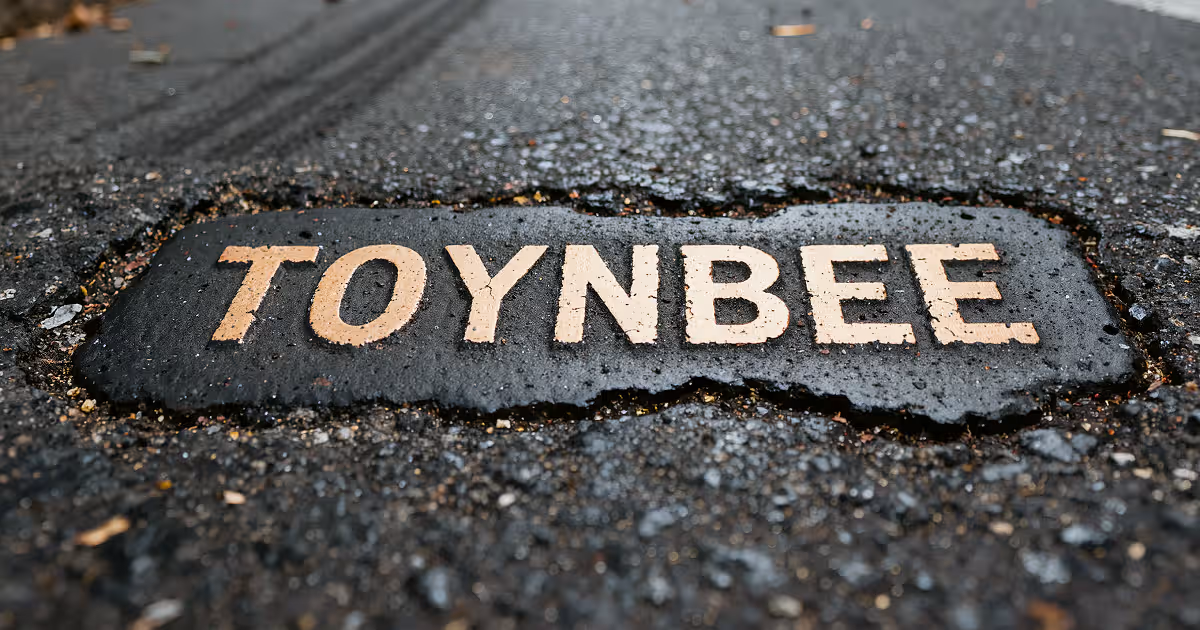
A tile set into the asphalt of a street with the word TOYNBEE.
Illustration, not a period photograph.

Opening
Since the 1980s, several hundred small plates have appeared pressed into the asphalt of about two dozen American cities and three in South America. Most carry a version of the same message: TOYNBEE IDEA IN MOVIE 2001 RESURRECT DEAD ON PLANET JUPITER. The first confirmed sighting was in Philadelphia in 1983.
The tiles are made of layers of linoleum and asphalt crack-filler, laid flat and pressed in by passing traffic. A 2011 documentary, Resurrect Dead, named a reclusive Philadelphia man as the likely maker. He has never publicly confirmed it, and nobody has fully explained what the message means.
Timeline
1980Researchers for Resurrect Dead later say they found a call that year to Larry King's radio show from a man describing the Jupiter idea.
1983The first confirmed tile is seen in Philadelphia. The Philadelphia Inquirer runs a story about a man named James Morasco contacting talk shows and newspapers to spread the message. David Mamet's play 4 A.M., about a radio host and a caller talking about 2001 and Jupiter, is written the same year and published in 1985.
1994The Baltimore Sun prints the first known media reference to the tiles.
1996Kansas City Star editor Doug Worgul finds a tile downtown, at 13th and Grand, on a street resurfaced that year. A local detective says it was clearly made by the same hand as the others. It is still there in 2003. The same year, a tile in Buenos Aires is damaged beyond reading.
1997A tile is reported in Detroit.
2003Worgul learns that a James Morasco in Philadelphia, in his late eighties, has died earlier that year. His widow says he knew nothing about the tiles.
2002 to 2008New Philadelphia tiles use different fonts and drop words, and very few new tiles in the original style appear outside the Philadelphia area. Larger tiles with red italic lettering appear on Pennsylvania highways and on U.S. Route 1 northbound from Drexel Hill. Tiles are also reported in Connecticut in 2006 and Edison, New Jersey, in 2007. A tile in Santiago, Chile, lists a Philadelphia address, whose occupants say they know nothing about it.
2011Resurrect Dead: The Mystery of the Toynbee Tiles premieres. Director Jon Foy wins the Sundance directing award for documentary.
2013 onwardCopycat tiles appear in Topeka, Kansas, in June 2013, removed the next day, and in Salt Lake City that July. In October 2015 Philadelphia's Streets Department recognises the tiles as street art. Tiles reappear in Philadelphia in 2016.
Key figures
Severino "Sevy" Verna is the Philadelphia resident identified by the documentary as the likely tiler. The investigators believe he used the name James Morasco as an alias.
Justin Duerr is the artist whose years of research drive the documentary. He proposed how the tiles were laid.
Jon Foy directed Resurrect Dead.
Arnold J. Toynbee, the historian, and Stanley Kubrick's 2001: A Space Odyssey are the most likely sources of the words, though neither has any known link to the tiler.
Physical and documentary trail
The trail: hundreds of tiles in situ or photographed, the 1983 Inquirer article, the 1980 radio call identified by the filmmakers, the 1996 Kansas City find, and the documentary's research. Many original tiles have since been destroyed by traffic and road maintenance. There is no statement from the maker in his own name.
TOYNBEE IDEA IN MOVIE 2001 RESURRECT DEAD ON PLANET JUPITER
Things you might not know
- Traffic did the installing. Duerr's theory is that the tiles were wrapped in tar paper and left in the road, and passing cars pressed them into the asphalt as the paper wore away.
- Possibly through the car floor. Duerr suspects the tiler dropped them through a hole in the floor of his car.
- There were practice runs. Small "proto-tiles" near the suspected maker's home may have been tests.
- A playwright claimed them. David Mamet said the tiles were a homage to his play 4 A.M. and called it the weirdest thing that ever happened. The 1980 radio call, if genuine, came first.
- Science fiction has other Toynbees. Ray Bradbury wrote a story called "The Toynbee Convector", and an Arthur C. Clarke story features a spaceship named the Arnold Toynbee.
- Cities do not agree on them. Chicago treats them as vandalism. Philadelphia's Streets Department has said it would save a few if it could remove them quickly and cheaply.
Competing explanations
One man with a single idea. This is the documentary's reading: Verna, using the Morasco alias, spent years trying to spread a belief that the dead could be brought back to life on Jupiter, first through the media and then through the street. The consistency of the early tiles supports a single maker.
More than one maker. The post-2002 tiles, with different fonts and missing words, and the copycats since 2013, show that others have taken up the form. That does not explain the originals.
Art or marketing. The long run of dirty, handmade tiles and the absence of any promotion make this hard to sustain.
Later life of the case
The tiles have become a cult subject, with photographers mapping surviving examples and new tiles still appearing. Resurrect Dead turned a street curiosity into one of the best-known American mysteries of authorship.
Finding
The tiles are real, the early ones show one consistent hand, and the documentary makes a strong case that the maker was a Philadelphia recluse who had been pushing the same idea since at least 1980. That is the best explanation, not a confirmed one, because the man named has never spoken publicly about it.
What still will not resolve: a statement from the maker, and what he meant by the 2001 connection.
Evidence signature
3/9 Thin
- Witnesses
- nothing on record
- Instruments
- photo, film or physical traces
- Paper
- official records at the time
How well documented the case is, not whether it's true. A strong record can still have an ordinary answer, and a thin one can still be real.
You decide · TOYNBEE TILES
What do you think happened?
One vote per case, anonymous. You'll see how other readers voted once you've voted.