CORAL CASTLE
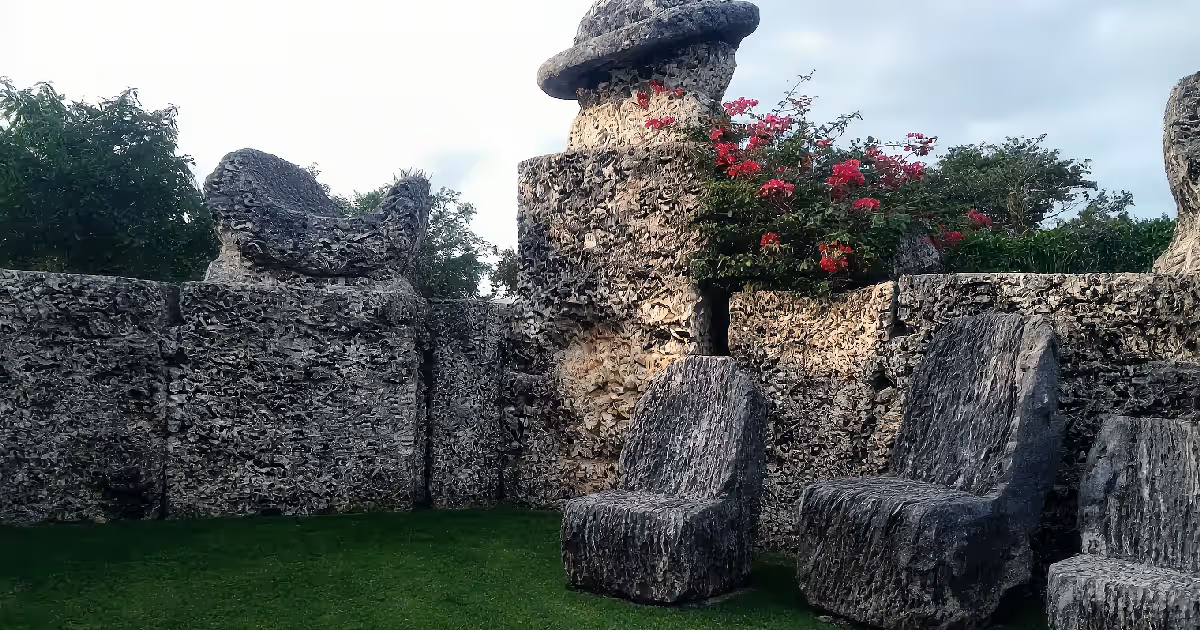
Stone chairs and a wall of limestone blocks with red flowers.
Illustration, not a photograph.

Opening
On a plot of land in Homestead, Florida, stands a walled garden of cut limestone: about 1,100 short tons of walls, a two-story tower, a sundial, a polar telescope, an obelisk, a fountain and some twenty-five rocking chairs. The stones average about 15 short tons each, and the largest weighs 30. It was built, and moved, by one man, a Latvian-born immigrant named Edward Leedskalnin.
Leedskalnin said he had rediscovered the secret by which the Egyptians built the pyramids, and that he understood the laws of weight and leverage. He never explained how he moved the blocks. Photographs, a film and a few eyewitness accounts suggest simple tools. The place is called Coral Castle, though it is oolitic limestone, not coral, and it remains one of the most visited unexplained structures in the United States.
Timeline
1887Edward Leedskalnin is born in Latvia.
About 1920 to 1923He begins work at a site in Florida City, called Ed's Place. Sources disagree on the start date.
About 1936He moves the structures about ten miles north to Homestead, a job that takes about three years, and renames the site Rock Gate.
1944A film shows him working.
November 1951Leedskalnin dies aged 64, of a kidney infection and its effects, about twenty-eight days after going to hospital following a stroke.
1952 to 1953The property changes hands. Accounts conflict: a nephew's sale to an Illinois family in 1953, or a Chicago jeweller's purchase in 1952.
1981Coral Castle, Inc. buys the site for $175,000.
1984It is listed on the National Register of Historic Places as Rock Gate.
1986The nine-ton gate stops turning after a rusted truck bearing fails. Removing it takes six men and a 50-ton crane.
Key figures
Edward Leedskalnin, a Latvian-American, built the place over some twenty-eight years. He charged visitors ten cents, later twenty-five, and let in those who could not pay for nothing. He had no will, and about $3,500 was found among his things. He sold pamphlets, including one on magnetic current, and later sold land for the construction of US Route 1.
Orval Irwin reportedly watched quarrying at the site. Julius Levin, a Chicago jeweller, bought the property after Leedskalnin's death according to his obituary, though the castle's own account differs.
"Agnes Skuvst" is the name given in his promotional material to a sixteen-year-old fiancée in Latvia who called off the wedding a day before it was due. A Latvian account names the girl Hermine Lusis. The story is widely repeated and unverified.
Physical and documentary trail
The record: the structure itself, the 1944 film, photographs from the 1930s and later, Leedskalnin's pamphlets, the sale records and the National Register listing. Photographs and eyewitness accounts show him using pulleys, tripods and simple tools. The claim that he used "reverse magnetism" or levitated stones comes from his own cryptic statements and from television programmes. Sources for the claim that he cured his tuberculosis with magnets are weak.
What is missing is a precise description of his method. He gave none, he worked largely alone, and he died without leaving notes or a will. The ownership history after his death is also uncertain, with the castle's own account and an obituary at odds.
Things you might not know
- The nine-ton gate turned with a finger. It was balanced so that it could be pushed open easily, and it stopped working in 1986 when a rusted bearing failed.
- The stones were moved once. Leedskalnin shifted the whole structure about ten miles in about three years when he left Florida City.
- It was a film set. Coral Castle appeared in The Wild Women of Wongo in 1958 and Nude on the Moon in 1961.
- It inspired a pop song. Billy Idol's 1986 song "Sweet Sixteen" was inspired by Leedskalnin's lost love.
- The owners sued Fortnite. In August 2020 they sued Epic Games over a game location called Coral Castle.
- One sign is not original. The "Adm. 10c Drop Below" sign was made for the Florida City site and was moved to the present one later.
Competing explanations
Ordinary engineering. The strongest reading. Photographs and witnesses show tripods, pulleys and chain hoists, and a determined man with time and leverage can move large stones. This explains the structure, though not how he moved the biggest blocks without anyone seeing.
A lost technique. Leedskalnin's own claim that he knew the secret of the pyramid builders and of reverse magnetism. No one has reproduced a method that matches it, and his stated explanation is vague.
A story that grew. The idea that a lone man did everything may have grown with the telling, and the account of how much help he had is unclear. I have not found a source that settles it.
Later life of the case
Coral Castle is a tourist attraction, privately owned, and has been featured in programmes such as In Search of... and Ancient Aliens. It is often called Florida's Stonehenge.
Finding
The structure is real, the builder is documented, and the evidence suggests he used pulleys, tripods and a lot of patience, not a lost science. What nobody has shown is how a man of his size moved the biggest stones unseen, and he did not say.
What still will not resolve: the precise method he used for the largest blocks, and what the 1944 film and other period images would show if someone looked at them frame by frame.
Evidence signature
6/9 Solid
- Witnesses
- several people
- Instruments
- photo, film or physical traces
- Paper
- formal investigation, court or declassified file
How well documented the case is, not whether it's true. A strong record can still have an ordinary answer, and a thin one can still be real.
You decide · CORAL CASTLE
What do you think happened?
One vote per case, anonymous. You'll see how other readers voted once you've voted.