JUDGE CRATER
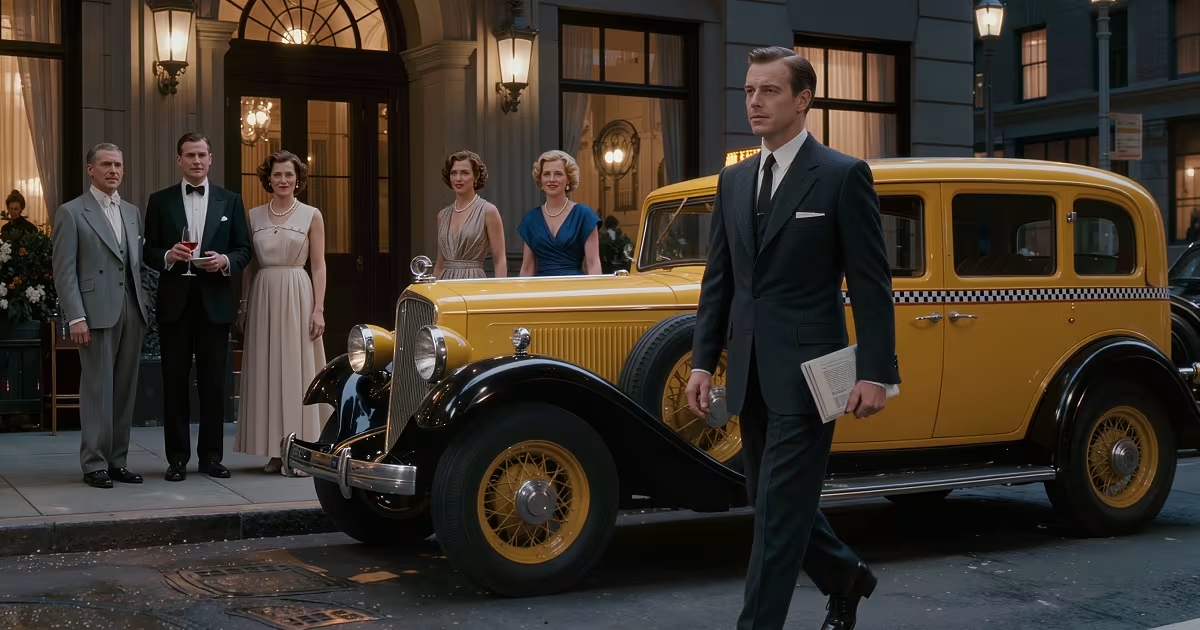
A man in a suit walking away from friends by a yellow taxi in 1930.
Illustration, not a period photograph.

Opening
On the evening of 6 August 1930 Joseph Force Crater, 41, a justice of the New York Supreme Court for four months, ate dinner at Billy Haas's chophouse on West 45th Street with a lawyer friend and a showgirl. Afterwards he left them on the pavement. Nobody has reliably placed him anywhere since. Nobody noticed for weeks: the police were not told until 3 September, and only then did the missing judge become front-page news.
That morning he had cleared files from his chambers, had his clerk cash two checks for $5,150 and sent two locked briefcases home. A grand jury heard 95 witnesses and could not say whether he was alive or dead. New York declared him dead in 1939 and police closed the case in 1979. A 2005 letter named his killers and a burial site. No body has ever been identified as his.
Timeline
5 January 1889Crater is born in Easton, Pennsylvania. He studies at Lafayette College and Columbia, practises law in Manhattan, and rises through Martin J. Healy's Cayuga Democratic Club, a Tammany Hall organisation.
8 April 1930Governor Franklin D. Roosevelt appoints him to a vacancy on the New York Supreme Court for New York County, a trial court despite the name.
Summer 1930With an inquiry into the sale of judgeships under way, the Craters are at their summer cabin at Belgrade Lakes, Maine. Crater makes trips to New York, and by most accounts goes to Atlantic City with the showgirl Sally Lou Ritz.
3 AugustAfter a telephone message he returns to New York, promising his wife he will be back for her birthday on 9 August.
6 August, morningHe spends two hours going through files in his chambers. His clerk, Joseph Mara, cashes two checks for $5,150, and the two men take two locked briefcases to the Crater apartment at 40 Fifth Avenue. Mara is given the rest of the day off.
6 August, eveningCrater buys a ticket at a friend's agency for Dancing Partner at the Belasco Theatre, then dines with William Klein and Ritz. After dinner he parts from them in the street.
25 AugustHe misses the opening of the courts. Fellow justices make private inquiries.
3 SeptemberThe police are notified.
16 SeptemberThe New York Times reports a $20,000 ransom note sent to Stella Crater, which friends regard as fake, and Klein's account to the grand jury of the taxicab.
9 January 1931The grand jury is dismissed without reaching any conclusion.
January 1931Back at the Fifth Avenue apartment, Stella Crater finds envelopes of cash, checks, securities, insurance policies and a note from her husband listing people who owed him money, in a drawer that police searches had not turned up.
6 June 1939Crater is declared legally dead.
1979The police formally close the case.
August 2005Police reveal a letter left by Stella Ferrucci-Good, a Queens widow who died that year at 91, naming Crater's killers and a burial site in Coney Island.
Key figures
Joseph Force Crater was a Tammany lawyer, adjunct law teacher and former secretary to Robert F. Wagner. He was known to friends as "Good Time Joe" for his nightlife and his showgirl friendships.
Stella Crater stayed in Maine, refused to appear before the grand jury, and later lost the apartment for non-payment of rent. She sued insurers to collect on his policies, received $20,561 in life insurance after the death declaration, and in The Empty Robe (1961), written with Oscar Fraley, argued that he had been murdered. She died in 1969.
William Klein, a lawyer for the Shuberts, and Sally Lou Ritz were the last friends known to have seen him.
Joseph Mara, his clerk, saw the cash and the briefcases.
Connie Marcus was his long-term mistress. June Brice, a showgirl seen talking to Crater the day before he vanished, disappeared herself around the time the grand jury convened and was found in a mental hospital in 1948.
Stella Ferrucci-Good wrote the 2005 letter. Her husband, Robert Good, died in 1975.
Physical and documentary trail
The hard record is short. Bank and clerk evidence shows the $5,150 in checks on the last day. The apartment had the two briefcases delivered at noon, and detectives later found them gone and his safe deposit box empty. The January 1931 envelopes held cash, checks, securities, insurance policies and the note. Then there are the grand jury's findings, the 1939 death declaration and the 2005 letter.
The last sighting is the weak point. The contemporary report of Klein's testimony is below. Ritz at first confirmed the taxicab. Later both said that they had taken the cab and Crater had walked away down the street. The departure time also varies between accounts, from just after 9 pm to about 9:30. Someone collected his ticket at the Belasco box office, but whether it was Crater is not known.
It was said that Mr. Klein testified that the judge got into a taxicab outside the restaurant about 9:30 P. M. and drove west on Forty-fifth Street.
Note the hedge: even the Times was reporting what was said about secret testimony. The earlier version of this report had him getting into a cab, in one account, or stepping toward one. It also said the 2005 site "was not dug to a close". In fact no excavation for Crater there has been reported. Police said they could find no record that remains were recovered when the aquarium site was dug in the 1950s, a report of skeletons from that work proved unfounded, and the police file on Charles Burns, one of the men named, showed nothing to suggest he was a murderer. The grand jury's figures are given here as 95 witnesses and nearly 1,000 pages; one later account says hundreds of witnesses and 2,000 pages.
Things you might not know
- The grand jury ruled out nothing. It found the evidence insufficient to say whether Crater was alive or dead, whether he had left voluntarily, whether he had amnesia, or whether he was the victim of a crime.
- The ransom note came first. Within two weeks of the police being called, Stella Crater received a note demanding $20,000 in small bills for his safe return. His friends treated it as a fake.
- A murder witness died before testifying. Vivian Gordon, a woman linked to high-end prostitution in whose apartment Crater's jacket was reportedly found, offered to testify about police graft to the Seabury inquiry on 20 February 1931 and was murdered five days later.
- The 2005 letter has a geography problem. The boardwalk at West Eighth Street was moved back about 280 feet in 1939, so detectives first had to work out where it had stood in 1930.
- His wife kept an anniversary. By several accounts, every 6 August she went to a Greenwich Village bar, ordered two drinks and toasted him with one, leaving the other.
- He became a verb. "To pull a Crater" meant to vanish, and "Judge Crater, call your office" was a stock nightclub joke for years.
Competing explanations
Murder. Stella Crater believed it, her lawyer Emil Ellis argued it in the insurance litigation through the June Brice blackmail theory, and the 2005 letter supplies names. Crater moved among Tammany figures under investigation and had known Arnold Rothstein. Against it: no body, no confession, and the named policeman's record shows nothing.
A planned departure. The cleared files, the cash, the briefcases and the note in the drawer look like preparation, and Police Commissioner Edward Mulrooney took that view. Against it: no confirmed sighting in nine decades, and Crater left a new judgeship, a wife and his money arrangements behind.
Suicide, accident or amnesia. The grand jury listed amnesia among the possibilities it could not exclude. A body in the Hudson, or under a false name in a hospital, would fit the silence. None has been found.
Later life of the case
Thousands of false sightings followed in the 1930s, and in 1959 Westchester authorities dug a Yonkers backyard for his bones. Richard J. Tofel's Vanishing Point (2004) studied the case and its New York, and Tofel was sceptical of the 2005 letter when it appeared. In October 2005 detectives were reported to be studying old boardwalk maps before deciding whether to dig. The New York Post called it that year the NYPD's oldest unsolved missing-person case.
Finding
Joseph Force Crater vanished after dinner on West 45th Street on 6 August 1930, and the city did not start looking until four weeks later. The facts of that day point to a man who expected trouble or an absence: files cleared, cash drawn, papers sent home. Whether he left or was killed cannot be decided from what survives. The one named confession is third-hand and has never been tested by a dig or a body.
What still will not resolve: where he went from the pavement outside Haas's, by cab or on foot. A body identified as his would settle it, or a record of him alive after 6 August 1930.
Evidence signature
4/9 Solid
- Witnesses
- several people
- Instruments
- nothing on record
- Paper
- official records at the time
How well documented the case is, not whether it's true. A strong record can still have an ordinary answer, and a thin one can still be real.
You decide · JUDGE CRATER
What do you think happened?
One vote per case, anonymous. You'll see how other readers voted once you've voted.