HESSDALEN
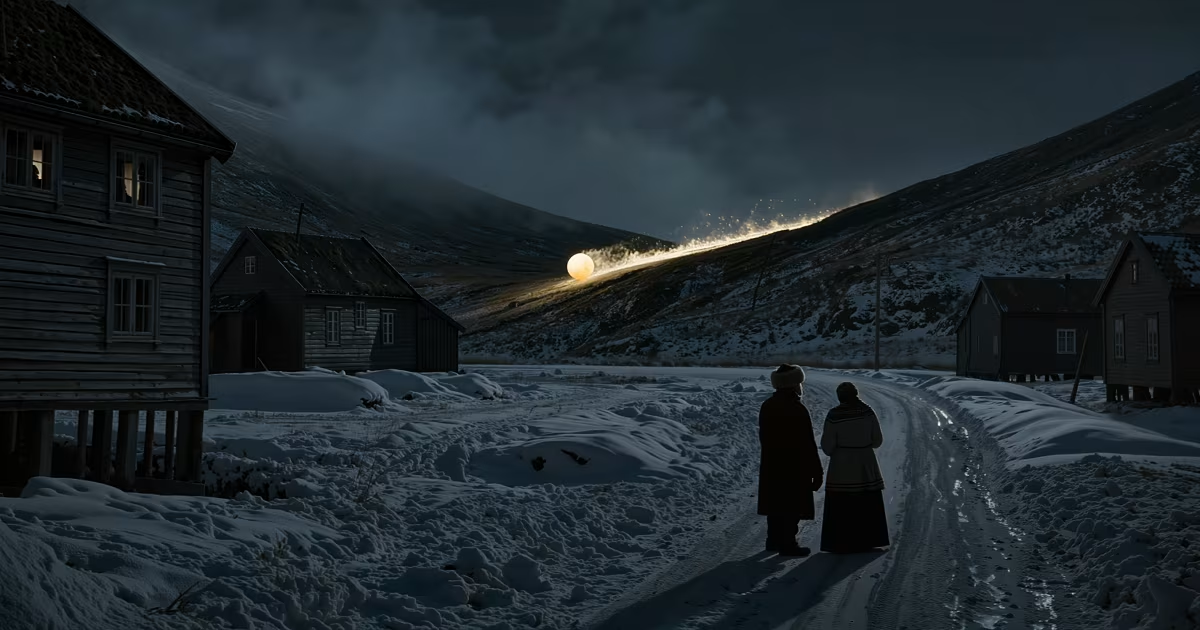
Norwegian winter valley. A standing light on a ridge.
Illustration, not a period photograph.
Opening
On 8 December 1981, Åge and Ruth Marry Moe, looking out their kitchen window in the Hessdalen valley of central Norway, saw what they described as a burning fireball hanging in the evening sky. Over the following three years, similar unexplained lights, floating orbs, fast-moving streaks, colored flashes, objects that appeared to split apart and reform, were reported by residents at a rate that peaked around twenty sightings a week. What makes Hessdalen unusual among UFO cases is not the lights themselves but what happened next: rather than a single flap that faded into folklore, the valley became the site of the longest-running instrumented scientific monitoring effort ever aimed at an unexplained aerial phenomenon, one still partly active more than four decades later.
Timeline
8 December 1981. The Moe family's sighting is the first widely cited report of what becomes known as the Hessdalen phenomenon.
1981-1984. Sighting frequency climbs sharply, peaking at an estimated twenty reports per week, drawing attention across Norway and prompting local concern serious enough to justify organized investigation rather than dismissal.
1983-1985. UFO-Norge and UFO-Sverige, two Nordic UFO research organizations, initiate Project Hessdalen, sending researchers to stay in the valley and document sightings systematically. During this instrumented campaign, fifteen to twenty events per week are recorded, alongside photographs, film, and, notably, radar detections independent of visual sighting.
1994. Assistant professor Erling Strand, the project's founder, co-organizes the first international scientific congress on the Hessdalen phenomenon, drawing researchers from multiple countries and substantially expanding the project's academic legitimacy and international scientific involvement.
1998. Project Hessdalen installs an automated measurement station on a slope at the valley's north end with a clear sightline south down the valley, equipped with optical cameras, magnetometers, weather instruments, and low-frequency electromagnetic radiation sensors, alongside a random number generator installed as part of the separate Global Consciousness Project.
Early 2000s. The EMBLA project, an international collaboration bringing in radio astronomy, plasma physics, and atmospheric science expertise, works to characterize the phenomenon's electromagnetic properties and test hypotheses ranging from ionized atmospheric plasma to interactions with the valley's specific geology.
2007. Research led by Bjørn Gitle Hauge and colleagues proposes a specific mechanism: acidic drainage from the valley's disused sulfide mines, active until 1933, running into the Hesjia river and reacting with zinc-rich rock on one valley wall and copper-rich rock on the other, functioning as a naturally occurring, low-voltage electrochemical battery capable of ionizing airborne dust. Norwegian press coverage of this proposal is headlined, prematurely, as solving the mystery. Physicist Bjørn Samset publicly raises specific technical objections, including skepticism that a stable "cold plasma" at the described low temperatures is physically coherent, and notes some journals cited in support of the theory carry limited academic standing.
2002. An Italian physics team led by Massimo Teodorani conducts a two-week field expedition, using photometric analysis to measure luminous power output as high as 100 kilowatts from observed light phenomena and finding the light distribution pattern inconsistent with a simple, canonical plasma signature.
2010. Physicists Paiva and Taft publish a peer-reviewed hypothesis proposing the lights are macroscopic Coulomb crystal clusters formed in a dusty plasma, ionized by alpha particles from radon decay in the valley's naturally radioactive subsoil, an explanation intended to account for observed oscillation, geometric structure, and light spectrum together.
Ongoing. Automated monitoring at the station continues, though the sighting rate has dropped substantially from its early-1980s peak to roughly twenty observations a year, a decline some researchers connect to the exhaustion or stabilization of whatever geological or chemical process may be driving the phenomenon.
Key figures
Strand is the project's founding and longest-serving figure, an academic who built Hessdalen's investigation from informal UFO-organization fieldwork into an internationally recognized, instrumented research program, and who has remained associated with the effort for over four decades.
Hauge is the case's leading proponent of the sulfide-mine battery hypothesis, a specific, testable mechanism grounded in the valley's genuine mining history rather than speculative physics, though one that has drawn open skepticism from other physicists over its plasma-stability claims and sourcing.
Teodorani represents the case's most rigorous instrumented fieldwork, bringing formal photometric and spectral analysis methods more commonly used in astrophysics to bear directly on the phenomenon, and reporting measured light output figures that any explanation now has to account for quantitatively rather than just descriptively.
Samset is the case's most vocal outside skeptical physicist, whose specific technical objections, particularly around the physical plausibility of a stable low-temperature plasma, represent genuine scientific pushback from within the physics community rather than dismissal from outside it.
Physical and documentary trail
On the paper, this file has an unusually strong instrumented record for a UFO-adjacent case: four decades of photographs and film, radar detections independent of and correlated with visual sightings, a permanently installed automated monitoring station with multi-instrument sensor coverage, peer-reviewed physics papers proposing specific mechanisms, and a documented, measurable decline in sighting frequency over time that any full explanation needs to account for.
What it lacks is scientific consensus. Multiple credible, mechanism-specific hypotheses, the sulfide-battery model, the radon-decay dusty-plasma model, the piezoelectric-quartz model, remain in open competition, and at least one leading proposal has drawn direct, substantive technical criticism from independent physicists rather than being accepted or definitively refuted.
The problem is simply that they are proceeding too fast.
Competing explanations
Misidentification of mundane sources. Some Hessdalen reports have been positively identified as astronomical bodies, aircraft, car headlights, or mirages, a genuine and acknowledged portion of the overall report volume that most serious investigators, including Strand's own project, readily separate from the harder-to-explain remainder.
The sulfide-mine electrochemical battery hypothesis. This explanation has the advantage of a real, confirmed geological mechanism, genuine zinc and copper deposits on opposite valley walls, genuine acidic drainage from historical sulfide mining, and a testable physical process. Its weakness, per Samset's critique, is that the specific plasma behavior proposed to result from it may not be physically stable at the temperatures described, and some of its supporting citations do not hold up well under scrutiny.
The radon-decay dusty-plasma model. This peer-reviewed hypothesis accounts for several specific observed properties, oscillation, structure, spectral content, together in one framework, and rests on the valley's documented radioactive subsoil. It remains a modeled hypothesis rather than a confirmed mechanism, and has not resolved the broader disagreement among researchers.
Airborne dust combustion. An earlier, specifically tested hypothesis identifying hydrogen, oxygen, and titanium in combustion analysis, initially reported by some Norwegian press as solving the case outright, an overstatement not shared by the wider research community given the persistence of other unexplained properties.
A genuine, still only partly characterized atmospheric-electrical phenomenon unique to or unusually concentrated in this specific valley's geology. This remains the most defensible reading of the case's overall state: real, measured, high-output light phenomena, occurring with a documented and declining frequency, whose precise mechanism has narrowed considerably through forty years of instrumented study without yet being settled.
Later life of the case
Hessdalen is now widely cited in serious literature on unexplained atmospheric light phenomena as the closest thing to a controlled, long-term natural laboratory for the subject, and its methodology, permanent instrumentation, peer-reviewed hypothesis testing, public data, has been held up as a model other similar-phenomenon sites elsewhere in the world could productively follow rather than relying only on eyewitness testimony.
Finding
Something real and measurable has been happening in the Hessdalen valley for over four decades: instrumented cameras, radar, and electromagnetic sensors have independently recorded light phenomena with power outputs professionally measured in the tens of kilowatts, occurring at a rate that has declined substantially but not vanished since the early-1980s peak. Multiple physically grounded mechanisms remain in serious, ongoing scientific competition, and none has yet achieved the kind of consensus that would let this file close.
What still will not resolve: a single mechanism accounting for the full range of documented properties, oscillation, structure, spectral output, and radar-visual correlation, that survives sustained peer scrutiny the way the sulfide-battery model's cold-plasma claim has not yet managed to. Until one does, Hessdalen remains what its own investigators call it: not a solved mystery, but the best-instrumented open one on record.