AVEBURY
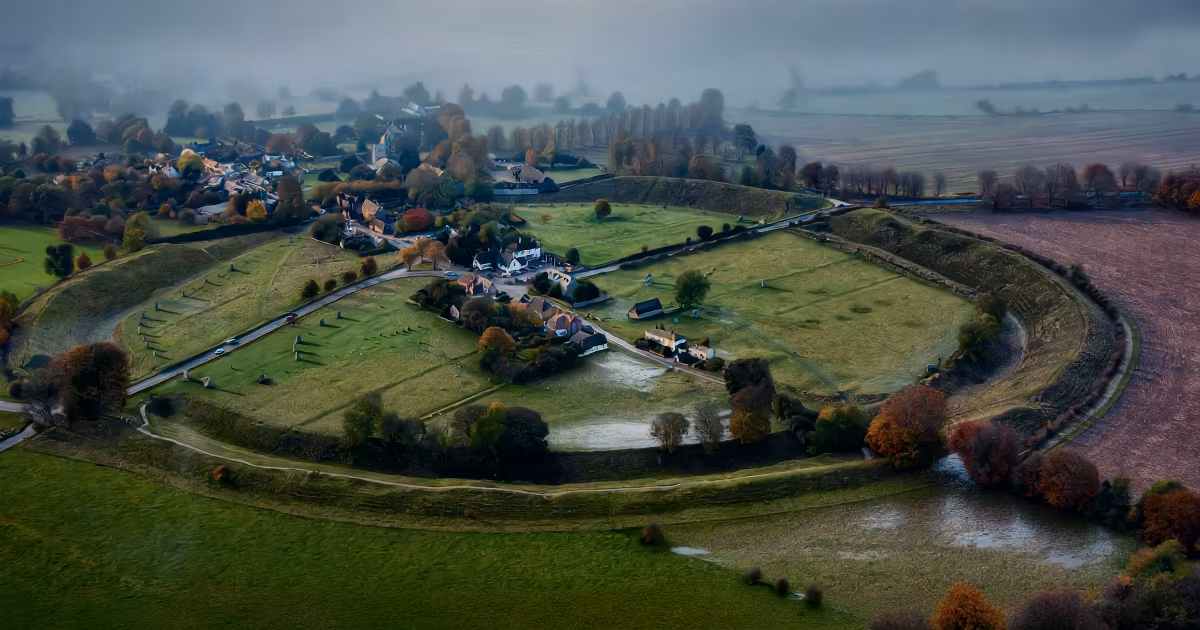
An aerial view of the stone circle and village of Avebury in autumn.
Illustration, not a period photograph.

Opening
Avebury, in Wiltshire, England, holds the largest stone circle in the world, a Neolithic monument built between roughly 2850 and 2200 BCE, its purpose still not fully understood by archaeologists beyond a general assumption of ritual use. The site carries two very different kinds of mystery worth separating cleanly.
The first is a genuine, physically documented archaeological puzzle: the skeleton of a man crushed beneath a toppled megalith in the fourteenth century, lost, presumed destroyed in the Blitz, and then unexpectedly rediscovered in a London museum decades later. The second is a modern crop circle appearing beside the stones in 1999, deliberately and openly created by a named team of artists at a newspaper's request specifically to demonstrate how confidently some crop circle researchers would misidentify an admitted hoax as genuine.
Timeline
2850-2200 BCEAvebury's henge and stone circles, including two smaller circles set within the outer Great Circle, are constructed, their specific ritual or ceremonial purpose never definitively established by later archaeological study.
15th century, per local tradition, possibly under church direction. Villagers begin breaking down and burying the megaliths, a practice some accounts attribute to religious objection to the monument's pagan associations.
Same period, the "Barber Stone" incidentA man engaged in toppling one of the stones is crushed beneath it when the megalith falls, killing him. Given the stone's sheer size and weight, his companions reportedly abandon the recovery effort rather than attempt to move it further, leaving his body beneath the fallen stone.
1930sArchaeologists rediscovering and re-erecting Avebury's stones find a human skull beneath the stone later named the Barber Stone, alongside a set of fourteenth-century coins and, per some accounts, surgical instruments consistent with the trade of a traveling barber-surgeon, a profession that in this period commonly performed both haircuts and minor medical procedures, giving the stone and the case their enduring nickname.
Following the discoveryThe recovered remains are taken to London for further study and study collection.
World War II. The remains are believed lost, presumed destroyed during the Blitz bombing of London, and the case effectively closes as an unfortunate casualty of the war rather than any ongoing mystery.
1998The skeleton is unexpectedly rediscovered, intact, in the collection of the Natural History Museum in London, resolving one specific loose thread (the remains' fate) while leaving the original circumstances of the man's death exactly as documented decades earlier: a genuine, if centuries-old, workplace accident during an act of religious or civic iconoclasm.
1976The first widely recorded modern crop circle sighting in the region occurs at Headbourne Worthy in nearby Hampshire, marking the informal beginning of what would become the broader English crop circle phenomenon.
From 1980Serious organized research into crop circles begins, and reported formations proliferate rapidly through the following decades, with Hampshire and Wiltshire, the same county containing both Avebury and Stonehenge, consistently producing by far the largest concentration of reports in the country.
28 July 1999A team calling itself the CircleMakers, originally formed under the name "Team Satan" and consisting of London-based graphic artists including named members Rod Dickinson, John Lundberg, and Will Russell, is commissioned by the Daily Mail newspaper specifically to construct a crop circle near the Avebury stones as a public demonstration of how confidently crop circle researchers might misattribute a known, deliberately staged formation to a genuine unexplained cause.
Same nightWorking with four additional collaborators under a full moon, the team constructs an elaborate "3D cubes" design roughly 300 feet in diameter in a barley field on Waden Hill, less than 200 feet from the Avebury stone circle itself, a location deliberately chosen both for its visibility from the village and tourist paths and because crop circles had already been appearing there annually for over a decade. The work begins at 11 p.m. and concludes by 4:30 a.m., accompanied throughout by a Daily Mail journalist and photographer working under pseudonyms specifically to preserve the demonstration's integrity until the reveal. The farmer, Mr. Farthing, had given his permission in advance and received compensation.
Same morningThe formation is discovered by roughly 5:30 a.m. and draws crop circle tourists, a television crew, and researchers within hours, with the farmer charging a small viewing fee.
Following the revealCrop circle researcher Erik Deetken, having visited the site and reportedly performed dowsing to assess "Earth energies" he associated with the ancient location, initially states the formation looked like "a mess" and that his opinion was confirmed once the Daily Mail revealed it as a deliberate hoax, before subsequently reversing himself in the same account and returning to a more credulous position, per contemporary documentation of his shifting statements.
Separately. Crop circle researcher Lucy Pringle maintains that the formation could not have been made by people at all, on the specific stated grounds that the Avebury area is never genuinely deserted overnight, since visitors and locals reportedly walk the lanes and mingle with the stones throughout the night, an objection the CircleMakers' own confirmed, witnessed, five-and-a-half-hour overnight construction directly and specifically contradicts.
Key figures
The unnamed barber-surgeon is the case's original human subject, a genuine historical figure whose death, workplace accident during a period of religious iconoclasm, is documented through physical archaeological evidence, his own skeleton, contemporary coins, and, per some accounts, his own trade tools, rather than through any later reconstructed legend.
Dickinson, Lundberg, and Russell are the case's named, confirmed, and entirely open creators of the 1999 crop circle, whose specific purpose, exposing the confidence with which some researchers would misidentify an admitted hoax, makes this a rare instance of a crop circle case where the creators' own stated intent and method are fully documented rather than inferred after the fact.
Deetken and Pringle represent the case's most directly challenged skeptical failure points: one researcher whose own recorded opinion shifted within the same conversation once confronted with the hoax's confirmed origin, and another whose specific stated objection, that the site is never truly deserted at night, is directly contradicted by the confirmed, witnessed timeline of the formation's actual overnight construction.
The Daily Mail journalist and photographer, working under pseudonyms during the demonstration, represent the case's independent, contemporaneous documentary witnesses to the construction process itself, present throughout rather than relying solely on the CircleMakers' own later account.
Physical and documentary trail
The record has, for its archaeological thread, a physically recovered skeleton with dateable associated coins, and a documented, if dramatic, chain of custody through presumed wartime loss and eventual 1998 rediscovery. For its crop circle thread, it has a fully confirmed, witnessed, timed construction process, named creators, an independent journalist and photographer present throughout, and directly documented, contradictory statements from the researchers who subsequently examined the result.
What it lacks, for the broader crop circle phenomenon generally, is any confirmed non-human explanation for any formation ever definitively ruled out as human-made, a gap this specific 1999 demonstration was deliberately designed to highlight by showing how thoroughly a confirmed, fully documented hoax could still pass as genuine to at least some experienced researchers.
Visitors and locals mingle with the stones and walk through the lanes all night long.
Things you might not know
- A marmalade fortune restored it. Alexander Keiller, heir to the Keiller marmalade business, bought much of the site between 1924 and 1939 and had fallen and buried stones raised again.
- Concrete posts mark missing stones. Where stones were lost, Keiller put up concrete markers, and Avebury today is largely his creation.
- Only nine were standing in 1939. The outer circle once had about 98 sarsens.
- It is Britain's largest stone circle. The outer ring is about 330 metres across, inside a henge nearly 350 metres wide.
- The stones were cracked with fire. In the 17th and 18th centuries villagers heated sarsens, doused them with cold water to split them, and used the pieces for building.
- An antiquarian named the culprits. William Stukeley surveyed the site from 1719 to 1724, watched the destruction and recorded who was doing it.
Competing explanations
For the Barber Stone: a genuine, documented fourteenth-century workplace accident during deliberate megalith destruction, fully consistent with the physical evidence recovered, requiring no supernatural element despite the site's much broader separate reputation for ghost stories and reported time-slip experiences layered on top of this one specific, well-documented case.
For the 1999 crop circle: a confirmed, fully documented human construction, given named creators, a witnessed timeline, and independent journalistic presence throughout, a case with essentially no genuine ambiguity remaining once the Daily Mail's planned reveal is taken into account.
For the broader crop circle phenomenon this specific case was designed to comment on: this demonstration itself argues strongly that at least some portion of reported formations, and at least some portion of the researcher community's confident attributions, reflect human skill and human error respectively rather than any unexplained natural or non-human cause, without this one confirmed hoax by itself resolving every other reported formation's origin.
Later life of the case
Avebury remains a genuinely dual-natured site in paranormal and mystery culture: a location with real, physically documented historical strangeness (the Barber Stone) sitting alongside one of the crop circle phenomenon's most thoroughly and deliberately documented debunking demonstrations, the two threads frequently blended together in popular retelling despite having almost nothing evidentially in common beyond sharing the same physical location.
Finding
Avebury's genuine historical mystery, the Barber Stone skeleton, rests on solid physical archaeological evidence and requires no supernatural explanation, while its most famous crop circle incident is not a mystery at all but a fully confirmed, named, witnessed demonstration specifically designed to expose researcher overconfidence, a demonstration that succeeded exactly as intended when at least two experienced crop circle researchers offered confident non-human explanations directly contradicted by the confirmed facts of the formation's own construction.
What still will not resolve: nothing regarding either specific thread covered here, both being unusually well-documented for cases of their kind. What remains genuinely open is only the broader question the 1999 demonstration was built to probe, how many other, less thoroughly documented crop circle claims across Wiltshire and beyond might reflect the same pattern of confident misattribution this one confirmed case exposed so directly.
Evidence signature
5/9 Solid
- Witnesses
- several people
- Instruments
- photo, film or physical traces
- Paper
- official records at the time
How well documented the case is, not whether it's true. A strong record can still have an ordinary answer, and a thin one can still be real.
You decide · AVEBURY
What do you think happened?
One vote per case, anonymous. You'll see how other readers voted once you've voted.