SILBURY HILL
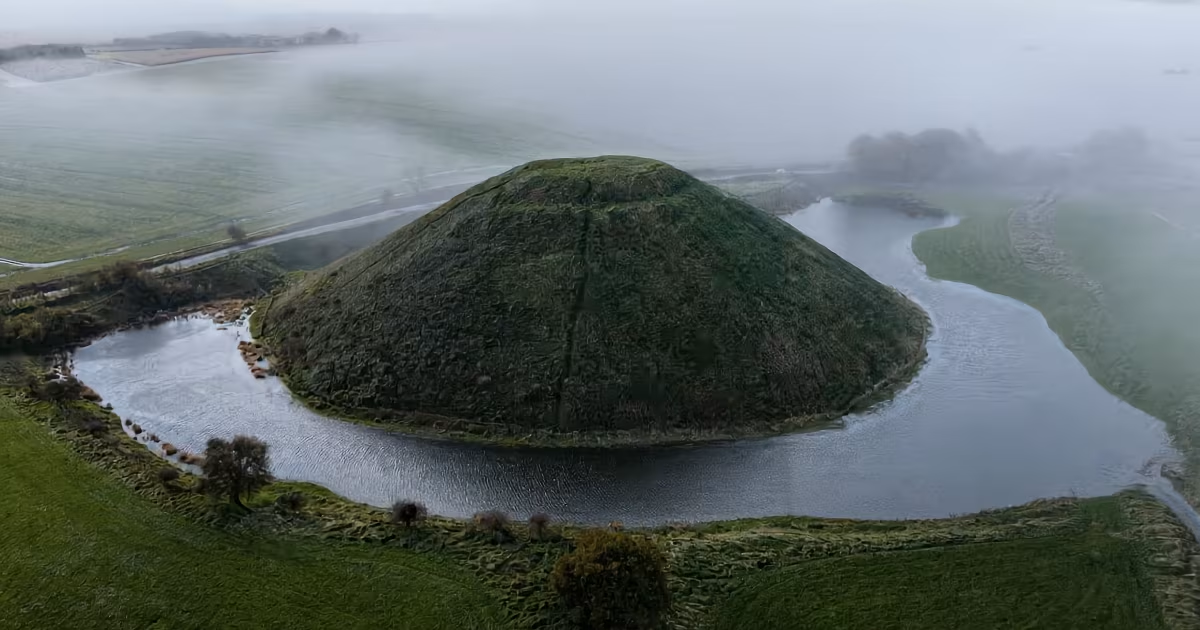
Silbury Hill ringed by flood water and early morning mist.
Illustration, not a period photograph.

Opening
Silbury Hill, near Avebury in Wiltshire, is the largest prehistoric artificial mound in Europe: about 30 metres high, built of chalk and earth around 2400 BC. For three hundred years, people have dug into it expecting a burial, a king, or treasure, and each time they have found nothing of the kind. The hill has no chamber, no body, and no clear purpose. That empty centre has made it a magnet for ley lines, crop circles, and earth-energy theories, which have spread into the fields around it.
Timeline
About 2400 to 2300 BCThe mound is built in stages over a few generations. Remains of winged ants in the original turf core suggest work started in late summer.
1776Cornish miners working for the Duke of Northumberland and Colonel Drax sink a shaft from the top down to the base. They find nothing.
1849A tunnel is driven into the side toward the centre. It finds no burial.
1968 to 1970Richard Atkinson reopens the tunnel for an excavation broadcast by the BBC. It produces the ant evidence and the building sequence, but again no burial.
1974Climbing the hill is banned to protect it.
May 2000After heavy rain, the old 1776 shaft collapses and opens a hole in the summit.
2007 to 2008English Heritage reopens the Atkinson tunnel one last time to fill the old voids with chalk and stabilize the mound, and records the building stages more precisely before sealing it.
Key figures
The Duke of Northumberland's miners, the 1849 excavators, and Richard Atkinson all came looking for a burial and left without one.
English Heritage, which looks after the monument, settled the dating and made the mound safe.
Crop-circle makers and researchers made the surrounding fields famous from the late 1980s onward. Formations near Silbury became some of the most photographed examples.
Physical and documentary trail
What survives: 18th- and 19th-century excavation accounts, Atkinson's 1968 to 1970 work, and English Heritage's reports from 2007 to 2008. They agree on construction in stages and no primary burial.
The mound's purpose isn't recorded anywhere. It was built in a society that left no writing.
Things you might not know
- It is 39.3 metres high. That makes it the tallest prehistoric man-made mound in Europe, on a base about 167 metres across.
- The top is flat. The summit is about 30 metres wide, and may have been levelled in the medieval period, possibly for defence.
- It holds 248,000 cubic metres. That much chalk and earth went into it.
- It took about 18 million hours of work. That is roughly 500 people working for 15 years.
- Legend puts a king inside. Local tradition says King Sil is buried there with a life-size golden statue of himself on a golden horse.
- Romans lived at its foot. A Roman village with regular streets and houses has been found beside the hill.
Competing explanations
A monument that mattered for building it rather than for what's inside. Many archaeologists think the act of building, generation after generation, was the point, along with its place in the Avebury landscape and next to the River Kennet's springs.
A viewing platform or marker. The hill's position has been linked to sight lines across the Avebury complex. None of these readings has been proven.
An earth-energy or ley-line centre. This is popular in alternative writing and around the crop-circle scene. It depends on measurements and energy claims that haven't been independently checked.
Later life of the case
Silbury's place in modern weird culture comes mainly from its neighbours. The crop circles were made in fields next to it, some of them openly by known makers, and the lack of a burial left space for other stories. The monument itself is fenced, protected, and seen from the path.
Finding
Silbury Hill is a real, carefully dated Neolithic monument with no chamber and no burial, confirmed by three excavations over two centuries. Its lack of a purpose is an archaeological problem, not a paranormal one.
What still will not resolve: why people spent generations building it. The hill has no inscription, and the answer isn't going to turn up in the chalk.
Evidence signature
3/9 Thin
- Witnesses
- nothing on record
- Instruments
- photo, film or physical traces
- Paper
- official records at the time
How well documented the case is, not whether it's true. A strong record can still have an ordinary answer, and a thin one can still be real.
You decide · SILBURY HILL
What do you think happened?
One vote per case, anonymous. You'll see how other readers voted once you've voted.