UMMO
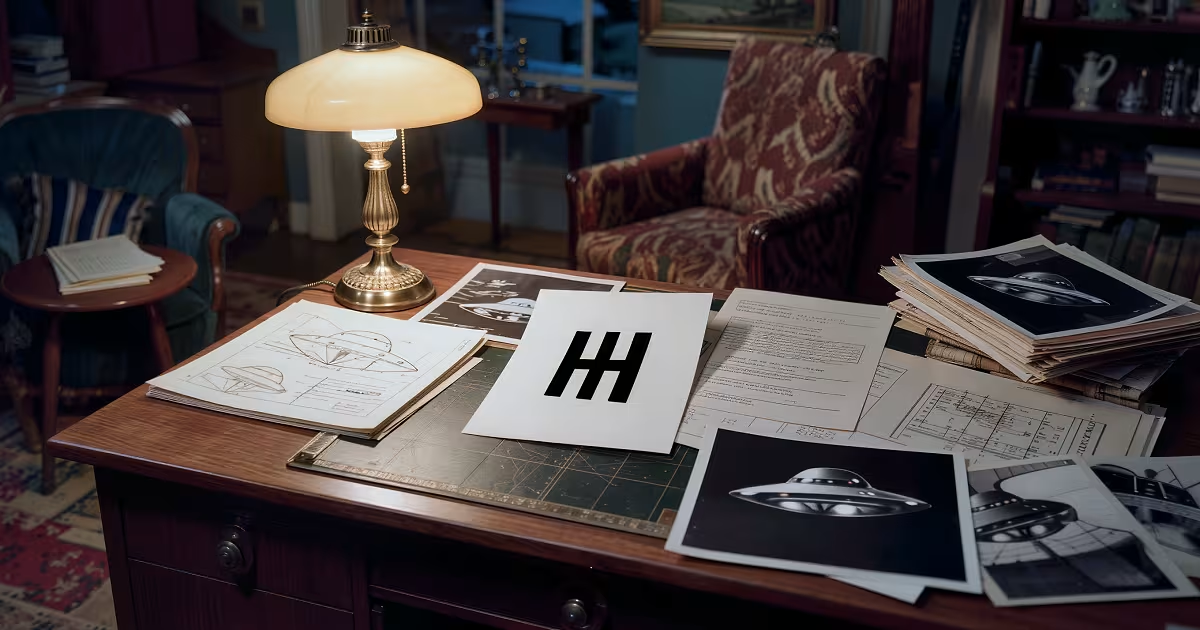
UFO photographs and letters marked with the Ummo symbol under a lamp.
Illustration, not a period photograph.

Opening
Beginning in January 1966, a series of anonymous typewritten letters began arriving at addresses across Spain and, eventually, from as far afield as Australia, Canada, Switzerland, and West Berlin, bearing a distinctive stamp and claiming to originate from "Ummo," a planet orbiting a star some 14.6 light-years from Earth. The letters, thousands of pages of them across nearly three decades, described in exhaustive pseudo-scientific detail Ummite biology, physics, and philosophy, alongside pointed political commentary criticizing the Franco regime, American foreign policy, and capitalism.
What began as one Madrid contactee's claimed correspondence grew into one of the most elaborate, sustained hoaxes in UFO history, and in 1993, one of the case's own originating figures published an article naming himself as the man behind it.
Timeline
1965In Madrid, a loosely organized group calling itself the Society of the Friends of the Space Visitors gathers regularly at a coffee shop nicknamed "the Merry Whale," discussing Gnosticism, philosophy, and extraterrestrial contact. Its leader, Fernando Sesma Manzano, a telegraph technician who falsely presented himself as a professor of cartography and cryptology, claims contact with a separate, earlier fictional civilization from a planet called "Auco," a claim later revealed within the Ummo material itself to have been an invented hoax perpetrated by another group member for his own amusement, an origin story that already establishes a pattern of layered fabrication before Ummo itself even begins.
January 1966The first Ummo letters arrive, addressed to Sesma and, over time, an expanding circle of recipients, always sent anonymously and bearing no return address, signed by a self-described "unified government of the planet Ummo" and an "extraterrestrial expeditionary group" on mission in Spain.
6 February 1966Several witnesses report seeing a flying saucer near Aluche, Spain, marked with a peculiar symbol; José Luis Jordán Peña, one of the witnesses, personally sketches the object and reports it to newspapers.
1967Sesma publishes Ummo: Another Inhabited Planet, the first book-length popularization of the material. Separately, he announces that a spacecraft will appear near Madrid on the evening of 1 June.
1 June 1967A UFO sighting occurs as apparently predicted, with photographs taken showing a symbol matching Jordán Peña's earlier sketch. A flyer signed by a "Henri Dagousset" circulates afterward claiming the object left behind small cylinders and inviting anyone who found one to make contact via the general post office; one such cylinder is anonymously sent to a UFO author, containing a paper bearing the same symbol.
Late 1960sDocumented efforts, per later research, are made by the Sesma circle to interest American filmmaker Orson Welles in the material, an ambitious and unsuccessful attempt to secure high-profile validation for the case.
Through the following years. The recipient circle grows and formalizes into a research association, ERIDANI, formed specifically to study the accumulating Ummo material.
1970The letters temporarily stop.
1975Following the death of Francisco Franco, letter frequency declines but does not cease, and the surviving material continues to carry sharp anti-American, anti-capitalist commentary consistent with its earlier political content.
1975Researcher Antonio Ribera publishes The Ummo Mystery, treating the case as a genuine, if bewildering, ongoing subject of study rather than settled hoax.
1987-1993Correspondence resumes, this time reaching new recipients particularly in France, continuing intermittently through at least 1993. By this point the total surviving material is estimated at somewhere between 200 and 300 pages directly in researchers' hands, with a 1988 letter itself referencing an internal total of 3,850 pages, distributed copies of which researchers calculate could represent the equivalent of roughly 160,000 pages of material in total across all recipients over the decades.
1993Jordán Peña, the same man who had sketched the original 1966 saucer sighting and by this time a psychologist and former vice-president of the Spanish Society of Parapsychology, publishes an article in La Alternativa Racional (The Rational Alternative) titled "UMMO Special: the other myth that CRASHED," in which Spanish ufologists identify him as the Ummo hoaxer, a role he does not straightforwardly deny in the piece and which subsequent researchers treat as a substantial, credible confession given his documented, verifiable proximity to the case's earliest physical evidence.
Following the exposureDespite Jordán Peña's identification as the likely central architect, some believers continue to present him instead as a credible original witness to a genuine 1966 landing, a framing that requires setting aside his own later, detailed public account of the hoax's mechanics.
Later decadesThe Ummo material continues circulating and being cited within broader UFO contactee literature and dedicated websites, with dangerous fringe groups including one calling itself "Edelweiss" and another "the Friends of the Brothers from Ummo" adopting and extending the hoax's framework independently in cities across Spain, France, and Argentina.
Key figures
Sesma is the case's original public promoter, a man with a documented history of embracing at least one earlier, already-exposed hoax (the "Auco" material) before Ummo itself began, a pattern of credulity, or complicity, that colors how seriously his own role should be weighed.
Jordán Peña is the case's central and most substantiated architect: the same person who personally sketched the object at the center of the very first 1966 sighting later published a detailed account effectively confessing his authorship, a rare instance in this kind of case where the originating witness and the identified hoaxer are documented as the same specific named individual.
The unnamed group members at the "Merry Whale," including a construction engineer, a police officer, and a young woman reportedly connected to the U.S. Embassy, represent the case's genuinely murky social origin, a small circle of Madrid eccentrics whose specific individual roles in constructing the Ummo mythology were never fully, individually documented beyond Jordán Peña's own later admission.
Ribera represents the case's more credulous later scholarly engagement, treating the material as worthy of serious extended study even as suspicion mounted within the wider Spanish ufological community.
Physical and documentary trail
The record has an enormous volume of primary material: thousands of pages of letters spanning nearly three decades, contemporary press coverage of the 1966 and 1967 sightings, photographs matching a specific recurring symbol, and, critically, a named individual's own 1993 published account effectively identifying himself as the hoax's architect.
What it lacks is any confirmed extraterrestrial content whatsoever verified independent of the letters' own self-description, and no surviving cylinder, craft fragment, or other physical artifact from either the 1966 or 1967 sighting has ever been independently authenticated as anything other than a prop consistent with an elaborate, sustained fabrication.
Ufology is at the edge of agony in the countries of the Old and the New Worlds.
Things you might not know
- The confession came in April 1993. Jordán Peña first admitted his role that month to Spanish journalists and ufologists, at first declining to give a motive.
- His later reason was manipulation. He went on to say he created Ummo to show how easily public opinion could be manipulated.
- Vallée thought of Borges. Jacques Vallée compared the authors to the fictional creators of Tlön in Jorge Luis Borges's story "Tlön, Uqbar, Orbis Tertius", and called the witnesses victims and instruments rather than authors.
- A French physicist took it seriously. In the 1990s Jean-Pierre Petit said on French television that some of his main scientific ideas came from studying the Ummo documents.
Competing explanations
A sustained hoax authored substantially by Jordán Peña, potentially with input from other members of the original Madrid circle, motivated by some combination of personal amusement, intellectual game-playing, and, given the letters' persistent anti-Franco and anti-American political content, possible deliberate political messaging disguised as extraterrestrial contact. This reading is directly supported by Jordán Peña's own 1993 published account and by his earlier, documented proximity to the case's very first physical "evidence."
A genuine extraterrestrial contact case, the reading some committed believers continue to maintain even after Jordán Peña's identification, generally by treating his 1993 confession as itself suspect or incomplete rather than as the case-closing admission most outside researchers consider it.
A deliberate intelligence or political disinformation operation, given the letters' persistent, pointed anti-American and anti-capitalist content and one recipient's documented, if unconfirmed, personal connection to the U.S. Embassy, a reading some researchers have floated without ever producing confirmed evidence of formal state involvement on either side.
A combination of a genuine original hoax that later took on an independent life, with subsequent fringe groups and individual correspondents extending and elaborating the mythology well beyond whatever Jordán Peña and the original Madrid circle actually authored themselves, particularly in the material's later 1987-1993 French-recipient phase.
Later life of the case
Ummo remains one of the most extensively documented UFO hoaxes in European history specifically because of its sheer volume, an estimated equivalent of 160,000 pages across all known recipients, and its unusually direct resolution: a named, identifiable figure's own later published account of his role, rather than only accumulated circumstantial suspicion. Its persistent adoption by later fringe groups across multiple countries shows how a well-constructed hoax framework can outlive and outgrow its own original authors' intentions.
Finding
The Ummo affair produced one of the largest single bodies of UFO-contact documentary material ever generated, and its most substantiated explanation rests on a named individual's own 1993 published account effectively identifying himself as the hoax's central architect, a level of direct resolution few comparable cases achieve. The material's persistent, pointed political content and its independent adoption by later fringe groups across several countries remain genuinely interesting features regardless of the core hoax's now-substantiated authorship.
What still will not resolve: the precise individual contributions of the other original Madrid circle members beyond Jordán Peña himself, and full confirmation or refutation of any deliberate political-disinformation motive behind the letters' consistent anti-Franco and anti-American content. Given Jordán Peña's own detailed 1993 account, though, this report treats Ummo as substantially resolved rather than genuinely open, a status relatively rare in this archive.
Evidence signature
5/9 Solid
- Witnesses
- several people
- Instruments
- photo, film or physical traces
- Paper
- official records at the time
How well documented the case is, not whether it's true. A strong record can still have an ordinary answer, and a thin one can still be real.
You decide · UMMO
What do you think happened?
One vote per case, anonymous. You'll see how other readers voted once you've voted.