SASOVO
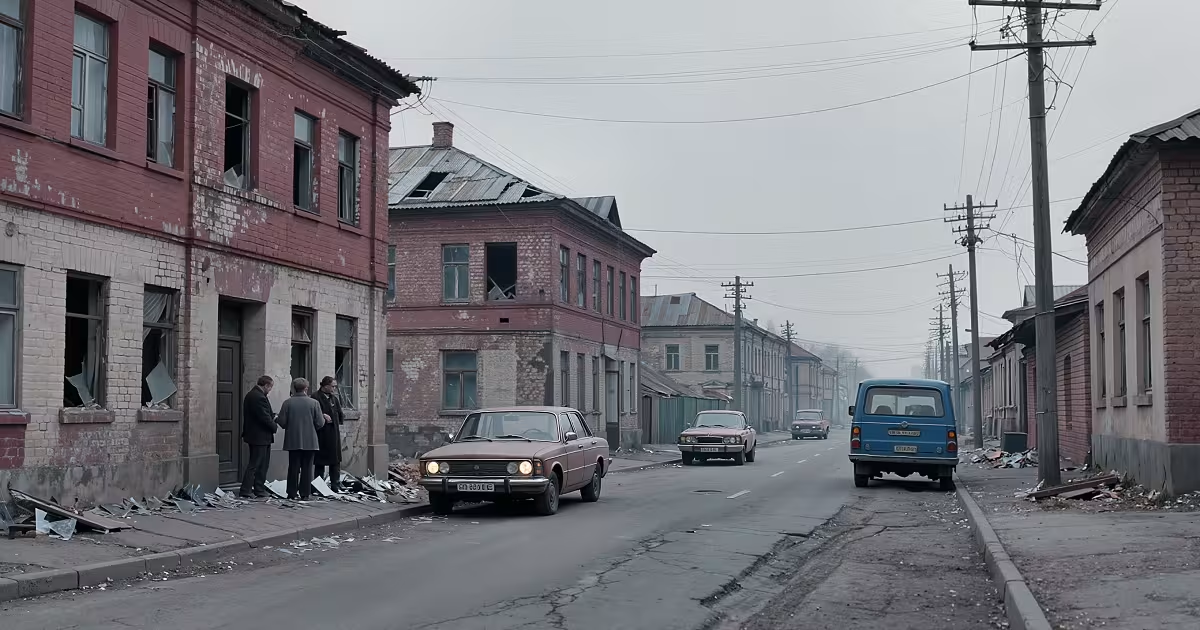
A street of damaged brick buildings with broken windows.
Illustration, not a period photograph.

Opening
At about 1:30 a.m. on 12 April 1991, a powerful explosion went off in the water meadows of the Tsna river, roughly 800 metres from the edge of Sasovo, a railway town in Russia's Ryazan region. It blew out windows and frames across much of the town and damaged roofs on houses, hospitals and schools. A few people had minor cuts. Nobody was seriously hurt.
It left a crater about 28 metres across and 3 to 3.5 metres deep, with a mound in the middle. About 31.8 tonnes of fertiliser had been stored on the spot in paper sacks, but officials doubted it could have caused a blast that size. In 1992 a second, smaller crater appeared about 8 km away. Neither explosion has an agreed cause.
Timeline
11-12 April 1991, nightWitnesses later describe glowing balls and a pillar of light over the site, an approaching rumble, then two blows a few seconds apart and a bright white flash. Researcher A. Yu. Olkhovatov later gives the time as 22:31 GMT on 11 April, which is 1:31 a.m. local time.
12 April 1991, morningTASS reports the blast. Sasovo district council chairman A. F. Rozhkov describes a crater 28 metres across and 3.5 metres deep about 1.5 km from town. A military helicopter visits and leaves. The army duty general says no aircraft were flying within 50 km at the time.
13 April 1991Komsomolskaya Pravda lists three working theories from the military: stored saltpetre, wartime munitions or a meteorite.
April 1991A military team with a bomb detector finds no metal within 100 metres of the centre or to 5 metres deep in the crater. Radiation is normal. Soil samples analysed at the USSR Academy of Sciences Institute of Chemical Physics show no radioactive or harmful substances. Oily spots on nearby roofs turn out to be nitrogen fertiliser.
27 April 1991The district emergency commission reports in the local paper, Prizyv, that 20,000 square metres of glass have arrived and repairs are 45 per cent done. It dismisses rumours that officials are moving their families away as provocative and baseless.
Night of 28 June 1992Residents of Frolovskoye hear a strong bang. On 8 July a fresh crater about 11.5 metres across and 4 metres deep is found in a maize field of the Novy Put state farm, with soil thrown up to 300 metres.
November 1992Senior investigator A. V. Shirokov of the Ryazan regional prosecutor's office reports that forensic tests on the second crater found no explosive residue and no casing fragments.
1993-1995Papers in the Russian Academy of Sciences journal Doklady (V. P. Rudakov, 1993) and Fizika Zemli (Olkhovatov, 1995) treat the explosions as natural geophysical events.
August 2005Geologists Vladimir and Nikolai Larin visit with Vladimir Syvorotkin and measure free hydrogen in the soil near both craters. The first crater has become a pond.
Key figures
Colonel Valentin Prodan, head of civil defence for the Ryazan region, argued at the crater that saltpetre alone could not produce a blast equal to about 25 tonnes of TNT without a large detonator, and that there were no combustion products. He said only 10 to 12 tonnes of the stored fertiliser could be accounted for.
Captain Alexander Matveev, an army sapper, said the shock wave seemed to spread in a cross shape, mainly southwest to northeast, while power poles 100 metres from the crater stood undamaged.
A. V. Shirokov, the prosecutor's investigator, concluded that both events were explosions but of different kinds: the first probably the saltpetre, the second not man-made.
E. V. Barkovsky of the Institute of Physics of the Earth was among the first to propose a shallow earthquake. Olkhovatov and Rudakov developed the geophysical reading.
Vladimir Larin, a geologist, proposed that a jet of hydrogen from deep in the earth formed the craters.
Physical and documentary trail
The record is unusually good for a Soviet-era event. It includes the TASS report, Komsomolskaya Pravda's coverage and a long on-site report by its correspondents, the emergency commission's statement in Prizyv, the prosecutor's findings and two peer-reviewed papers. The crater measurements vary a little: Olkhovatov gives about 31 by 28 metres and 3 metres deep, with a central mound 12 metres across and 1.9 metres high.
There is no agreed official conclusion. Sources even differ on what fertiliser was stored at the site: press reports say ammonium nitrate (saltpetre), Olkhovatov says urea. No bomb casing, meteorite material or aircraft debris was ever found.
Things you might not know
- Someone tried to warn the Defence Minister. On the morning after, a frightened man in a gas mask came to Sasovo's post office trying to telegraph Marshal Yazov that an enemy nuclear bomber had attacked.
- A fuel depot was close by. Storage tanks for petroleum products stood about 700 metres from the crater.
- The damage was patchy. A five-storey building facing the crater from 1 km lost no windows, while a factory 4 km away lost thick ground-floor glass.
- A seismic station may have noticed. The station at Mikhnevo, about 270 km west, recorded weak oscillations at the right time, but Olkhovatov said the link could not be proved.
- Local boys stocked the crater with fish. It flooded, and by one press account boys tried to breed fish in it, after samples had already been taken.
Competing explanations
The stored fertiliser. Tonnes of it sat on the spot, and sack fragments were scattered around. Shirokov thought it the likely cause of the first blast. Prodan and the sappers doubted that undetonated fertiliser could produce such a powerful, odd-shaped blast with no burn marks, and this explanation does not cover the second crater, where too little was found.
A natural geophysical event. Barkovsky, Rudakov and Olkhovatov proposed a shallow tectonic release, pointing to the light effects, ground-borne shocks and patchy damage, and to ground deformation reported in the area over earlier years.
Gas from below. The Larins' hydrogen-degassing idea would explain craters without explosive residue and the measured hydrogen. It rests on measurements made 14 years later, which could not be taken inside the flooded first crater.
A bomb, missile or meteorite. The military denied any flights, the bomb detector found no metal, and no meteorite material was found. One local resident argued for a crashed missile from an aircraft. Others suggested an ice meteorite, which would leave no trace.
A UFO. Based on the glowing lights some witnesses described, this was popular locally but has no physical support.
Later life of the case
Sasovo became a fixture of Russian anomaly literature and is sometimes compared, on a small scale, to Tunguska. A. F. Chernyaev's brochure argued for an "ether-gravitational bolide" bursting out of the earth. The second explosion in 1992 kept the case open and drew in the prosecutor's office and academic geophysicists.
Finding
Two real explosions left two real craters near Sasovo, and the first did serious damage to the town. The stored fertiliser is the obvious ordinary suspect for 1991, but the officials on site doubted it, and it cannot explain 1992. A natural release of gas or energy from the ground fits both events better than anything else proposed, but no one has proved it.
What still will not resolve: what detonated in the Tsna meadows. No investigation produced a final finding.
Evidence signature
5/9 Solid
- Witnesses
- several people
- Instruments
- photo, film or physical traces
- Paper
- official records at the time
How well documented the case is, not whether it's true. A strong record can still have an ordinary answer, and a thin one can still be real.
You decide · SASOVO
What do you think happened?
One vote per case, anonymous. You'll see how other readers voted once you've voted.