HOPE DIAMOND
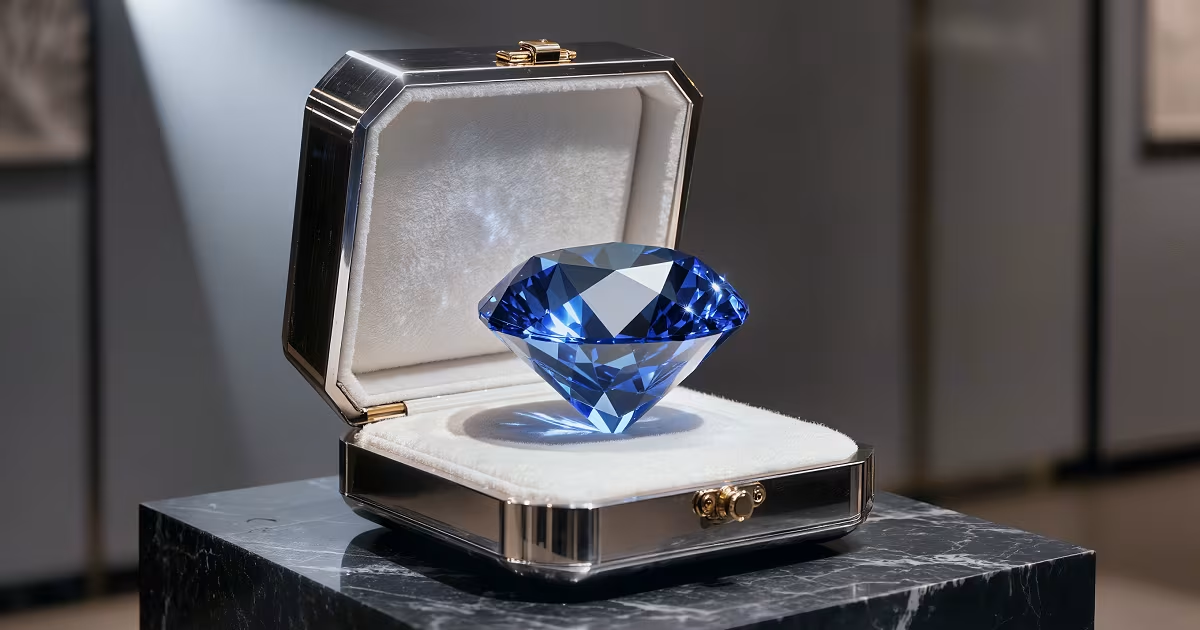
The Hope Diamond in an open display case.
Illustration, not a period photograph.

Opening
On 10 November 1958, a letter carrier named James Todd walked into the Smithsonian's Museum of Natural History in Washington and handed over a small package wrapped in brown paper. Inside was the Hope Diamond, a 45.52-carat deep blue stone, sent by New York jeweller Harry Winston by registered mail.
It came with one of the most famous curses in the world: stolen from the eye of a Hindu idol, it was said to have ruined or killed nearly everyone who owned it. The diamond's real history is well documented. The curse's history is shorter, and points to people who wanted to sell it.
Timeline
1668French gem merchant Jean-Baptiste Tavernier sells King Louis XIV a blue diamond of about 115 carats that he bought in India. The story that he stole it from an idol and was torn apart by wild dogs has no contemporary support. He died in Moscow in 1689, aged about 84.
1673Louis XIV has the stone, by then called the Tavernier Blue, cut into a 67-carat gem, the "French Blue".
September 1792During the Revolution, the French crown jewels are stolen. Louis XVI and Marie Antoinette are executed the following year. Later curse stories tie their deaths to the stone, though neither ever owned it in the sense the legend implies: it belonged to the crown.
1812A large blue diamond, now known to have been cut from the French Blue, appears in London in the hands of a diamond merchant, twenty years after the theft.
By 1839It belongs to the banker Henry Philip Hope, whose name it keeps.
1901Lord Francis Hope, deep in debt, is allowed to sell it. His wife, American actress May Yohé, later leaves him and spends years promoting the idea that the stone brought them bad luck. She dies poor in 1938.
1909 to 1911The diamond passes through dealers in London, New York and Paris, and is reported, probably falsely, to have belonged to an Ottoman sultan. Pierre Cartier buys it and in 1911 sells it to Washington heiress Evalyn Walsh McLean, after newspapers have begun printing lurid curse stories. The Smithsonian suggests Cartier may have embellished the legend to make the sale.
1912 to 1947McLean, married to Edward "Ned" McLean, heir to the Washington Post and Cincinnati Enquirer fortune, wears it constantly. Her nine-year-old son is killed by a car in 1919. Her husband leaves her, the family loses the Washington Post, and he dies in a psychiatric hospital in 1941. Her daughter dies of an overdose in 1946. McLean dies in 1947.
1949Harry Winston buys McLean's jewels, including the Hope.
10 November 1958Winston gives it to the Smithsonian.
Key figures
Jean-Baptiste Tavernier brought the original stone out of India. Pierre Cartier sold it to McLean and is suspected of polishing the curse story. Evalyn Walsh McLean was its most famous owner, and the one whose losses made the legend. Harry Winston, its last private owner, gave it away.
Physical and documentary trail
What survives: royal inventories, the 1812 London record, the Hope family sale, the Cartier and Winston transactions, and the Smithsonian's accession records, including the postal wrapper. Researchers have confirmed by computer modelling and analysis that the Hope was cut from the French Blue.
Still missing: any record of a curse before about 1900.
More than anyone, Evalyn Walsh McLean became the poster child for the Hope Diamond's legendary curse.
Things you might not know
- It cost $2.44 to post. Winston paid $145.29 in total to send it, nearly all of it insurance for $1 million. The wrapper is now at the National Postal Museum.
- It glows red. Under ultraviolet light the Hope gives off a red-orange glow that lasts for about a minute after the light is switched off.
- The dog wore it. McLean was said to fasten it to the collar of her Great Dane and to hide it at parties for guests to find.
- McLean thought bad luck was good luck. She believed objects other people thought unlucky brought her good fortune, which is why a curse helped the sale.
- Tavernier had a long life. The man said to have been torn apart by dogs for stealing it lived into his eighties.
Competing explanations
A sales story. The curse appears in newspapers only in the 1900s, when the stone was on the market, and dealers had every reason to make it more interesting. Earlier owners, including Henry Philip Hope, are left out of the legend because nothing bad happened to them.
A real curse. The tragedies in the McLean family were real and terrible, and believers see a pattern. The record shows ordinary causes for each one: a road accident, alcoholism, a drug overdose.
Later life of the case
The Hope is one of the most visited objects in the Smithsonian. It has left the museum only a handful of times, including trips to the Louvre in 1962 and to Johannesburg in 1965.
Finding
The diamond's history is unusually well documented and the curse is not: there is no sign of it until a century ago, when the stone needed a buyer. McLean's losses were real, and they made the legend, but nothing connects them to the stone.
What still will not resolve: who first told the idol story, and whether Cartier invented it or only made the most of it.
Evidence signature
4/9 Solid
- Witnesses
- several people
- Instruments
- nothing on record
- Paper
- official records at the time
How well documented the case is, not whether it's true. A strong record can still have an ordinary answer, and a thin one can still be real.
You decide · HOPE DIAMOND
What do you think happened?
One vote per case, anonymous. You'll see how other readers voted once you've voted.