SAILING STONES
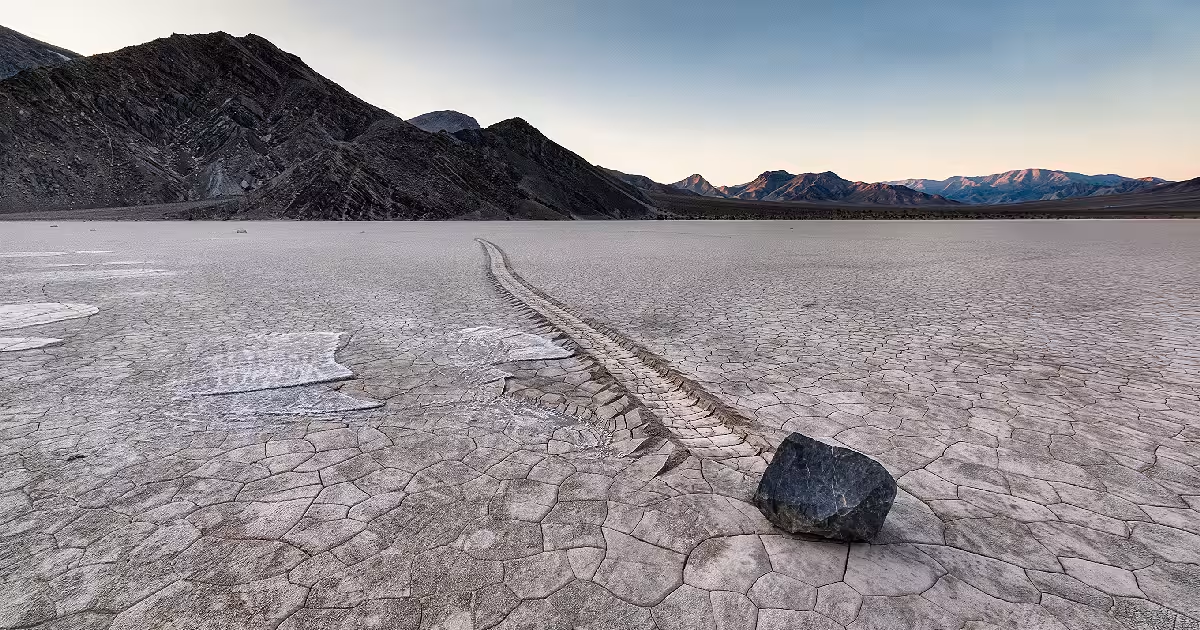
A smooth rock with a long track behind it on a dry cracked lake bed.
Illustration, not a photograph.

Opening
Racetrack Playa is a dry lake bed in Death Valley National Park, California, so flat that it looks like a vast cracked table. Scattered across it are rocks, typically 15 to 46 centimetres across, each at the head of a long track in the clay behind it. Some tracks run straight. Some curve, some loop, and some run for as much as a hundred metres. Nobody had ever seen a stone move, and the stones were nowhere near anything that could have pushed them.
They are called the sailing stones, or sliding rocks. For about seventy years they were one of the best-known puzzles in American science. The explanation came in December 2013, when two researchers who had left GPS units in the rocks and cameras on the hillside caught them moving. It turned out to involve ice a few millimetres thick, a light breeze and a sunny morning.
Timeline
1915The prospector Joseph Crook visits the playa. His is the first documented account.
1948Jim McAllister and Allen Agnew publish the first report in a Geological Society of America bulletin. They propose that wind-driven scrapers made the furrows.
1952The park ranger Louis G. Kirk records detailed observations of the tracks.
1955George M. Stanley argues that ice sheets either catch the wind or drive the stones.
May 1968 onwardRobert Sharp and Dwight Carey begin a monitoring programme with about thirty labelled stones. Over seven years most of the stones move, and the largest moves about 36 kilograms. One stone, called Karen, of about 320 kilograms, does not move.
1995John Reid's team from Hampshire College and the University of Massachusetts Amherst finds congruent trails and concludes that wind alone, or wind combined with ice floes up to 800 metres wide, could move the stones.
1996Researchers find that winds over smooth playa surfaces can be intensified, with boundary layers as low as about five centimetres.
2011Ralph Lorenz and colleagues propose ice rafts that reduce friction with the bed, so light winds can move stones.
2013Another group links movement to fluctuating water levels and the thermal conductivity of the rocks. Park officials investigate the theft of several rocks.
20 December 2013More than sixty rocks move.
2014Richard Norris, James Norris, Ralph Lorenz and colleagues publish the first GPS and time-lapse observations in PLoS ONE.
August 2016About ten miles of tyre tracks are made on the playa by an illegal driver. Volunteers remove them in 2018.
Key figures
Robert Sharp and Dwight Carey, geologists, ran the long monitoring programme from 1968. Their rebar-corral test found that the stone they tested was not slowed or deflected by rebar, which argued against ice collars being important.
Ralph Lorenz, a planetary scientist, proposed the ice-raft idea in 2011 and was part of the team that caught the movement in 2014. Richard and James Norris, cousins, led the field work.
John Reid led the 1995 study that argued for wind and ice floes.
The Death Valley park rangers, who investigated the thefts of 2013 and the damage of 2016, are part of the story too.
Physical and documentary trail
The record: the tracks themselves, the stones, the field observations from 1915 onward and the 2014 GPS and time-lapse data. Most of the rocks lie in the southern part of the playa. They are of three types: syenite, mostly on the west side; blue-grey dolomite with white bands; and black dolomite, the most common, with nearly all the stones in the north half. They are typically 15 to 46 centimetres across, and the tracks are 8 to 30 centimetres wide and usually much less than 2.5 centimetres deep. Rough-bottomed stones tend to leave straight tracks, and smooth-bottomed ones tend to wander.
The 2014 observations are the decisive evidence. Thin ice sheets, a few millimetres thick, float on the winter pond. They break up on sunny mornings and are pushed by light winds, which shove the rocks. The observed speeds reached about five metres a minute, about 0.2 miles an hour, and some moves lasted up to sixteen minutes. Some stones moved more than five times during the 2013 and 2014 pond. This contradicted earlier views that strong winds or thick ice were the main cause, and an earlier camera study had suggested that movement happens about once every three years and lasts about ten seconds, which the 2014 results make look out of date.
Things you might not know
- The ice is thin. A few millimetres, floating on a shallow winter pond.
- More than sixty rocks moved in one day. It happened on 20 December 2013.
- The biggest tracked stone is a mystery of its own. The 320-kilogram stone called Karen did not move in the seven years of monitoring and was rediscovered in 1996.
- The speed is slow. About 0.2 miles an hour at the fastest.
- People steal them. Several rocks were stolen in 2013.
- Drivers have damaged it. About ten miles of tyre tracks were made in 2016.
- Movement may be declining. Lorenz and Jackson suggested a link with climate change, with odds of four to one. That is a statistical inference, not a proven cause.
Competing explanations
Ice sheets pushed by light winds. The strongest reading, and the most widely accepted. It was observed directly in 2014 and fits the speeds, the tracks and the timing.
Wind alone, or ice rafts. Earlier explanations that gave wind or large ice floes the main role are still discussed, and were not entirely discarded.
Water level and rock temperature. The 2013 suggestion that fluctuating water and the thermal conductivity of rocks matter is still in the literature, and may play a part.
Later life of the case
The sailing stones are one of the few mysteries of this kind that has been solved by patient observation, and they are an example of how a puzzle can persist for decades because nobody was watching at the right time. Like the Marfa Lights, the case also shows how a legend can sit alongside an ordinary explanation.
Finding
The sailing stones move because thin ice, wind and sunshine push them, as the 2014 observations showed. The mystery was never the stones but the lack of a witness. It is one of the cleaner cases in which an old puzzle has been solved in the field.
What still will not resolve: how often the conditions line up, since the stones have been moving less in recent years and the reason is still being debated.
Evidence signature
9/9 Strong
- Witnesses
- trained, independent witnesses
- Instruments
- more than one sensor agrees
- Paper
- formal investigation, court or declassified file
How well documented the case is, not whether it's true. A strong record can still have an ordinary answer, and a thin one can still be real.
You decide · SAILING STONES
What do you think happened?
One vote per case, anonymous. You'll see how other readers voted once you've voted.