SS WARATAH
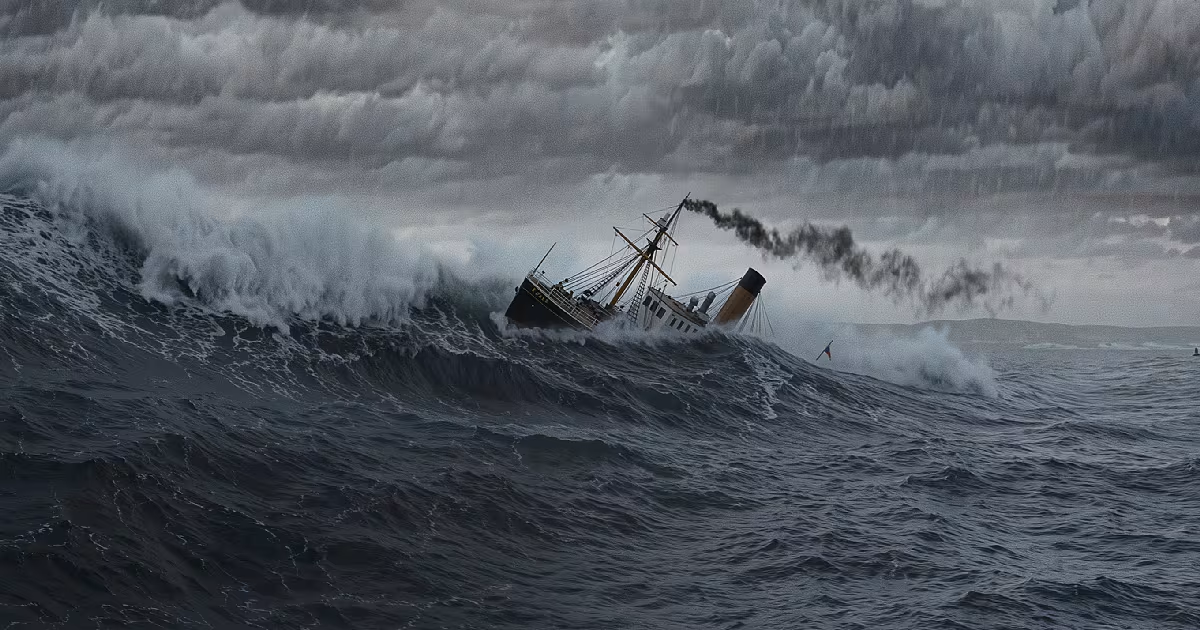
A steamship heeling over in huge grey waves under a storm sky.
Illustration, not a photograph.

Opening
SS Waratah was a Blue Anchor Line passenger, cargo and mail steamship, built in 1908 by Barclay Curle in Glasgow. On 27 and 28 July 1909, on only her second voyage, she vanished between Durban and Cape Town in South Africa. There were 92 passengers and 119 crew aboard. She was last seen by the freighter Clan MacIntyre off the Transkei coast on the morning of 27 July, and a severe storm followed. No confirmed wreckage and no remains have been found.
It remains one of the great unsolved losses of the sea, and a question of ship design as much as of mystery. The Board of Trade could find no cause beyond a storm of exceptional violence. Passengers on her first voyage had reported that she listed heavily and recovered slowly, and one man left the ship at Durban because he thought she was top-heavy. Searchers have looked for her for more than a century and have not found her.
Timeline
1908Waratah is built at Glasgow and enters service.
Her first voyageHer captain, Josiah Edward Ilbery, reports that she does not have the stability of the line's earlier ship Geelong. Passengers describe heavy listing, slow recovery and bow-diving. Some former crew reportedly refuse to sign on for the second voyage.
26 July 1909She leaves Durban for Cape Town. Claude Sawyer, a passenger, has left the ship at Durban.
27 July 1909The freighter Clan MacIntyre passes her in the morning, and she goes out of view off the Transkei coast. A severe storm follows. In the evening the Harlow reports distant flashes, which were first taken for brush fires and later linked to Waratah. Another ship, the Guelph, sees a ship at night and reads only the partial signal letters T A H.
15 December 1909Lloyd's posts her as missing.
1909 and 1910The search involves tugs, the Royal Navy cruisers Pandora, Forte and Hermes, the chartered Sabine, which spends about eight weeks in the Indian Ocean, and the Wakefield, which lands crews on the Kerguelen Islands.
1910 to 1911The Board of Trade inquiry sits and attributes the loss to a storm of exceptional violence. It finds no criminal or civil fault but criticises Blue Anchor's business practices.
1983 to 1997Emlyn Brown leads a series of expeditions to find the wreck.
1999 to 2001A sonar target is reported about ten kilometres offshore. A dive in 2001 identifies it as the Nailsea Meadow, a ship sunk in the Second World War.
2004 and 2009Brown gives up in 2004 and in 2009 suggests she capsized and drifted before sinking.
Key figures
Josiah Ilbery, the captain, reported that the ship did not have the stability of the Geelong.
Claude Sawyer, the passenger who left at Durban, said in 1909 that he thought the ship was top-heavy. A 1910 article gave a different account involving a recurring vision, which accounts of the wreck treat with scepticism.
Edward Joe Conquer, a signalman, gave an account of a capsizing ship about twenty years later, which changed between versions and has no documentary support.
Emlyn Brown spent more than twenty years searching.
Physical and documentary trail
The record: the inquiry report, the shipping records, the ship's design and the accounts of passengers and crew on the first voyage. The design was largely based on Geelong, with changes that added weight. The hybrid layout could hold about 500 extra third-class passengers in the cargo holds, and it raised questions about stability. Builders and owners' witnesses defended the design, and the stability calculations in the sources contradict each other.
The cargo is described differently in different sources: about 1,500 tons of lead concentrates, and 395 tons of lead bullion in another place, and more than 300 tons of bullion in a third. Bullion means refined metal, not necessarily gold. Wreckage reports, including wreckage at Mossel Bay in 1910, a life buoy in New Zealand in 1912, a pilot's sighting of a submerged wreck in 1925 and cork and timber found in 1939, were never confirmed. Bodies reported in 1909 turned out to be whale carcasses and skate.
Things you might not know
- It was her second voyage. She was less than a year in service.
- Some crew refused to sail. Former members reportedly refused to sign on after the first voyage.
- The search found the wrong ship. The 1999 sonar target was the Nailsea Meadow, a wartime loss.
- A curse is a myth. Several other ships called Waratah were lost, but so were many ships with other common names.
- It changed shipping law. Her loss fuelled calls for wireless equipment on passenger ships, which the 1914 SOLAS convention later required.
- The classification mark was not praise. The "+" in her classification was a special-survey mark, not a grade of excellence.
- A 2025 paper points to Algoa Bay. It suggests a rogue wave there as a possible cause.
Competing explanations
A rogue wave and instability. The strongest reading. A big wave in a storm, off a coast known for them, striking a ship that had already shown signs of poor stability, could have capsized her quickly, without time for a signal.
A cargo shift. A liquefying ore concentrate can destabilise a ship, and it was not treated as hazardous at the time. This is a plausible mechanism but unproven.
Other ideas. A whirlpool is described as fanciful, piracy as unsupported, and a coal-dust explosion as unlikely, partly because the bunkers were full.
Later life of the case
The Waratah is a stock case in the literature of ships that vanished, alongside the Baychimo and the Joyita. The 2009 suggestion that she capsized and drifted shows how little the searchers still know. No wreck has been confirmed.
Finding
The Waratah was lost with all hands in a severe storm, and there is good reason to think she was a poor sea-boat. The inquiry found no fault beyond the storm. The best explanation is a capsize in heavy seas, but nothing but the ship herself can say how.
What still will not resolve: where she lies. The searchers' main target in 1999 was another ship, and the 2025 Algoa Bay idea is a hypothesis, not a find.
Evidence signature
5/9 Solid
- Witnesses
- several people
- Instruments
- photo, film or physical traces
- Paper
- official records at the time
How well documented the case is, not whether it's true. A strong record can still have an ordinary answer, and a thin one can still be real.
You decide · SS WARATAH
What do you think happened?
One vote per case, anonymous. You'll see how other readers voted once you've voted.