BUNNY MAN
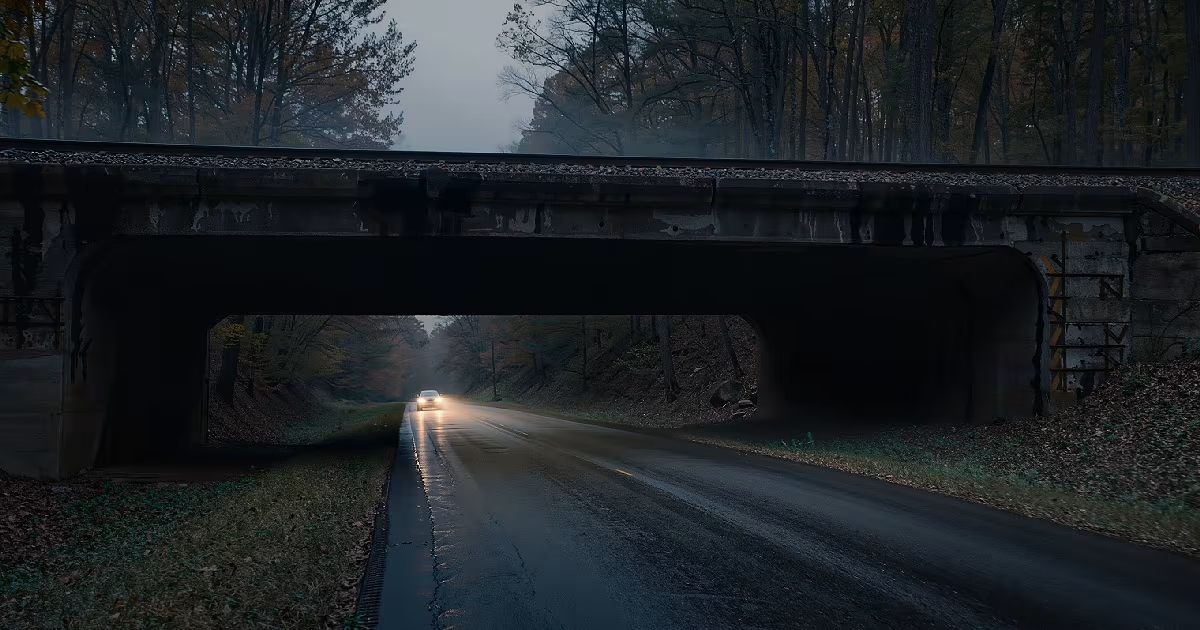
A narrow concrete railway underpass at night, mist on the road.
Illustration, not a photograph.

Opening
On the night of 19 October 1970, near Burke in Fairfax County, Virginia, a US Air Force Academy cadet named Robert Bennett was parked with his fiancée on Guinea Road when a man ran out of the dark and threw a hatchet through the car window. It landed on the floor. The man shouted at them for trespassing and ran off. Bennett told police he was wearing a white suit with long rabbit ears.
Twelve days later, on Halloween night, a security guard on a building site nearby found a man in a rabbit costume chopping at a porch post with an axe. He was never caught. From those two police reports grew one of America's best-known urban legends, and a railway bridge near Clifton where crowds gather every Halloween.
Timeline
19 October 1970The hatchet attack on Bennett's car on Guinea Road. Bennett describes rabbit ears; his fiancée remembers a white hood with a point rather than ears.
31 October 1970The Washington Post runs "The 'Rabbit' Reappears". That night, security guard Paul Phillips confronts a man in a rabbit suit on the porch of an unfinished house in Kings Park West, also on Guinea Road. The man hits a porch post with a long-handled axe and threatens him. Phillips goes to his car for his gun, and the man vanishes into the woods.
November 1970More than 50 people contact police with sightings. Someone claiming to be the "axe man" phones a construction worker and arranges to meet him. Police stake out the spot. No one comes.
1973A University of Maryland folklore student, Patricia Johnson, collects 54 different versions of the story.
1999A version posted online gives the legend its modern form: asylum inmates escaping from a prison bus in 1904, a trail of skinned rabbits, bodies hanging from the Colchester Overpass. It spreads fast.
2003 onwardFairfax County police control access to the bridge around Halloween. On Halloween 2011, a 14-hour checkpoint turns away more than 200 people.
Key figures
Robert Bennett and his fiancée, the first witnesses, and Paul Phillips, the guard who saw the axe, are the only people with a documented first-hand account. W. L. Johnson of the Fairfax County Police Criminal Investigation Bureau took the second case.
Brian A. Conley, historian and archivist at Fairfax County Public Library, is the person who went back to the police files and newspapers and separated the 1970 events from the legend.
Physical and documentary trail
The record: two Fairfax County police reports from October 1970, a series of Washington Post articles that autumn including "The 'Rabbit' Reappears" (31 October) and "Bunny Reports Are Multiplying" (6 November), and the hatchet itself, which police examined, found no leads on, and gave back to Bennett. The investigation was eventually closed without an arrest.
What the record does not contain is any trace of the 1904 escape, the asylum, the hanging bodies or any death at all. Conley looked for them and found no record of the escape, the asylum or the convict named in the online story.
Things you might not know
- The witnesses didn't agree on the ears. Bennett said bunny ears. His fiancée said a pointed white hood.
- It started with property rights. According to the reports, the man yelled that they were on private property, and the guard's encounter was at a house being built.
- Nobody was hurt. In either incident.
- The bridge was there first. The Colchester Overpass, now called Bunny Man Bridge, was built around 1906 and has nothing to do with the 1970 events, which happened a few miles away.
- The detail came later. Conley has said that all the specifics in the popular 1999 version are false.
Competing explanations
A real man in a costume. The police record supports this: someone dressed as a rabbit, angry about building on land he thought was private, threatened people twice in two weeks and was never identified.
Two different people, or a copycat. The two witnesses describe different costumes, and the second incident fell on Halloween, when rabbit suits are easy to explain.
A supernatural Bunny Man. The legend's version, with a ghost at the bridge. It rests entirely on stories told after 1970, and the core of it, the 1904 escape, has no record behind it at all.
Later life of the case
The Bunny Man is now a fixture of Northern Virginia Halloween and of the internet's haunted-places lists. For a similar back-road legend from the same era across the Potomac in Maryland, see Goatman.
Finding
Something real happened in Fairfax County in October 1970: a man in a rabbit costume threw a hatchet through a car window and swung an axe at a porch, and police never found him. Everything else, the escaped inmates, the bodies and the ghost at the bridge, was added later and has no record behind it.
What still will not resolve: who was inside the rabbit suit, since the case was closed without a name.
Evidence signature
5/9 Solid
- Witnesses
- several people
- Instruments
- photo, film or physical traces
- Paper
- official records at the time
How well documented the case is, not whether it's true. A strong record can still have an ordinary answer, and a thin one can still be real.
You decide · BUNNY MAN
What do you think happened?
One vote per case, anonymous. You'll see how other readers voted once you've voted.