GOATMAN
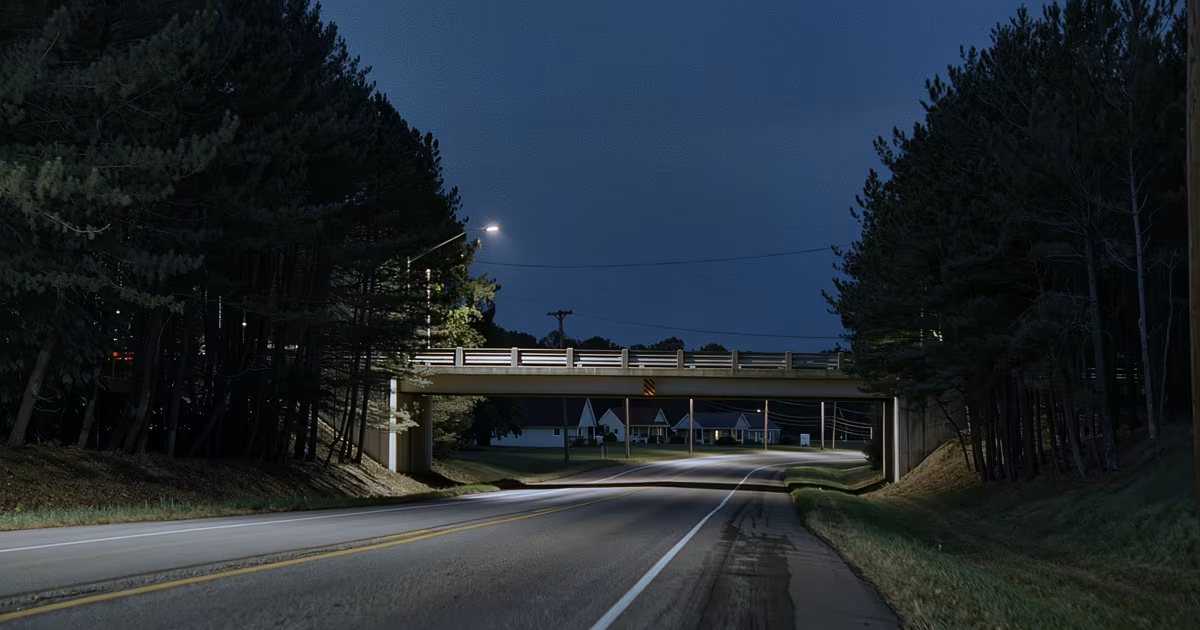
A country road leading under a bridge through the woods at dusk.
Illustration, not a period photograph.

Opening
The Goatman of Prince George's County, Maryland, is a half-man, half-goat creature said to haunt the woods and back roads around Bowie and Upper Marlboro, above all Fletchertown Road. The best-known origin story makes him a researcher at the nearby Beltsville agricultural research station whose experiments on goats went wrong. In November 1971 the legend reached the newspapers after a teenager's puppy was found decapitated near the railway tracks in Old Bowie.
Folklorist David Puglia has traced how that happened. A University of Maryland student's folklore project collected the story on Tucker Road in Clinton in May 1971. A local reporter found it in the university archive that October and moved it to Fletchertown Road, half an hour north. Within a week, teenagers in Bowie had a dead dog to blame on it.
Timeline
18 May 1971George Lizama, 21, hands in his project on "The Goatman of Tucker Road" for an introductory folklore course. He collects eight Goatman legends, mostly about an old hermit with a goat's face who guards a bridge.
27 October 1971Karen Hosler of the Prince George's County News publishes "University Archives Reveal: Boaman, Goatman, and Ghosts Still Haunt Area", placing the Goatman on Fletchertown Road in Bowie with the Beltsville origin.
3 November 1971April Edwards, 16, and her friends John Hayden and Willie Gheen hear noises in the woods behind her house. Next morning her ten-month-old puppy, Ginger, is missing. The boys find the dog's head near the Penn Central tracks.
November 1971Hosler's follow-up runs as "Residents Fear Goatman Lives: Dog Found Decapitated in Old Bowie".
30 November 1971Ivan G. Goldman's Washington Post story, "A Legendary Figure Haunts Remote Pr. George's Woods", brings the legend to a regional audience.
1972Student Clay Schofield finds many Bowie teenagers who have heard of the Goatman but hardly any who can tell the story.
1994 and 2007Writer Mark Opsasnick publishes interviews about the 1971 events.
1998Raymond Hayden, John's older brother, tells the Washington City Paper the dog was hit by a train.
2013Puglia publishes "Getting Maryland's Goat" in the journal Contemporary Legend.
Key figures
George Lizama, whose student project is the earliest dated record of the legend.
Josiah Proctor, a Clinton resident who told Lizama of a real hermit with a long white beard.
Karen Hosler, the county reporter who relocated the story to Bowie.
April Edwards, John Hayden and Willie Gheen, the teenagers at the centre of the dog incident.
Captain Lawrence Wheeler, Bowie district commander of the county police.
David Puglia and Barry Pearson, folklorists who have studied the legend.
Physical and documentary trail
The record is Lizama's project in the Maryland Folklore Archives, the 1971 newspaper stories, later student collections and interviews. The dog's death is the only physical event. Hosler's October story, drawn from the archive, introduced the version that stuck:
The woods around Fletchertown Road have other strange inhabitants, folklore records indicate. One is a Goatman, half-man, half-goat who supposedly once was a researcher at the Beltsville Agricultural Farm.
The police view was more down to earth. Wheeler told the Post he had "heard there really was an old man who used to live in a shack in the woods" and that children would visit and the man would sometimes come out and scare them. No Beltsville scientist or incident has ever been tied to the story.
Corrections to the earlier version of this report. The earlier version said teenage legends about the creature circulated in the 1950s and 1960s. I found no dated evidence for that; the earliest record is Lizama's project of May 1971. It also said a family's dog was found dead in a general way. The dog was April Edwards's puppy, and in 1998 Raymond Hayden said it had been hit by a train, so blaming the Goatman was the teenagers' own addition.
Things you might not know
- It started as homework. The oldest dated Goatman text is an undergraduate folklore project submitted on 18 May 1971.
- A move of 23 miles made it. Hosler shifted the story from Tucker Road in Clinton to Fletchertown Road in Bowie, where it has stayed.
- The state folklorist missed it. George Carey's books on Maryland legends, published in 1970 and 1971 while he worked at the University of Maryland, never mention the Goatman.
- Coatman, maybe. A local minister recalled trappers in thick hide coats whom children called "Coatman", one suggested root of the name.
- He also had a bridge. One version put the Goatman on Governor's Bridge, the "Crybaby Bridge" near Upper Marlboro.
- The name travels. Unrelated goat-man legends include the Pope Lick Monster in Kentucky, the Lake Worth Monster in Texas and Goatman's Bridge, Old Alton Bridge, near Denton.
Competing explanations
A creature in the woods. Witnesses in 1971 described noises and something hairy on two feet. Nobody has produced physical evidence of an animal or hybrid.
A real hermit behind the story. Proctor's account and Wheeler's comment both point to an old man living in the woods who scared children who came looking. This would explain the hermit core of Lizama's versions.
A legend that met a bad week. Folklorists read 1971 as a newspaper story, a dead dog and teenagers acting out the legend, what folklorists call ostension. Raymond Hayden's 1998 account of the train fits that reading.
Later life of the case
The Goatman became a Maryland Halloween fixture and a regular on cryptid lists, with legend trips to Fletchertown Road and Crybaby Bridge. Student collections after 1971 show it merging with older stories such as "The Boyfriend's Death". The same name now covers separate legends across the country, which are often blended together.
Finding
Folklore. The earliest record is a 1971 student project, a reporter moved it to Bowie that October, and the decapitated dog that made it famous was most likely hit by a train. No creature has ever been documented.
What still will not resolve: the hermit. Proctor and Captain Wheeler both described a real old man in the woods, but nobody recorded his name, and whether he was the Goatman's original is unknown.
Evidence signature
4/9 Solid
- Witnesses
- several people
- Instruments
- nothing on record
- Paper
- official records at the time
How well documented the case is, not whether it's true. A strong record can still have an ordinary answer, and a thin one can still be real.
You decide · GOATMAN
What do you think happened?
One vote per case, anonymous. You'll see how other readers voted once you've voted.