FOUKE MONSTER
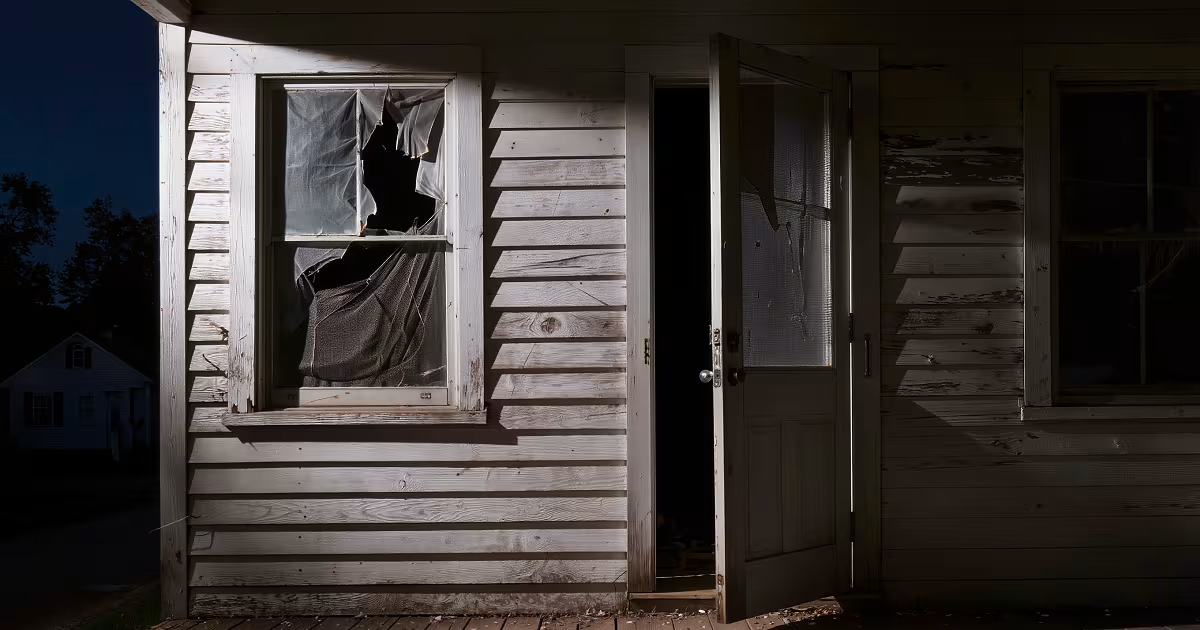
A broken window and an open door on a clapboard house at night.
Illustration, not a period photograph.

Opening
Shortly before midnight on Saturday 1 May 1971, something came at the Ford family's rented house on US 71, about ten miles south of Texarkana and just outside Fouke, Arkansas. They had lived there five days. Elizabeth Ford, asleep in the front room, saw what she took for a bear's paw at the window screen, with red eyes behind it. Bobby Ford, 25, his brother Don and Charles Taylor fired seven shots at a shape about seven feet tall.
Bobby said a hairy arm came over his shoulder on the porch and that he went through the front door without opening it. He was treated at St. Michael Hospital in Texarkana for scratches and mild shock. Morning brought three-toed tracks, claw scratches on the porch and no blood. Jim Powell's Texarkana Gazette stories named the Fouke Monster, and Charles B. Pierce's film The Legend of Boggy Creek followed in 1972.
Timeline
Late April 1971The Fords move into the house on US 71. The wives hear something outside on the Wednesday and Friday nights before the attack.
1 May 1971, shortly before midnightElizabeth Ford sees the paw and the eyes. Bobby, Don and Charles Taylor go out with a light and guns and fire seven times. Bobby is grabbed on the porch and breaks back into the house through the door.
2 May 1971, 12:35 a.mConstable Ernest Walraven is called to the house and stays until about 5 a.m. Daylight shows three-toed tracks, three-claw scratches on the porch, tin ripped from the bottom of the house and a damaged window. No blood is found.
3 May 1971Powell's first story, "Hairy 'monster' hunted in Fouke sector", runs in the Gazette. The follow-up the next day carries the first published use of "Fouke Monster". AP and UPI pick it up. Powell and KTFS news director Dave Hall find the family packing a U-Haul.
22 May 1971, about midnightD.C. Woods Jr., Wilma Woods and Mrs. R. H. Sedgass report an ape-like figure crossing US 71 two miles south of Fouke. The Texarkana Daily News prints it on 24 May.
13 June 1971Three-toed tracks, 13.5 inches long and 4.5 inches wide, with a 57-inch stride, are found in a soybean field on Willie E. Smith's land. Game warden Carl Galyon and Sheriff Leslie Greer will not say the tracks are authentic.
17 June 1971Southern State College archaeologist Frank Schambach tells the press there is a "99 percent chance" the tracks are a hoax, noting that primates have five toes.
17 August 1972The Legend of Boggy Creek premieres in Texarkana.
1986An AP retrospective quotes Mayor Virgil Roberts and former sheriff Greer as considering the soybean-field tracks man-made.
24 June 2001The Texarkana Gazette reprints Powell's original stories in a 30th-anniversary retrospective.
Key figures
Bobby Ford gave the core account: the arm over his shoulder, the run through the door, the hospital visit. Elizabeth Ford was the first to see the creature, and her description of red eyes "like coals of fire" is the one later tellings repeat.
Don Ford and Charles Taylor were the other two shooters that night. Their account matches Bobby's on the shots and the size of the figure.
Constable Ernest Walraven took the report and spent the rest of the night at the house. He told reporters there had been earlier "hairy monster" reports from the Jonesville area.
Jim Powell wrote the first stories and coined the name at his typewriter. Carl Galyon, the state game warden, and Sheriff Leslie Greer examined the June tracks and declined to call them genuine.
Charles B. Pierce, a Texarkana advertising man, made The Legend of Boggy Creek with local people in the cast.
Physical and documentary trail
The best documentation is the contemporary local press: Powell's Gazette stories of 3 and 4 May 1971, the Daily News report of the highway sighting, and the June coverage of the soybean-field tracks and Schambach's comments. The Gazette's 2001 retrospective reprints the original text, which is how the details above can be checked today.
The physical traces were tracks, claw marks, torn tin and a damaged window, all recorded by the constable and the press. No hair, blood or photograph from the night of 1 May has surfaced. Smith made a mold from the June tracks and sold casts from it. The original mold was later destroyed in a fire.
I was moving so fast I didn't stop to open the door. I just ran through it.
Things you might not know
- The name was a headline choice. Powell's first story said only "hairy monster". "Fouke Monster" first appeared in his follow-up a day later.
- A radio station put a price on it. Little Rock's KAAY offered a $1,090 reward for the creature.
- The excitement cost some people money. Three hoaxers were each fined $59 during the 1971 flap.
- Toes counted against it. Schambach's main objection to the soybean-field casts was that primates have five toes, not three.
- The film made a fortune. The Legend of Boggy Creek cost about $160,000 and grossed more than $20 million.
- The landowner played himself. Willie E. Smith, whose field produced the famous tracks, appears in Pierce's film as Willie E. Smith.
Competing explanations
An unknown upright animal. The Fords, Taylor and the Woods party all describe a tall, hairy, upright figure, and the shooting and the hospital visit are documented the same week. The difficulty is that three-toed tracks fit no known primate, and no body, blood or hair was recovered despite seven shots.
A known animal seen badly at night. Elizabeth Ford's own first thought was a bear, and one early Gazette headline floated a mountain lion. A bear on its hind legs could explain size and claws, though not the arm over Bobby's shoulder as he described it.
A prank or a man in costume. The 1971 fines show that people were hoaxing during the excitement, and Schambach, Roberts and Greer all considered the June tracks man-made. None of that evidence reaches the night of 1 May itself, which came before any publicity.
Later life of the case
Boggy Creek turned a local scare into a regional industry. The film's success brought sequels. Later Arkansas sightings were often filed under the same name, which blurs the 1971 record. The original sequence of events is still best read in Powell's dated stories rather than in the film, which dramatised them.
Finding
What holds: on 1 May 1971 three men fired at something outside the Ford house, Bobby Ford was treated for scratches and shock, and a constable logged tracks and damage before any reporter arrived. The later soybean-field casts are a separate matter, and the people who examined them at the time judged them man-made or would not vouch for them. The strongest reading is a frightening real encounter with an animal nobody identified, wrapped in a later run of hoaxes and a hit film.
What still will not resolve: what the Fords shot at that night. No hair, blood or photograph survives from the porch.
Evidence signature
4/9 Solid
- Witnesses
- several people
- Instruments
- photo, film or physical traces
- Paper
- press and later accounts
How well documented the case is, not whether it's true. A strong record can still have an ordinary answer, and a thin one can still be real.
You decide · FOUKE MONSTER
What do you think happened?
One vote per case, anonymous. You'll see how other readers voted once you've voted.