MONTAUK MONSTER
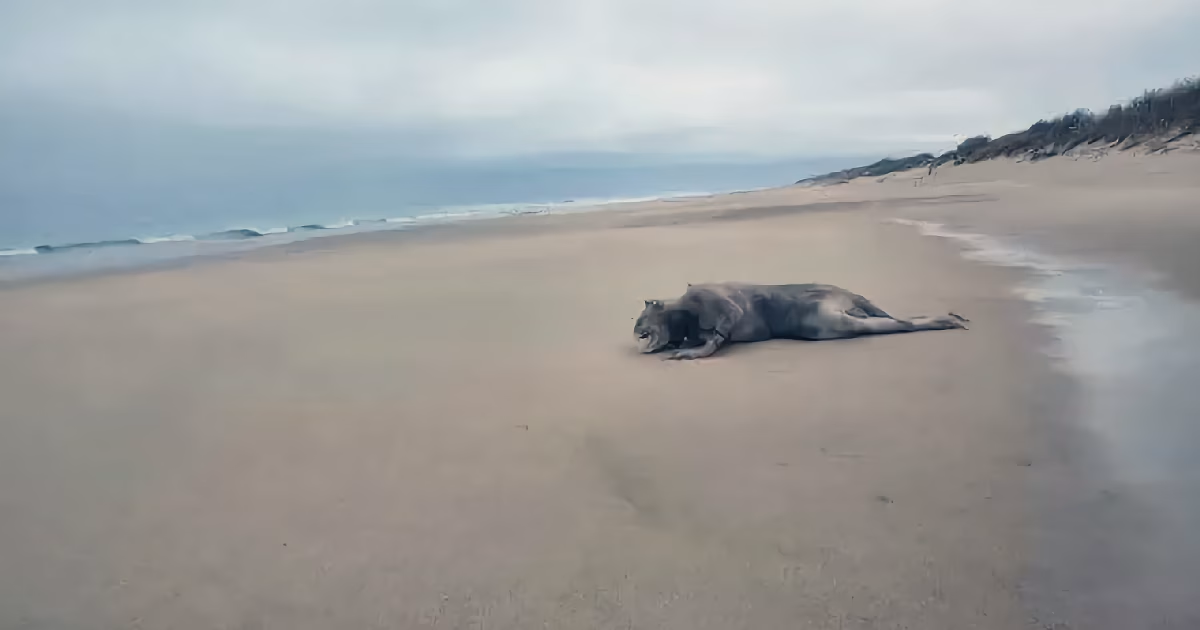
A grey carcass lying on an empty beach under a cloudy sky.
Illustration, not a photograph.

Opening
On 12 July 2008, a young woman from Montauk, at the eastern tip of Long Island, said she and three friends had found something strange washed up at Ditch Plains, a popular surfing beach. It was hairless, swollen and pale grey, with a beak-like snout, long fingers on its paws and a ring of sharp teeth. One of them took a photograph. Within three weeks that single picture had been seen by millions of people online, and the creature had a name: the Montauk Monster.
Just across the water from Montauk sits Plum Island, home since the 1950s to a secretive government laboratory that studied animal diseases. To many people the conclusion was obvious. To most of the scientists who looked at the photograph, the answer was obvious too, and much less exciting. What nobody could do was check, because the body itself had gone.
Timeline
12 July 2008Jenna Hewitt, 26, and three friends say they find the carcass at Ditch Plains beach in East Hampton, Long Island, and photograph it.
23 July 2008The local paper, The Independent, runs the story under the headline "The Hound of Bonacville".
29 July 2008The photograph reaches the website Gawker, passed on through a chain of people working in online media, and runs as "Dead Monster Washes Ashore in Montauk". It spreads around the world within days.
Late July and August 2008Experts and amateurs offer identifications: a turtle without its shell, a dog, a coyote, a large rodent, a hoax, or an escaped experiment from Plum Island. Larry Penny, East Hampton's natural resources director, concludes it is a raccoon. Hewitt says a man took the body and put it in the woods behind his house, but will not say who or where.
LaterThe palaeozoologist Darren Naish studies the photograph closely and also concludes it is a raccoon, its strange look caused by decay and long immersion in water.
4 August 2011The Montauk Monster appears on the television series Ancient Aliens.
Key figures
Jenna Hewitt and her friends found and photographed the creature, and became briefly famous for it, giving interviews to local television.
Larry Penny, East Hampton's natural resources director, was the first official to put a name to it. Darren Naish, a palaeozoologist and science writer, gave the most detailed analysis.
William Wise, director of Stony Brook University's Living Marine Resources Institute, first judged the photo a fake, with a diseased dog or coyote as his next guess.
Gawker and the bloggers who passed the picture along turned a local oddity into one of the internet's first viral monsters.
Physical and documentary trail
The trail: the photograph; the local newspaper report; the online coverage; and the analyses by Penny, Wise, Naish and others.
What is missing is the animal. No scientist examined the body, no samples were taken, and the man said to have removed it was never named. An anonymous local told reporters that the creature was only about the size of a cat, and had rotted down to a skeleton by the time the story broke. Everything anyone knows comes from the pictures.
The raccoon reading explains the strangest features. Penny noted that the upper jaw appeared to be missing, which would leave the beak-like look. Raccoons have long, finger-like toes on their front paws. And Naish put the hairless, swollen body down to decomposition and time in the water, where fur slips off and flesh bloats.
Things you might not know
- It might have been the size of a cat. Photographs make it look large, but a local who claimed to have seen it said it was small.
- Plum Island was real and secretive. The Plum Island Animal Disease Center studied dangerous livestock diseases such as foot-and-mouth disease, which is why it attracted so many rumours.
- Some experts first thought it was fake. The Stony Brook marine scientist William Wise said the photo looked doctored before offering a diseased dog or coyote as his best guess.
- A TV naturalist agreed it was a raccoon. Jeff Corwin also identified it as a raccoon on Fox News.
- Beaches have their own monster tradition. Similar unrecognisable carcasses wash up regularly, and some Indigenous groups have a name for them, meaning "the Ugly One", treated as a bad omen.
- It went viral the old way. In 2008 the picture spread mainly through blogs, gossip sites and email, years before most monster stories started on social media.
Competing explanations
A decomposed raccoon. The conclusion of East Hampton's natural resources director and of Darren Naish's detailed analysis. Every odd feature matches a raccoon after death and time in the water. This is the strongest reading by a long way.
A dog, coyote or other animal. Suggested early on and fitting the general size and shape, though the paws and skull match a raccoon better.
A creature from Plum Island. The popular favourite: a mutant or experimental animal escaped or dumped from the government laboratory. There is no evidence for it, and nothing in the photographs needs it.
A hoax. Some suspected a model or an edited photo, perhaps as viral marketing. No one has shown that it was faked.
Later life of the case
The Montauk Monster became a template for a new kind of mystery, the viral beach carcass, in which one photograph travels the world long before anyone can examine the body. Similar "monsters" have turned up on other shores since, and most have turned out to be ordinary animals in an extraordinary state of decay. Plum Island's laboratory, meanwhile, has been replaced by a new federal facility in Kansas, and the island's future has been the subject of a long fight over conservation.
Finding
A strange carcass was found and photographed on a Montauk beach in July 2008, and the photographs became an internet sensation. Every feature visible in them matches a raccoon that had been dead in the water for some time, and that is what the local naturalist and the most detailed analysis concluded. The government laboratory nearby was real, but nothing ties it to the animal.
What still will not resolve: what happened to the body, and who took it, since one look at the actual skull would have settled the matter in minutes.
Evidence signature
4/9 Solid
- Witnesses
- several people
- Instruments
- photo, film or physical traces
- Paper
- press and later accounts
How well documented the case is, not whether it's true. A strong record can still have an ordinary answer, and a thin one can still be real.
You decide · MONTAUK MONSTER
What do you think happened?
One vote per case, anonymous. You'll see how other readers voted once you've voted.