BEAR LAKE MONSTER
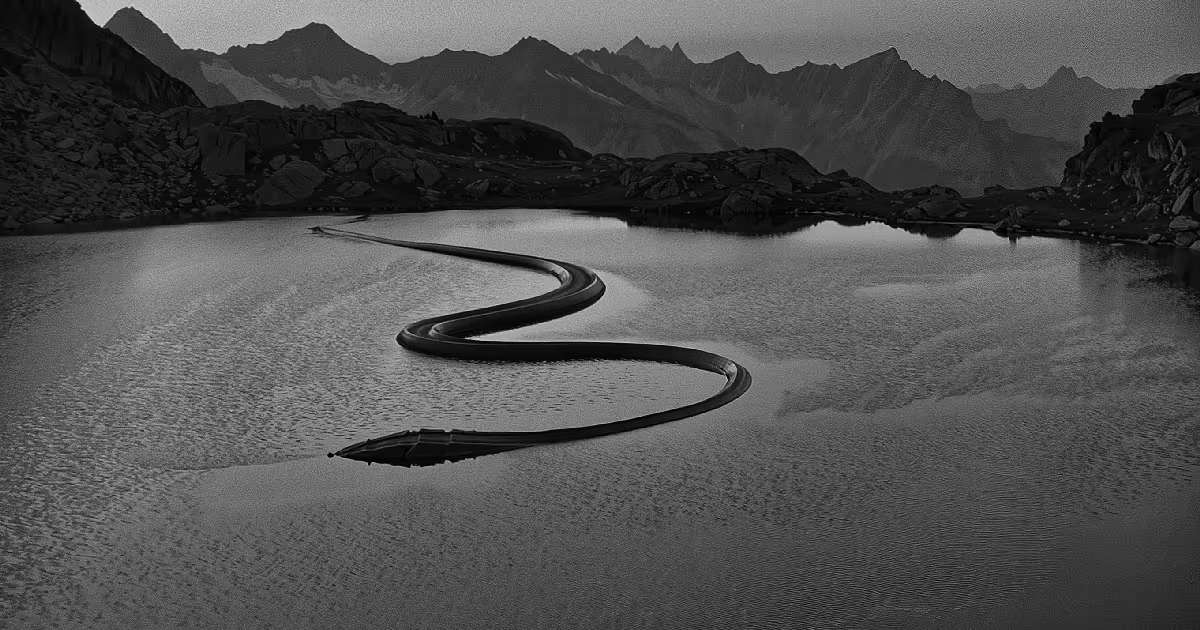
Bear Lake Monster historic marker, Garden City UT, 2024.
Illustration, not a period photograph.
Opening
In July 1868, Joseph C. Rich, a Latter-day Saint settler and son of Apostle Charles C. Rich, the man who had founded the Bear Lake Valley settlements five years earlier, wrote a letter to the Deseret News in Salt Lake City reporting that local white settlers had seen a "water devil" living in Bear Lake, a creature the Shoshone people had reportedly spoken of long before. Sightings multiplied over the following three years: swimmers pursued, sheep and a horse allegedly devoured, a lakeside camp destroyed, gun sales rising in the surrounding valley from sheer panic. In 1894, twenty-six years after his original letter, Rich admitted the whole thing had been what he himself called "a first-class lie," intended to draw settlers and visitors to a remote, struggling frontier community. People kept reporting the monster anyway, on and off, for more than a century after he said so.
Timeline
1868, prior to Rich's article. Shoshone oral tradition, predating any white settlement of the area, already describes a large serpent-like creature inhabiting the lake, giving the later hoax a genuine pre-existing folkloric foundation to build on rather than inventing the concept from nothing.
July 1868. Rich's letter appears in the Deseret News, describing the "water devil" tradition and stating that a number of white settlers now claimed to have seen the creature themselves, sparking what he later described as considerable local excitement.
1868-1871. Reported sightings multiply and escalate in specificity: local resident Thomas Sleight reports a huge animal swimming at extraordinary speed; Aquilla Nebeker reports the creature devouring his flock of sheep along with several rolls of barbed wire; campers report a huge alligator-like creature emerging from the water and destroying their camp; a local fisherman claims to have caught "a junior member of the notorious Bear Lake monster family" near Fish Haven in the summer of 1871. Descriptions vary wildly across these accounts, ranging from six to ninety feet in length, with a head described alternately as horse-like or snake-like, and a body reported as brown, green, shiny, scaly, or hairy depending on the witness.
Same period. Gun sales in the surrounding valley reportedly increase noticeably between 1868 and 1870, a genuine, if informally documented, economic indicator of how seriously at least some residents took the perceived threat.
Same period. LDS Church president Brigham Young reportedly sends a rope to Paris, Idaho, specifically to aid local efforts to capture the creature, with some hope that a captured specimen could later be profitably exhibited, a detail that places the hoax's momentum at the highest level of contemporary regional civic and religious authority rather than confining it to informal local rumor.
1907. The Logan Republican publishes a dramatic later account describing the creature attacking a horse directly, grabbing it with "two front paws" and tearing at it "like a bullterrier would a mouse" before making "an awful howl" and vanishing, a report arriving well after the sighting wave's initial peak and using considerably more violent, embellished language than the original 1868-71 reports.
1894. Rich, twenty-six years after his original article and roughly seventeen years after his last known writing on the subject, finally admits the entire story was fabricated, later described in his own words as "a world-class lie" or "a first-class lie" depending on the retelling, created specifically to draw settlement and tourist interest to what had been, in 1868, a remote and economically struggling valley.
Despite the confession. Sightings continue intermittently across the following decades regardless, including further reported encounters in 1937 and 1946.
2002. The most recent widely reported sighting occurs, attributed to a local business owner, more than a century after Rich's original fabrication and over a hundred years after his own public confession.
1996. Elementary school children at Garden City's annual Raspberry Days festival formally vote to name the creature Isabella, folding the monster fully into the region's civic and tourism identity.
Present day. Bear Lake markets the monster actively and cheerfully: a boat shaped like the creature has offered scenic lake cruises with folklore storytelling, the annual Raspberry Days parade has featured a float of local children labeled "The Real Bear Lake Monsters," and a Bear Lake Monster Winterfest runs annually. In 2024, the Utah State University Folklore Program and the William G. Pomeroy Foundation install a formal historic marker at the lake specifically documenting the legend's origin with Rich's 1868 article.
Key figures
Rich is the legend's sole confirmed author, a man whose specific personal position, the son of the valley's founding religious authority, gave his original account an unusual degree of built-in local credibility that an anonymous or less prominent source's claim would not have carried.
Sleight, Nebeker, and the various other named 1868-71 witnesses represent the hoax's real, if unconfirmed, secondary spread: whether these individuals were knowingly participating in Rich's fabrication, independently misperceiving ordinary lake phenomena under the influence of a story already circulating, or themselves contributing further invented detail, has never been separately established for any of them.
Brigham Young's own reported involvement, sending capture equipment to the site, is a genuinely notable detail, since it places at least nominal engagement with the story at the highest level of contemporary Utah Territory civic and religious leadership, whether from genuine belief, political prudence in the face of local excitement, or some mixture of both.
The local business owner behind the 2002 sighting, and the various later 20th-century witnesses, represent the case's most interesting ongoing puzzle: people continuing to report an experience specifically associated with a story its own original author confirmed, in writing, was invented, more than a century earlier.
Physical and documentary trail
On the paper, this file has Rich's own original 1868 Deseret News article, his later, specific, dated 1894 confession, contemporary secondary newspaper accounts including the 1907 Logan Republican report, and a genuine, if informally sourced, economic indicator (rising local gun sales) reflecting real contemporary anxiety regardless of the story's origin.
What it lacks is any confirmed authorship or documentation behind the numerous later sightings, 1907, 1937, 1946, 2002, none of which have ever been traced to a confirmed source or motive the way the original 1868-71 wave has been definitively traced to Rich himself.
Now it seems this water devil, as the Indians called it, has again made an appearance. A number of our white settlers declare they have seen it with their own eyes.
Competing explanations
A confirmed, deliberate hoax by Rich, confessed in his own words decades after the fact, intended to promote settlement and tourism in a struggling frontier valley. This is the only reading actually confirmed by primary-source admission from the story's originator, and it is not seriously disputed by any researcher who has examined Rich's own documented biography and later statement.
A pre-existing genuine Shoshone folkloric tradition, opportunistically borrowed and dramatically amplified by Rich rather than invented wholesale. This reading does not contradict Rich's confession so much as refine it: he appears to have taken a real, older piece of Indigenous oral tradition and used it as raw material for a considerably more elaborate and specifically motivated fabrication.
Ongoing genuine misidentification of real lake phenomena (large fish, waterfowl, floating debris, wave patterns) by later witnesses operating with no knowledge of or connection to Rich's original hoax, sustained purely by the story's independent cultural persistence rather than any coordinated later fabrication. This reading accounts reasonably well for why sightings continued sporadically for over a century after the confession, treating each later report as its own separate, ordinary misperception rather than a continuation of any single conspiracy.
Continued deliberate storytelling and tourism-motivated exaggeration by later residents and business interests, following directly in Rich's own original playbook once the area's economic dependence on the monster's tourist appeal became clear. This reading treats the legend's remarkable multi-generational persistence as less mysterious than it first appears: Bear Lake's own modern civic embrace of "Isabella" as a named, marketed mascot shows the same basic economic incentive that motivated Rich in 1868 remaining fully active today.
Later life of the case
Bear Lake Monster has followed the same broad arc as the Hodag, a confessed hoax fully absorbed into a small community's celebrated civic identity, but with a genuinely distinctive added wrinkle: unlike the Hodag, which produced no further "sightings" once Shepard confessed, Bear Lake kept generating fresh reports for well over a century after Rich's own admission, giving this case a persistence pattern few other confirmed hoaxes in the archive can match.
Finding
Joseph Rich confessed, in his own words and on the record, to inventing the Bear Lake Monster to promote settlement in a struggling frontier valley, drawing on a genuine pre-existing Shoshone tradition as his raw material. That confession is not in dispute. What remains genuinely interesting, rather than mysterious, is the sightings' own remarkable persistence for well over a hundred years afterward, a pattern this file reads as ordinary cultural momentum and continued tourism incentive rather than as any evidence the creature itself might be real.
What still will not resolve: the specific motive or explanation behind each individual later sighting, from 1907 through 2002, none of which has been traced to a confirmed source the way the original 1868-71 wave has been definitively traced to Rich. Given the confirmed hoax at the story's root, though, this stays a gap in documentation rather than a live cryptozoological question.