THE BLOOP
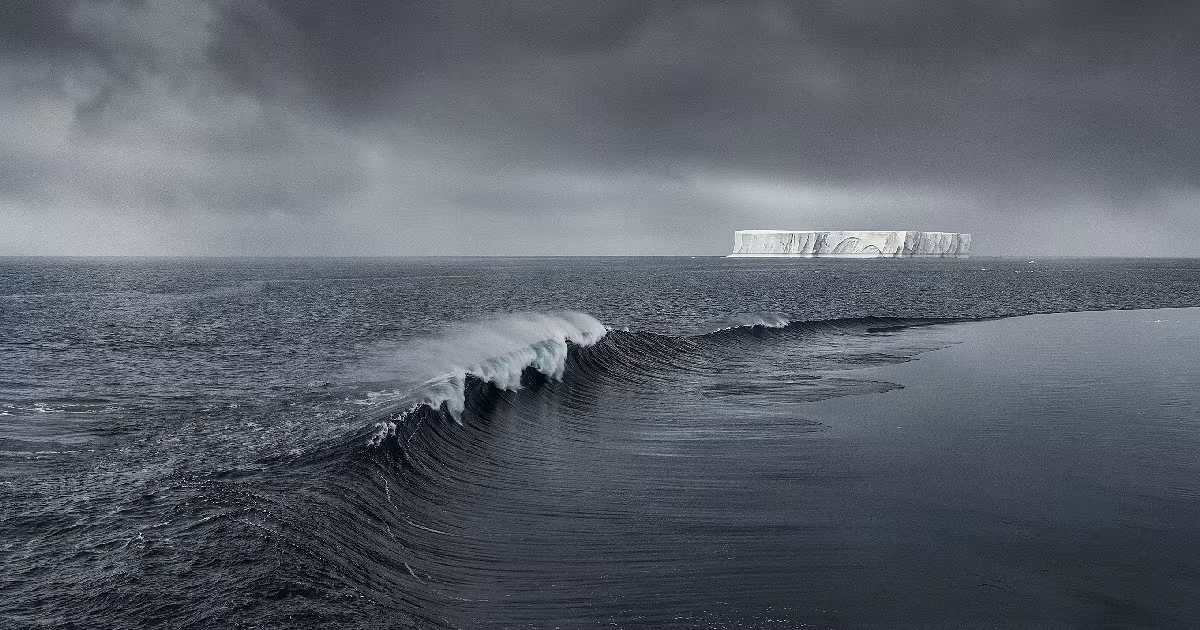
A swell breaking on a dark grey ocean, a flat iceberg on the horizon.
Illustration, not a photograph.

Opening
In the summer of 1997, underwater microphones belonging to the United States government picked up a sound in the remote South Pacific, far west of the southern tip of South America. It lasted about a minute, rose in pitch, and was so loud that it was recorded by sensors thousands of miles apart. Scientists at the National Oceanic and Atmospheric Administration, who had been listening for undersea volcanoes, could not identify it. They called it the Bloop.
When the recording went online, it took on a life of its own. Played back sixteen times faster so human ears could hear it, the Bloop sounded eerily like something alive, and too loud for anything known to be alive. It was linked to giant squid, unknown monsters, and the sunken city of Cthulhu from the horror stories of H. P. Lovecraft, which happened to sit in the same empty stretch of ocean. Years later NOAA tracked down the answer, and it was not a monster. It was ice.
Timeline
1990sNOAA's Pacific Marine Environmental Laboratory runs an array of hydrophones, underwater microphones, across the equatorial Pacific, alongside the U.S. Navy's SOSUS network, which was built to track Soviet submarines.
Summer 1997Several hydrophones record a powerful, ultra-low-frequency sound that rises over about a minute. NOAA roughly places its source near 50 degrees south and 100 degrees west, a remote patch of the South Pacific. The sensors that heard it are reported to have been up to around 3,000 miles apart.
2001 and 2002NOAA's Christopher Fox tells CNN he thinks it was probably ice calving in Antarctica. In New Scientist, he is reported as saying it did not sound man-made and resembled a living creature, but was far louder than any animal known.
2005NOAA begins acoustic surveys of the Antarctic off South America, recording the sounds made by ice.
Early 2008NOAA researchers track the sounds of a giant iceberg, A53a, as it breaks up near South Georgia Island.
2011 to 2012NOAA concludes that the Bloop matches the sound of an icequake: ice cracking and breaking away from an Antarctic glacier or ice shelf, or icebergs grinding along the seabed.
27 May 2012Animal Planet airs Mermaids: The Body Found, a fictional documentary that uses the Bloop as supposed evidence of real mermaids.
27 June 2012NOAA publishes a statement that "no evidence of aquatic humanoids has ever been found".
Key figures
Christopher Fox was chief scientist of the acoustic monitoring project at NOAA's Pacific Marine Environmental Laboratory. He has said the team "considered every possibility, including animal origin", while leaning towards ice from early on.
Robert Dziak, also at the laboratory, became the public voice of the icequake explanation.
The internet did the rest. The Bloop became a fixture of creepy-sound lists and forums, and an unofficial mascot for the idea that the deep ocean hides something huge.
Physical and documentary trail
What survives: the original hydrophone recordings, which NOAA published online in sped-up form, the laboratory's own notes on the sound and its likely source, later recordings of Antarctic icequakes for comparison, and published research on the sounds made by ice. This is an unusually solid record for a mystery: the evidence is a recording, and anyone can listen to it.
What the record does not include is an exact source. Because the Bloop was heard from so far away, its origin was only roughly located. NOAA puts the most likely ice somewhere between the Bransfield Strait and the Ross Sea, or near Cape Adare in Antarctica, a long way south of where the early triangulation pointed. No one saw the ice that made it.
Sounds of ice breaking up and cracking is a dominant source of natural sound in the southern ocean.
Things you might not know
- It was not the only named sound. NOAA's hydrophones also caught "Julia", "Slow Down", "Train", "Whistle" and "Upsweep". Most have been traced to icebergs scraping the seabed or to undersea volcanoes.
- Slow Down was recorded that year too. On 19 May 1997 the same network recorded a sound that dropped in pitch over about seven minutes, thought to be a drifting iceberg grinding to a halt on the seabed.
- Cthulhu is more than a thousand miles away. Lovecraft placed R'lyeh at 47°9′S 126°43′W. That is not the same spot, but it is in the same empty ocean, which was enough for the internet.
- The ocean is full of icequakes. Dziak has said there are tens of thousands of icequakes every year, and that their signals are very similar in character to the Bloop.
- The mermaid show fooled people. Mermaids: The Body Found was presented in documentary style, and enough viewers believed it that a U.S. government agency issued a statement on mermaids.
- The hydrophones were Cold War ears. The Navy's SOSUS system was built to listen for Soviet submarines, and was opened to civilian science after the Cold War.
Competing explanations
An icequake. NOAA's conclusion, based on years of recording Antarctic ice and finding sounds that match. It explains the loudness, the low frequency, the rising pitch and the remote location. This is the strongest reading by some distance.
A giant unknown animal. The early favourite online. The sound does have a living quality when sped up, but it was far louder than the calls of the largest whales, and no animal big enough to make it is known or likely to exist.
Something human-made. Military tests or ships were suggested early on. NOAA's scientists did not think it sounded man-made, and nothing points that way.
Later life of the case
The Bloop survives as one of the internet's favourite ocean mysteries, usually told with the monster first and the ice as an afterthought. It has inspired fiction, music, games and endless videos. It also became a small example of how public science works: an agency put strange raw data online, the public filled the gap with monsters, and the scientists kept listening until they could explain it.
Finding
The Bloop was a real sound, recorded by real instruments, and for several years its scientists could not say what made it. The answer they found, after years of recording the southern ocean, is that it matches the sound of Antarctic ice cracking and breaking up, a noise made tens of thousands of times a year. It was never a monster, though it was one of the loudest natural sounds anyone had recorded.
What still will not resolve: exactly which piece of ice made it, and where, since the source was too far from the listening posts to be pinned down.
Evidence signature
5/9 Solid
- Witnesses
- nothing on record
- Instruments
- more than one sensor agrees
- Paper
- official records at the time
How well documented the case is, not whether it's true. A strong record can still have an ordinary answer, and a thin one can still be real.
You decide · THE BLOOP
What do you think happened?
One vote per case, anonymous. You'll see how other readers voted once you've voted.