WAITOREKE
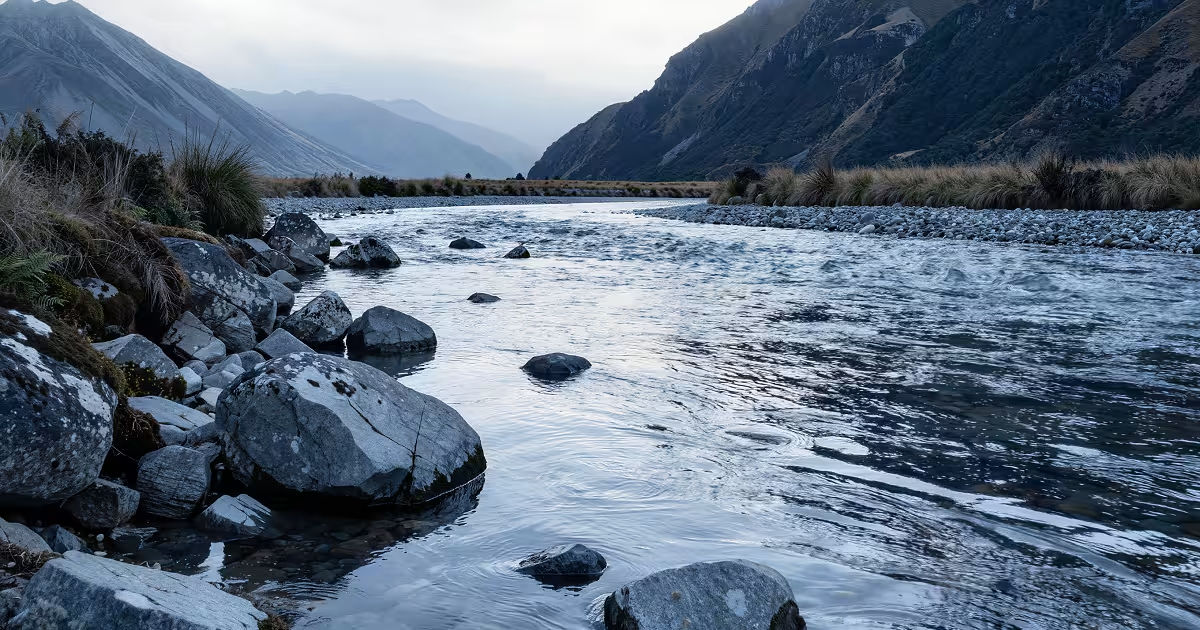
A clear braided river running over stones below mountains.
Illustration, not a period photograph.

Opening
New Zealand has no confirmed native land mammals beyond two species of bat, a genuinely unusual biogeographic fact given the country's long isolation. For more than 250 years, sporadic sightings across the South Island have described a small, otter- or beaver-like creature the Māori are said to have called the waitoreke, cat-sized, brown-furred, short-legged, and consistently seen near water. Captain James Cook himself recorded an encounter with an unusual four-footed animal on a Dusky Sound beach in 1773.
What makes this case genuinely distinctive among cryptids, though, is a specific linguistic problem sitting at its very foundation: when a prominent Māori anthropologist was asked directly about the creature's supposed traditional name, he identified the word itself as grammatically inconsistent with actual Te Reo Māori, raising the real possibility that even the animal's name may be a later invention layered onto genuine, older, and more ambiguous sighting reports.
Timeline
1773Captain James Cook records seeing an unusual four-footed animal on a beach in Dusky Sound, Fiordland, one of the earliest written European accounts cited in connection with the later waitoreke tradition, though Cook's own account does not use that specific name.
1868Naturalist Julius von Haast obtains a pelt reportedly identified as belonging to a waitoreke. The fur is brown with white spots, and the toes show no webbing, physical characteristics that later reviewers note more closely resemble a quoll, a marsupial predator not native to New Zealand, than any genuine otter or beaver-type animal, making this earliest physical specimen inconclusive at best.
1877 and 1879Haast publishes his own findings treating the creature's existence as a serious subject of naturalist inquiry, work later reviewer G. A. Pollock specifically credits as authoritative for its era despite the broader scientific community's general willingness to dismiss the animal as myth.
1926Researcher Wall attempts a review of the accumulated evidence, though Pollock's later assessment specifically criticizes this earlier work for reflecting only a superficial understanding of actual otter ecology and behavior.
1920sE. A. Tapper of Invercargill reports three separate encounters with otter-like creatures in the Waihopai River and Waikiwi Stream, among the more specific and repeated individual witness accounts in the case's documented history.
1954A local paua fisherman reports seeing an animal he believed to be an otter swim beneath his glass-bottomed boat at the same Dusky Sound location Cook had described nearly two centuries earlier.
Undated, per later interviewsBetty Hawk reports seeing a cream-colored, whiskery creature roughly 30 centimeters long poke its head out of the water at Clifden Bridge, near Tuatapere, a description consistent with the broader pattern of southern South Island sighting reports.
1974G. A. Pollock publishes "The South Island Otter: A Reassessment" in the New Zealand Journal of Ecology, taking the accumulated body of evidence, Haast's early findings, Māori oral accounts, and numerous documented amateur naturalist sighting claims, seriously enough to propose the animal may have been introduced to New Zealand by human agency rather than existing as a genuinely native, evolutionarily isolated species, a specific scholarly attempt to reconcile the sightings with New Zealand's otherwise well-established absence of native land mammals.
1980sA dedicated search effort is conducted specifically to locate physical evidence of the waitoreke, part of a period of renewed organized interest in resolving the question, though it does not produce confirmed proof.
Linguistic challenge, timing not precisely dated but predating modern retellings. When directly challenged on the term's authenticity, Māori anthropologist Te Rangi Hīroa (Sir Peter Buck) states that the word "waitoreke" does not appear anywhere in Māori dictionaries and that its construction uses Te Reo Māori grammatical structures incorrectly, a specific, credentialed linguistic objection to the very name most commonly used for the creature.
Following decadesSporadic sighting reports continue accumulating, exclusively from the South Island, with no reports from the North Island despite otherwise similar habitat and waterway availability.
2000s-2011Invercargill natural history teacher and author Neville Esler conducts sustained personal research, speaking directly to eleven individual witnesses over the following decade, ten of whose sighting locations fall within a 25-kilometer radius of Otautau in western Southland. Esler specifically notes the accounts, spanning sightings from 1929 through 2011, are "remarkably similar" to one another, consistently describing a roughly 60-centimeter animal, half of that length tail, with legs and a flattish face, swimming in local waterways.
Esler's own assessment. He states plainly that nothing in New Zealand's known fauna fits the consistent description beyond an otter, while acknowledging the complete absence of any confirmed photograph, bone, or fossil evidence troubles him even as the volume and consistency of individual sighting accounts continues to hold his interest.
2006, planned but apparently unreleasedA documentary titled Waitoreke: On the Track of the New Zealand Otter is announced, intended to trace the creature's story from a proposed origin as much as 80 million years ago through to contemorary claimed evidence, though available records do not confirm the film's actual completion or release.
Key figures
Cook is the case's earliest cited, though not name-specific, European witness, whose 1773 journal entry has been retroactively connected to the later waitoreke tradition by subsequent researchers rather than representing his own explicit claim to have seen that specific named creature.
Haast is the case's key early physical-evidence figure, whose 1868 pelt remains the closest thing to a tangible specimen the case has ever produced, undermined specifically by its own physical characteristics more closely matching an already-known marsupial than any genuine otter-type animal.
Te Rangi Hīroa represents the case's most significant and specifically credentialed challenge to its own foundational terminology, a Māori anthropologist whose direct linguistic assessment that the creature's supposed traditional name is grammatically inconsistent with genuine Te Reo Māori raises real doubt about whether the entire naming tradition, as opposed to the underlying sighting reports themselves, is authentically indigenous at all.
Pollock is the case's most significant academic investigator, whose 1974 peer-reviewed reassessment took the possibility of human introduction seriously as a genuine biogeographic question rather than dismissing the accumulated evidence outright.
Esler is the case's most sustained recent field investigator, whose decade-long personal interview project with eleven individual witnesses represents a genuine, methodical modern data-collection effort, distinguished by his own honest acknowledgment that the total absence of physical evidence genuinely troubles him even as he remains personally engaged by the sightings' consistency.
Physical and documentary trail
The case has a documented 250-year written sighting record beginning with Cook's own journal, a physical pelt specimen from 1868 whose characteristics undermine rather than confirm the traditional identification, a peer-reviewed 1974 academic reassessment, and a decade of methodically collected modern witness testimony from a named regional investigator.
What it lacks is any confirmed photograph, fossil, bone, or DNA sample supporting the creature's existence across the entire documented period, and, distinctively for this case specifically, independent linguistic confirmation that its most commonly used name even reflects genuine Māori tradition rather than a later colonial-era invention.
There is nothing that fits that description apart from an otter.
Things you might not know
- The name was recorded in the 1840s. The missionary Richard Taylor listed "Waitoreke, otter", adding that it was uncertain and perhaps a seal.
- It goes by many names. Kaurehe, Māori otter, South Island otter, waitoreki and waitorete have all been used.
- It is said to be cat-sized. Witnesses describe a small, otter-like animal with brownish fur and short legs.
- New Zealand has almost no native land mammals. The only recognised ones are two species of bat, which is why an otter would be so remarkable.
- Searchers have checked Otago lakes. A 1980s search covered lakes Waihola and Waipori, and the Otautau area has more records than most.
- Quolls may have been released. The brushtail possum was introduced from Australia in 1858, and an attempt to introduce quolls may have happened around the same time, which would fit the spotted 1868 pelt.
Competing explanations
Misidentification of a known introduced species, most plausibly feral mink, stoats, or other mustelids established in New Zealand following European settlement, whose general size, swimming behavior, and riverside habitat would closely match the consistent witness descriptions Esler and earlier researchers collected, without requiring any undiscovered or ancient native species at all.
A genuine, human-introduced but now-established otter-like species, per Pollock's specific 1974 proposal, potentially brought by early Polynesian or later European settlers and surviving in isolated southern waterways for generations without producing confirmed physical remains, a reading that accounts for the consistent physical descriptions without requiring the animal to be a genuinely ancient native New Zealand mammal.
A largely or entirely invented tradition, given the specific, credentialed linguistic objection that the creature's very name may not be authentic Māori terminology at all, a reading that would treat at least the "waitoreke" framing itself, if not necessarily every individual sighting report, as a later colonial-era construction rather than a preserved piece of genuine indigenous oral history.
A genuine, still-undiscovered relict native species, the reading that would carry the most significant biogeographic implications given New Zealand's otherwise well-established total absence of native land mammals, resting entirely on the volume and consistency of accumulated sighting testimony rather than on any confirmed physical evidence.
Later life of the case
The waitoreke is frequently described by New Zealand commentators as the country's "most legitimate cryptid" specifically because, unlike more obviously folkloric or clearly fictional creatures, genuine uncertainty remains about even its most basic categorization, whether native, introduced, misidentified, or partly invented, a genuinely open question sustained by more than two centuries of individually modest but collectively consistent sighting reports.
Finding
More than 250 years of sporadic, geographically concentrated South Island sightings describe a small, consistent, otter-like animal, supported by a peer-reviewed 1974 academic reassessment taking the human-introduction hypothesis seriously and a decade of methodical modern witness interviews finding remarkable consistency across accounts spanning more than eighty years. Undermining any confident conclusion, the case's one claimed physical specimen more closely resembles an already-known marsupial than a genuine otter, and the creature's own traditional name has been directly challenged by a credentialed Māori anthropologist as linguistically inauthentic.
What still will not resolve: any confirmed physical specimen, photograph, or genetic sample across the entire 250-year documented period, and, distinctively, whether the "waitoreke" name and its associated Māori-origin framing accurately reflects genuine indigenous tradition or represents a later invention grafted onto older, more ambiguous sighting reports. Until either is resolved, this report treats the underlying sightings and the specific traditional framing built around them as two separate questions deserving separate scrutiny.
Evidence signature
6/9 Solid
- Witnesses
- several people
- Instruments
- photo, film or physical traces
- Paper
- formal investigation, court or declassified file
How well documented the case is, not whether it's true. A strong record can still have an ordinary answer, and a thin one can still be real.
You decide · WAITOREKE
What do you think happened?
One vote per case, anonymous. You'll see how other readers voted once you've voted.