HODAG
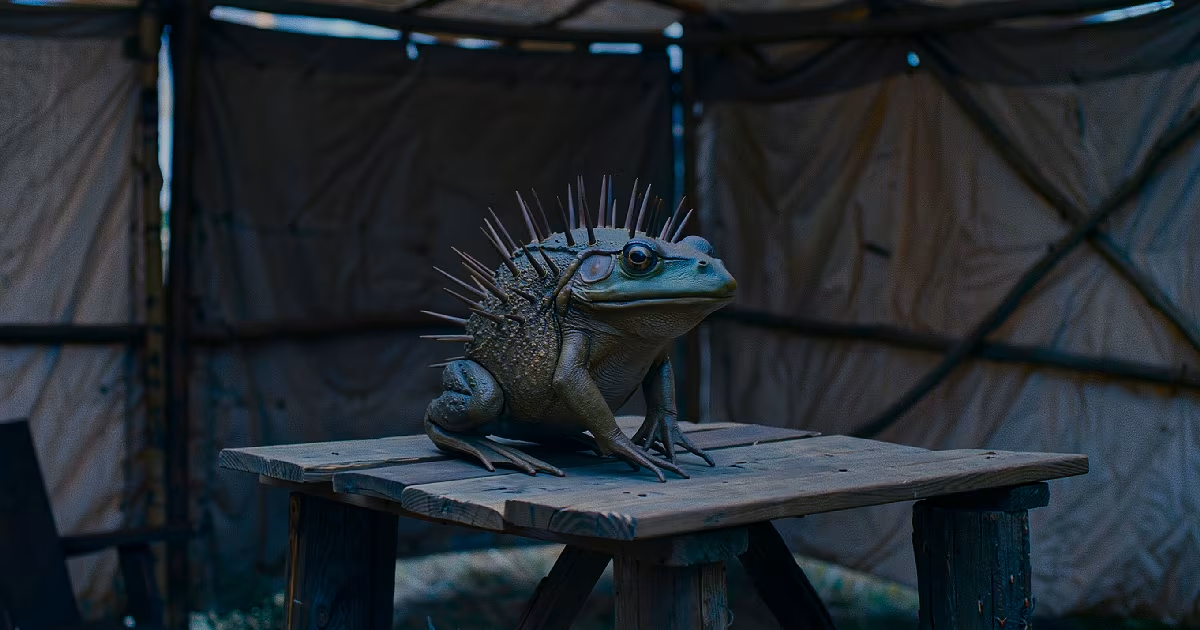
Capture of the Hodag postcard.
Illustration, not a period photograph.
Opening
On 28 October 1893, Rhinelander, Wisconsin, lumberman Eugene Shepard published an illustrated column in the town newspaper, The New North, describing his capture of a hodag, a beast with the head of a frog, the grinning face of an elephant, the spiked back of a dinosaur, thick clawed legs, and a long tail tipped with spears. He said it had taken dynamite to kill it. A photograph of its charred remains ran alongside the story. Within a few years Shepard would produce a second hodag, this one captured alive, chloroformed, and exhibited to paying crowds at the county fair. It was, by his own eventual admission, entirely fake from the start, and it is now the official mascot of the town that once fell for it.
Timeline
1870. The word "hodag," describing a mythical Northwoods creature, already appears in print in a Kent County, Michigan, history, showing the general folkloric concept predates Shepard by over two decades.
1889-1892. Newspapers from New Hampshire to Arizona run stories about a recurring hoax format: a traveling promoter claiming to have a captured hodag, charging admission to view it. By 1892 the basic idea of a "hodag hoax" is already widespread in American newspaper culture, meaning Shepard was working an established genre rather than inventing something wholly new.
28 October 1893. Shepard, a Wisconsin land surveyor, timber cruiser, and known local prankster, publishes his illustrated account in The New North describing the creature's capture and violent death by dynamite, accompanied by a photograph of its charred remains, described in the coverage as "the fiercest, strangest, most frightening monster ever to set razor sharp claws on the earth," said to have gone extinct once its preferred food, white bulldogs, grew scarce in the area.
1895. The Centralia Lumber Company begins running advertisements tied to the hodag story, an early sign that Shepard's hoax was already being leveraged for local commercial promotion rather than staying a private joke.
1896. Shepard claims a second capture, this time alive: he and a group of "bear wrestlers" reportedly apply chloroform to the end of a long pole and work it into the creature's cave to subdue it. He displays this second hodag at the first Oneida County fair and later in a shanty at his own home. Thousands pay to see it. Shepard, having rigged the exhibit with hidden wires, occasionally makes the creature move, reliably sending the already-nervous crowd fleeing.
Following the fair. Shepard takes his hodag exhibit on the road to additional county fairs, continuing to charge admission as the story spreads through local, then statewide, then national newspaper coverage.
Shortly after the story goes national. A small group of scientists from the Smithsonian Institution announces plans to travel to Rhinelander specifically to examine the apparent new species. The announcement alone ends the hoax: Shepard, facing actual scientific scrutiny he cannot survive, admits before 1900 that the hodag was fabricated.
Following the confession. Tourists continue visiting Rhinelander to see the hodag anyway, now specifically because it had been such a successful and entertaining hoax rather than because anyone believed it was real.
Early 20th century. Shepard's original fabricated hodag specimen is destroyed in a fire.
1923. Shepard dies. Contemporary accounts describe him as both a funny, outgoing local figure and, separately, someone struggling with alcoholism who had become estranged from his family by the end of his life, a more complicated personal legacy than the folksy prankster image the hodag itself has come to represent.
1930s. Rhinelander High School formally adopts the hodag as its mascot, the beginning of the creature's transition from a debunked local hoax into an embraced civic symbol.
Present day. The hodag remains the official symbol of Rhinelander, appearing on the high school's mascot, numerous local businesses, the annual Hodag Country Festival, and a larger-than-life fiberglass sculpture outside the Rhinelander Area Chamber of Commerce that draws thousands of visitors annually. The city's own website styles Rhinelander "The Home of the Hodag."
Recent years. Rhinelander residents have pushed back, with some seeking to trademark the hodag's image, against other towns, including Algoma, Michigan, attempting to organize their own hodag-themed community festivals, treating the creature as a genuine piece of local intellectual and civic identity worth defending, even though everyone involved knows its origin was a confessed fabrication.
Key figures
Shepard is the hodag's sole author and, by his own eventual admission, sole fabricator, a man whose actual documented profession, land surveying and timber cruising, gave him both the outdoorsman credibility and the storytelling platform (lumberjacks' tall tales being a genuine, established regional tradition) to make the hoax land as effectively as it did.
The Smithsonian scientists are the case's decisive, if entirely passive, actors: they never needed to actually debunk anything, since the mere announcement of their intended visit was sufficient to force Shepard's own confession before any formal examination could occur.
Rhinelander's modern civic institutions, the high school, the Chamber of Commerce, local business owners, are the figures responsible for the hodag's second life, deliberately choosing decades after the confession to adopt a known hoax as a genuine, defended piece of town identity rather than letting it fade as an embarrassing historical footnote.
Physical and documentary trail
On the paper, this file has genuinely unusual completeness for a folklore case: Shepard's own original 1893 newspaper column, period photographs of both the "charred remains" and the later live exhibit, contemporary advertising material from the Centralia Lumber Company tying commercial interest to the story, and, most importantly, Shepard's own direct, dated confession, meaning this case does not require modern skeptical reconstruction the way most cryptid hoaxes do. The fabricator said it himself, in his own lifetime, on the record.
What survives in physical form today is entirely secondary: postcards, the fiberglass sculpture, mascot imagery, since Shepard's original fabricated specimen was destroyed by fire decades ago.
The fiercest, strangest, most frightening monster ever to set razor sharp claws on the earth.
Competing explanations
There is, unusually for this archive, no genuine competing explanation to weigh. Shepard fabricated both the 1893 "dead" specimen and the 1896 "live" exhibit, and confessed to doing so within his own lifetime, before 1900, under direct pressure from an impending scientific inspection he knew he could not survive. No serious researcher, believer or skeptic, treats the hodag as anything other than a documented hoax; the only open question this case actually poses is not "was it real" but "why does a small Wisconsin town continue to defend, celebrate, and even seek trademark protection for a monster its own founder admitted to inventing."
Later life of the case
The hodag's transformation from confessed fraud into cherished civic mascot is, in its own way, the more interesting half of this story: Rhinelander did not simply forget the hoax or treat it as a mistake to live down, it deliberately built an entire modern identity, a festival, a mascot, a chamber-of-commerce statue, around a creature everyone involved knows never existed. Recent disputes with other towns over hodag-themed events show that this adopted identity has real, defended civic value regardless of, or perhaps precisely because of, its openly fraudulent origin.
Finding
The hodag is a confessed, documented hoax, fabricated twice by the same named individual and admitted by him within his own lifetime under the specific pressure of impending scientific scrutiny. There is no lingering evidentiary question about whether the creature existed. The only genuinely open thread is cultural rather than cryptozoological: how and why a town chose, decades after a public fraud, to make that same fraud its permanent, actively defended civic symbol.
What still will not resolve: nothing about the creature itself, which this file closes without reservation. What remains genuinely worth watching is simply whether Rhinelander's claim on the hodag holds against other towns now angling to borrow the same confessed lie for their own tourism.