MOMO
St. Louis Post-Dispatch Momo coverage, July 19 1972.
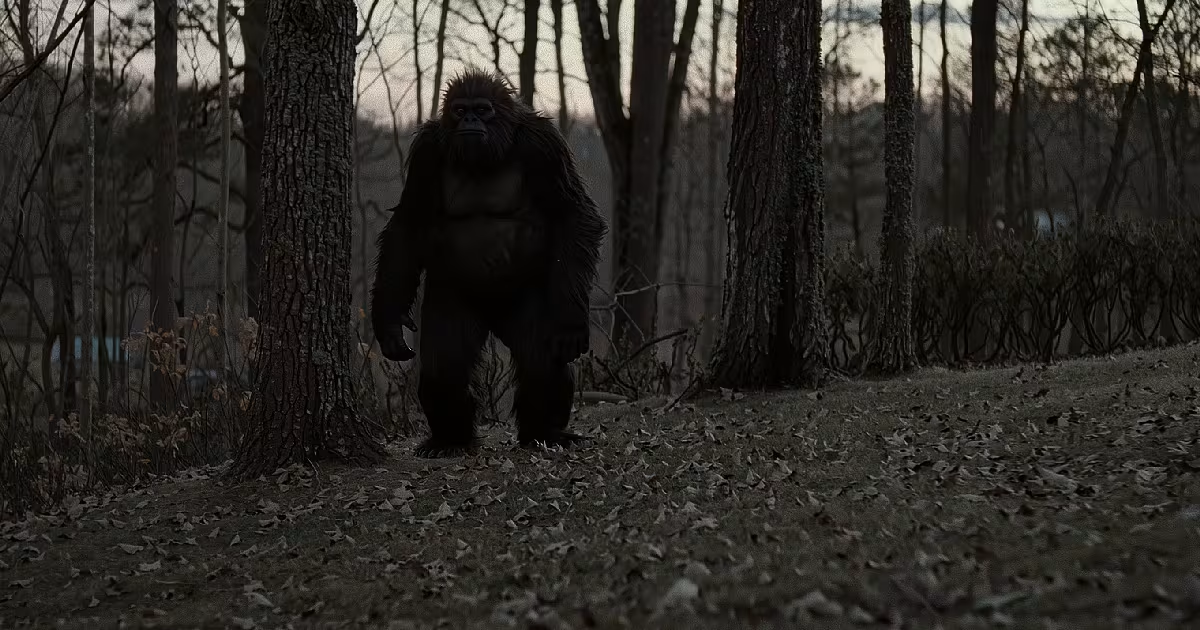
Illustration, not a period photograph.
Opening
At around 3:30 p.m. on 11 July 1972, eight-year-old Terry Harrison, playing outside his family's home at 1004 Allen Street near Marzolf Hill in Louisiana, Missouri, spotted a large, dark, hairy creature standing near a tree and ran screaming inside. His fifteen-year-old sister Doris, cleaning a bathroom sink, looked out the window and saw the same thing: a roughly seven-foot figure, its unkempt fur flecked with blood, clutching a dead dog under one arm, giving off a putrid smell that drifted through the open window. Over the following two weeks, sightings spread up and down the Mississippi River, drawing national media, search parties, and a formal track analysis from a zoo director. Fifty years on, one of the case's earliest teenage witnesses maintains she saw something real to her dying day. A local retired teacher maintains, just as firmly, that she knows exactly who made the whole thing up.
Timeline
1971, roughly a year before the main flap. Joan Mills and Mary Ryan report an earlier, less publicized sighting near Louisiana, Missouri, sometimes cited as Momo's first appearance, though this account receives far less documentation and press attention than the following year's events.
11 July 1972, approximately 3:30 p.m. Terry Harrison, then eight, and his five-year-old brother Wally are playing outside chasing the family dog when Terry spots the creature and runs screaming for the house. Fifteen-year-old Doris Harrison, alerted by the screaming, looks out the window and independently sees the same figure: roughly seven feet tall, dark and heavily furred, its face obscured by hair except for what some later, secondhand retellings describe as glowing eyes (a detail Doris's own original account did not include), holding a dead dog with blood visible in its fur.
Same afternoon. Doris rushes her brothers inside and calls her father, Edgar Harrison, who worked for the Louisiana Board of Public Works. The family, notably, does not immediately capitalize on the sighting; the Harrison children and their mother reportedly refuse to return to the house for a period afterward, a detail local historians cite as inconsistent with a family looking to profit from a hoax of their own making.
Following days. Word spreads locally and then nationally. Additional witnesses come forward, including lifelong Louisiana resident and eventual town fire chief and city council member Richard Alan Murray, who reports seeing an upright figure in the woods while driving along a creek through town, later stating plainly, "I was amazed to see something. I thought it was a bunch of nonsense, but then I saw something."
Following two weeks. Sightings continue up and down the Mississippi and eventually along other regional waterways further west. Witnesses report fleeting glimpses, a smell, bear-like growls, and inhuman screams. Physical tracks are found and submitted for professional analysis to Lawrence Curtis, director of the Oklahoma City Zoo and Botanical Garden.
Curtis's finding. He examines the submitted tracks and concludes they are a hoax, a formal, credentialed rejection of at least that specific piece of physical evidence, though it does not address or resolve the original Harrison family sighting directly.
Through the remainder of summer 1972. National media attention, curiosity seekers, and monster hunters descend on the small Pike County town; despite more than a month of active searching by local search parties, state officials, and outside investigators, no conclusive hard evidence is ever recovered. Sightings dwindle by summer's end.
Later. Retired Louisiana educator Priscilla Giltner states publicly and repeatedly that she knows the entire episode was a hoax, "a bamboozle," perpetrated by three of her former students, who she says confessed the prank to her directly. She has never publicly named them, and none of the three has ever come forward to confirm the account themselves.
Fifty-year retrospective, 2022. Doris Harrison Bliss, by then in her mid-sixties, continues to maintain, per multiple contemporary interviews, that what she and her brothers saw that day was not any animal known to science, a position local historian Brent Engel describes her holding firmly and consistently for the rest of her life. The town marks the anniversary with commemorative events, merchandise, a themed restaurant special, and a costumed Momo appearance at the local Elks Lodge.
Key figures
Doris Harrison Bliss is the case's central and most consistent original witness, whose account, independently corroborated in the moment by her younger brother's own separate reaction, remained unchanged across five decades of retelling even as secondary details (the glowing eyes, in particular) were added by later, secondhand accounts she herself did not originate.
Giltner represents the case's most specific, named, and confidently asserted hoax claim, though it is also, notably, entirely unverifiable at this remove: she alone holds the identities of the alleged confessing students, and without their own corroboration, her account remains a strong secondhand claim rather than a confirmed, documented hoax.
Murray is the case's most credentialed secondary witness, a man who went on to hold genuine public trust positions, fire chief, city councilman, in the same small town, and whose own account describes personal skepticism giving way to a direct, if brief, sighting of his own.
Curtis is the case's sole outside scientific authority to weigh in with a formal, credentialed finding, and his conclusion addresses only the physical tracks submitted to him specifically, not the original eyewitness testimony, a genuinely important distinction the case's retellings sometimes blur into a broader "the whole thing was debunked" summary that the actual record does not fully support.
Physical and documentary trail
On the paper, this file has extensive contemporary 1972 newspaper coverage (including detailed reporting in the St. Louis Post-Dispatch), a formal expert track analysis with a specific negative finding, and consistent, on-record witness testimony maintained by its original source for the rest of her life. It also has Giltner's specific but uncorroborated hoax claim, which names no one and has never been independently confirmed by any of the three alleged perpetrators.
What it lacks is any physical evidence surviving expert scrutiny: the one piece of concrete physical evidence formally examined, the tracks, was specifically judged fabricated by a qualified outside expert, leaving the entire remaining case resting on eyewitness testimony from multiple independent, differently credentialed sources.
She was extremely adamant about it. I don't think she was making it up. Doris Harrison went to her grave saying you couldn't tell her it didn't happen.
Competing explanations
A hoax perpetrated by local teenagers, per Giltner's specific claim, with the physical track evidence formally confirmed fabricated by an outside zoo director's expert examination. This reading accounts cleanly for the escalating, spreading nature of later sightings once the story had gone national, since a well-publicized hoax reliably generates a wave of unrelated copycat and misidentification reports, but it does not, on Giltner's account alone, fully explain the original Harrison family sighting, since her claimed confessing students are never placed at the scene of that specific first event.
A misidentified black bear, standing upright, a candidate raised by contemporary observers and consistent with the reported growl, general size, and dark coloring, though it does not comfortably account for the specifically reported humanlike upright posture sustained long enough for multiple independent witnesses to form a consistent description, nor the dead-dog detail.
A genuine, still-unidentified animal, the reading Doris Harrison Bliss herself maintained without variation for the rest of her life, resting entirely on her own and her brother's independent, immediate reactions rather than on any surviving physical evidence.
Local economic and civic self-interest sustaining the legend regardless of its original truth. Momo has become a genuine, actively marketed piece of Louisiana, Missouri's civic identity, complete with merchandise, a commemorative song, and anniversary events, giving the town a real, ongoing incentive to keep the story alive independent of whatever actually happened in July 1972.
Later life of the case
Momo has followed a trajectory similar to the Hodag's, if less fully resolved: a debunked piece of physical evidence sits alongside a still-unretracted core eyewitness account, and the town has embraced the legend as civic identity regardless of which reading is correct. Unlike the Hodag, no one has ever produced a confirmed, named, on-the-record confession, leaving Momo in a genuinely intermediate state between "confirmed hoax" and "unresolved mystery."
Finding
A formally examined piece of physical evidence, the tracks, was judged fabricated by a credentialed outside expert, giving this case real grounds for skepticism that many cryptid reports lack. What that finding does not touch is the original Harrison family sighting itself, independently experienced by two siblings in the same moment and maintained without variation by the elder witness for the rest of her life, nor does it connect to Giltner's separate, specific, but never independently confirmed hoax claim naming three unidentified students.
What still will not resolve: the identity of Giltner's alleged confessing students, whose corroboration alone would close this case definitively, and any confirmed animal identification for what the Harrison children actually saw on 11 July 1972. Until either surfaces, Momo sits in the same unusual middle ground many small-town legends do: partially debunked, partially defended by a witness who never wavered, and fully adopted as local identity regardless of the outcome.