JERSEY DEVIL
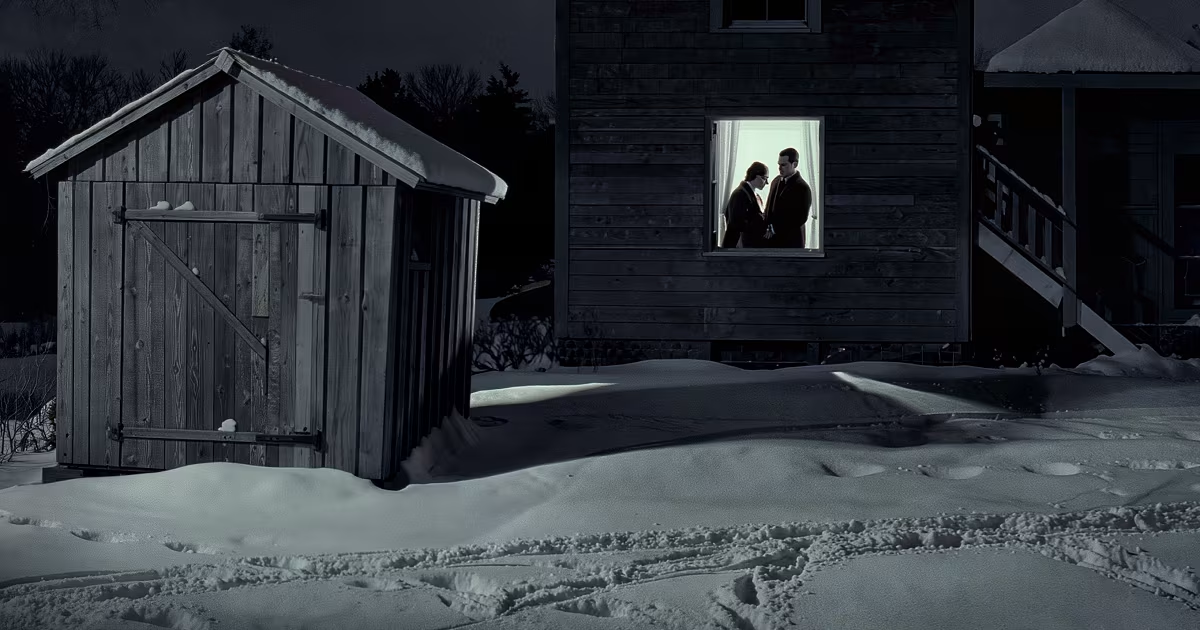
A woodshed and house in deep snow at night, a couple at a lit window.
Illustration, not a period photograph.

Opening
For one week in January 1909, towns across South Jersey and over the river in Pennsylvania reported a winged creature that left hoof-like tracks in the snow, even on rooftops, and screamed in the pine woods. Postmen, trolley crews and mill workers described it. Schools kept children in, mills talked of night watches, and posses went looking. Then, as suddenly as it began, it stopped.
The creature had a name long before that week. In the Pine Barrens it was the Leeds Devil, the cursed thirteenth child of a local family, a story already well over a century old. Newspapers knew how to sell a devil, and they sold this one hard. The older legend stayed in the pines. The 1909 week is the part that produced paper.
Timeline
1687 onwardsDaniel Leeds publishes almanacs in Burlington, New Jersey. His mystical writing angers his Quaker community, and the family gains a dark reputation.
1728His son Titan Leeds, who carries on the almanac, adopts a family crest showing a wyvern, a winged, dragon-like creature.
1733Benjamin Franklin, a rival almanac maker, mockingly "predicts" Titan Leeds's death in Poor Richard's Almanack, and keeps the joke going for years.
1735The year the legend gives for the birth: "Mother Leeds" of Leeds Point, already the mother of twelve, curses her thirteenth child, "Let the child be the devil!", and it flies up the chimney.
1840s to 1880sLivestock killings in 1840 and 1841 are blamed on the creature. An 1859 Atlantic Monthly article describes Leeds Devil tales, and an 1887 newspaper reports the "Devil of Leeds" in Burlington County.
16 to 23 January 1909Newspapers publish hundreds of reported encounters, from Bristol, Pennsylvania, through Burlington, Gloucester and Camden counties. A flying form, a horse's head in some accounts, wings, a cry. Prints in the snow in yards and on sheds and roofs. Schools close or keep children in, mills consider night watches, and armed groups search the pines. Police checks produce no shot and no hide. The Philadelphia papers run maps.
The same weekA rumoured $10,000 reward from the Philadelphia Zoo encourages hoaxes. Showmen Norman Jeffries and Jacob Hope exhibit a "Jersey Devil" at a Philadelphia museum: a kangaroo fitted with claws and bat wings.
End of January 1909The reports thin out and stop, as a panic does.
About 1929Jeffries admits the hoax.
1960Merchants in Camden offer a $10,000 reward for the creature's capture. It goes unclaimed.
Key figures
The postmen, trolley men and night workers of that week are the record. They had jobs that put them outside at the wrong hour.
Daniel and Titan Leeds, whose almanacs, crest and quarrels gave the legend its name, and Benjamin Franklin, whose jokes at their expense may have helped give it its shape.
Norman Jeffries, a former Philadelphia newspaperman turned publicist, and his partner Jacob Hope, who turned the panic into a sideshow.
Police and mill owners own the closings and the posses, and the newspaper desks own the maps that made a whole region feel hunted.
Physical and documentary trail
The record for 1909 is solid as a record of what people said: clustered newspaper reports across South Jersey and the river towns in a single week, reports of tracks in the snow on the ground and on roofs, and school and work disruptions noted in the press. The folklore before it is thinner, resting on later retellings and a handful of nineteenth-century articles.
There is no photograph of the flying form. No plaster cast of a track was kept. There is no body, and the one "specimen" ever shown was a kangaroo in costume.
Things you might not know
- It may have started as a feud. The historian Brian Regal links the legend to the Leeds family's reputation and to the rivalry between Titan Leeds and Benjamin Franklin.
- The family crest had a winged monster. Titan Leeds's wyvern, Regal notes, looks a lot like later descriptions of the Devil.
- There may have been a real Mother Leeds. Some researchers identify her with Deborah Leeds, whose husband Japhet's will of 1736 names twelve children.
- A showman faked part of the 1909 wave. Norman Jeffries fixed claws and bat wings to a kangaroo, exhibited it as the Devil, and admitted the hoax twenty years later.
- A zoo reward is part of the story. The Philadelphia Zoo reportedly offered $10,000 for its capture, though the offer is unconfirmed.
- Over 1,000 people said they saw it. One local history counts more than a thousand witnesses during the week of 16 January 1909.
- Famous names were added later. Legends say the naval hero Stephen Decatur fired a cannonball at it and that Napoleon's brother Joseph Bonaparte saw it while living in New Jersey around 1820. Neither story has a contemporary source.
Competing explanations
A real unknown animal. This is the Barrens reading. It has a week of paper and many witnesses. It has no body.
Mass panic, hoaxes and misidentified animals. Researchers including Robert Bartholomew have cited 1909 as a classic case of mass hysteria. Sceptics point to misidentified animals, possibly wandering sandhill cranes, to hoaxed tracks and to newspaper contagion. This fits the sudden start and the sudden stop.
An old legend meeting a slow news week. The Leeds story was ready-made, and the press gave it a stage. That explains the name and the frenzy; it does not explain every track.
Later life of the case
The Jersey Devil became the state's monster: the Pine Barrens legend, a staple of local tours and souvenirs, and the name first of a minor-league hockey team, the Jersey Devils, from 1964 to 1973, and since 1982 of the NHL's New Jersey Devils. The 1909 week is still the core of the story, and the showman's kangaroo is still the best-known explanation for part of it. For another winged figure that briefly frightened a whole town, see Mothman.
Finding
South Jersey spent a week in January 1909 reporting a winged thing and hoofed tracks on roofs, and schools and night shifts felt it enough to change their hours. That panic is well documented, and so is at least one hoax that fed on it. The legend behind it grew from a real family's reputation, not from any recorded birth.
What still will not resolve: what made the tracks that week, since no photograph from those nights survives and no cast was kept.
Evidence signature
5/9 Solid
- Witnesses
- several people
- Instruments
- photo, film or physical traces
- Paper
- official records at the time
How well documented the case is, not whether it's true. A strong record can still have an ordinary answer, and a thin one can still be real.
You decide · JERSEY DEVIL
What do you think happened?
One vote per case, anonymous. You'll see how other readers voted once you've voted.