PATTERSON-GIMLIN
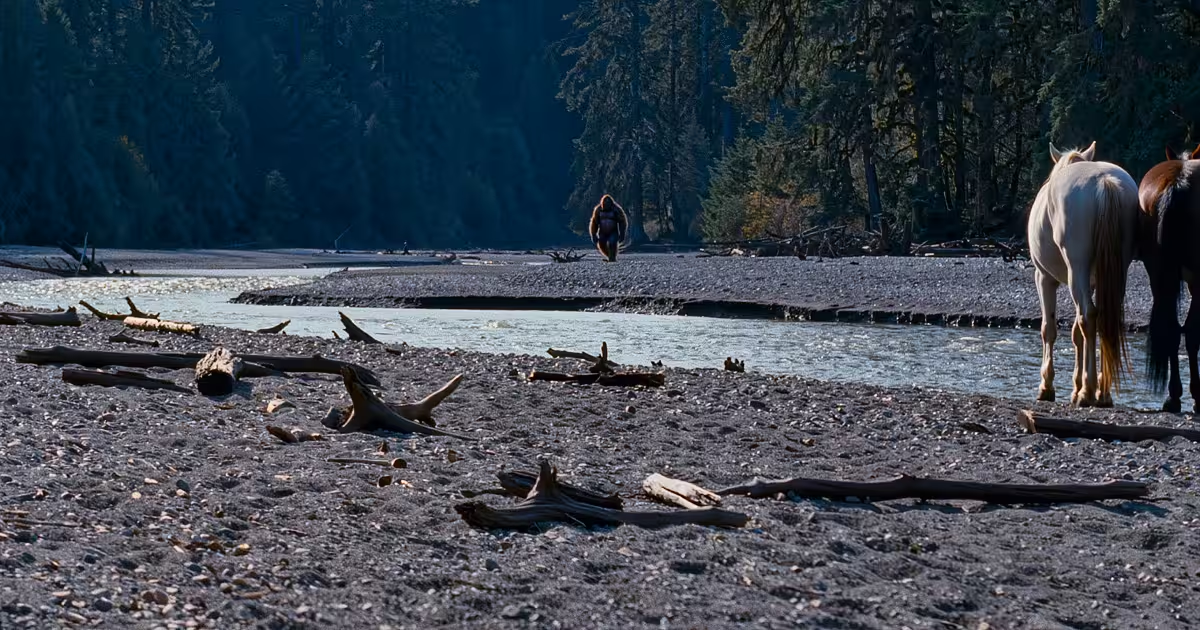
Creek bed. Timber and distant dark upright figure not detailed.
Illustration, not a period photograph.
Opening
On 20 October 1967, Roger Patterson and Bob Gimlin, riding on horseback along Bluff Creek in Northern California while filming footage for a planned Bigfoot documentary, say they came around a bend and encountered a large, hair-covered, bipedal figure crouched by the creek. Patterson grabbed his rented 16mm camera, dismounted in a scramble, and shot approximately one minute of film showing the figure walking away across a sandbar before disappearing into the treeline. That footage, less than a minute long and shaky throughout, became the single most examined piece of purported physical evidence in the entire history of cryptid research, subjected to more frame-by-frame technical analysis than any comparable film before or since.
This is also, unusually for this archive, a case with a named, on-record confessed hoax participant, a costume supplier with his own competing account, and, as of a 2024 documentary, one of Patterson's own sons stating publicly that his father told the family it was fake.
Timeline
1964 and 1966. Before the famous filming, Patterson makes trips to Hollywood, ostensibly to sell an unrelated hoop-toy invention, during which he visits Yakima native and rockabilly musician Jerry Lee Merritt, contacts later cited by investigators piecing together Patterson's broader activities and associations in the years leading up to 1967.
Prior to October 1967, likely around Memorial Day weekend. Patterson, working on a planned dramatized Bigfoot documentary, recruits at least nine volunteer acquaintances from his Yakima, Washington, hometown, including Gimlin and Bob Heironimus, for several days of staged shooting involving a fictional storyline with cowboys, an Indian guide character (Gimlin in a wig), and flashback sequences referencing earlier reported Bigfoot encounters such as the 1924 Ape Canyon incident. This production would have required a Bigfoot costume for any climactic creature scenes.
20 October 1967. Patterson and Gimlin film the famous sequence at Bluff Creek. Patterson estimates he came within about 25 feet of the figure at closest approach; he describes his horse rearing at the sight, several seconds spent extricating himself and retrieving his camera from a saddlebag, then running toward the figure while filming, at one point yelling to Gimlin to "cover me," meaning to draw a weapon. Gimlin crosses the creek on horseback but never fires.
Following the filming. The approximately one-minute film shows a large, hair-covered figure, described variously across different analyses as having silvery-brown, dark reddish-brown, or black hair, walking with a distinctive gait across a sandbar before turning to glance back toward the camera and continuing into the trees.
Contemporary technical dispute. Patterson states the film was shot at 18 frames per second; later investigators analyzing the camera and footage argue it was more likely shot at 24 frames per second, a significant discrepancy since the creature's apparent stride length and speed calculations, central to early claims that no human could replicate the movement, depend directly on the frame rate used in the analysis.
1972. Patterson dies of Hodgkin's lymphoma. Following his death, some of his own associates begin describing him openly as, in one characterization, "a liar and a conman," a notable shift from how he had been discussed while alive.
1998-2004. Author Greg Long, working with Kal Korff over what he describes as a roughly six-year investigation, tracks down and interviews numerous figures connected to Patterson's Yakima circle. Long's 2004 book, The Making of Bigfoot: The Inside Story, presents Bob Heironimus's account of having worn the costume himself, describing a gentleman's agreement to receive $1,000 for appearing in the suit, a payment he states he never actually received. Long separately traces the costume itself to Philip Morris, a North Carolina gorilla-suit specialist, who states he sold Patterson a custom suit for $435 shortly before the sighting.
28 December 1998. Heironimus, having seen a Fox network special on the case, decides to come forward publicly after what he describes as thirty-seven years of silence, telling interviewers he informed Gimlin directly, "I don't give a damn, I'm telling the truth. I'm tired," to which Gimlin reportedly replied, "Well, don't mention my name."
Following Heironimus's confession. A significant inconsistency emerges: Heironimus's own detailed description of the costume he says he wore does not match the specific suit Morris says he made and sold to Patterson, a discrepancy neither side has ever fully resolved and that critics of the hoax theory cite directly against it.
2004. Morris attempts to recreate the original footage using a new suit built to match his account of the original; the resulting recreation looks noticeably different from the actual Patterson-Gimlin footage, a result some treat as undermining Morris's specific claim even while not resolving the broader hoax question.
Separately, Bigfoot investigator and sculptor Cliff Crook claims to identify what he interprets as a visible zipper seam on the figure's back in enhanced frames of the film, a claim disputed by other analysts examining the same footage.
Through the 2000s. Gimlin, who had remained almost entirely silent about the film for over three decades, begins making public appearances at Bigfoot conferences starting around 2005, consistently maintaining under his own name that the footage is authentic and that no one wore a costume.
2020s. Researcher and Bigfoot advocate Matt Moneymaker publicly maintains, with what he describes as complete certainty, that the filmed figure's specific biomechanical details, smooth neck rotation, visible muscle rippling, breast movement, and limb proportions, could not have been replicated by any costume technology available in 1967.
2024. A separate, shorter piece of 16mm footage surfaces, showing a slimmer, Bigfoot-suited figure and a horseback rider apparently mimicking Gimlin's position; Moneymaker argues this is not an authentic pre-Patterson-Gimlin "dress rehearsal" but a later replication, most likely created by Al DeAtley, Patterson's brother-in-law and a figure closely involved in licensing and promoting the original film for profit, a claim raising its own separate question about DeAtley's specific role and financial interest in the footage's continued authenticity.
2024, documentary Capturing Bigfoot. Director Evans interviews Roger Patterson's son Clint, by then a 66-year-old Montana rancher, who states publicly that he had learned from his own mother years earlier that the film was fake, and that he had wanted to come forward with this for some time.
Key figures
Patterson is the film's creator and, per multiple later accounts including his own son's, its central architect if it was indeed staged; he died before any formal confession could be extracted from him directly, and per some associates' later characterization of his general honesty, his own credibility on the matter is itself disputed independent of the footage.
Gimlin is the case's most consistent and, to skeptics, most puzzling defender: the one surviving original participant who has maintained the footage's authenticity under his own name for decades, even after Heironimus's public confession implicated him directly in soliciting Heironimus's participation, a claim Gimlin has denied through legal representation.
Heironimus is the case's central confessed hoax participant, whose account is detailed and consistent in its broad strokes across multiple retellings, but whose specific costume description creates a genuine, unresolved discrepancy against Morris's own separate account of the suit he says he built and sold.
Morris is the case's named costume supplier, whose claim is independently sourced from Patterson's own account rather than from Heironimus, but whose 2004 attempted recreation using his own described methodology produced footage that looks visibly different from the original, a result that complicates rather than confirms his specific version of events.
Clint Patterson is the case's most recent and, in some ways, most personally weighty witness, a son stating publicly what he says his own mother told him privately years earlier, a claim that, if accurate, would settle the matter definitively from inside the family itself, though it remains a secondhand account of a private conversation rather than independently documented proof.
Moneymaker represents the case's most technically detailed ongoing defense, arguing the footage's specific biomechanical details exceed what 1967 costume technology could achieve, a claim that requires genuine expertise in both period costume construction and human versus non-human gait analysis to properly evaluate.
Physical and documentary trail
On the paper, this file has the original film itself, subjected to more frame-by-frame technical analysis over more than five decades than perhaps any other purported cryptid evidence in existence, a named confessed participant with a detailed if partially inconsistent account, an independently sourced costume-maker's claim, a family member's secondhand insider account, and ongoing, genuinely expert-level dispute over the footage's specific biomechanical plausibility.
What it lacks is full internal consistency among the hoax claims themselves: Heironimus's and Morris's costume descriptions do not match each other, meaning even accepting a hoax occurred does not yet produce one single, fully corroborated account of exactly how it was executed.
I told him, "I don't give a damn, I'm telling the truth. I'm tired after thirty-seven years," and he tells me, "Well, don't mention my name."
Competing explanations
A staged hoax using a purpose-built costume, executed as part of Patterson's broader planned Bigfoot documentary project. This reading is supported by Heironimus's detailed confession, Morris's independent costume-sale claim, the frame-rate discrepancy undermining the original stride-length argument, and Clint Patterson's 2024 secondhand family account. Its weakness is the unresolved mismatch between the two independent hoax accounts' own costume descriptions, which should, in principle, agree with each other if both are accurately describing the same suit.
A genuine encounter with an unidentified bipedal primate, with the film's specific biomechanical details exceeding what 1967-era costume technology could produce. This remains Gimlin's own consistent position and Moneymaker's technically argued defense, resting on close analysis of the figure's movement rather than on any alternative account of who might have worn a suit if one existed.
A hoax whose specific mechanics remain only partially documented, with real financial incentive (per the reported theatrical drawing power of the footage and DeAtley's later licensing role) to keep the authenticity question alive regardless of what actually happened at Bluff Creek in 1967. This reading treats the persistent internal inconsistencies among hoax accounts as evidence of a genuinely messy, imperfectly reconstructed decades-old fabrication rather than as evidence against a hoax having occurred at all.
Later life of the case
The Patterson-Gimlin film remains the most iconic single piece of purported Bigfoot evidence in existence, its roughly one minute of footage generating an entire subfield of frame-by-frame biomechanical and costume analysis spanning over five decades. The 2024 documentary Capturing Bigfoot and Clint Patterson's on-record family account represent the most direct insider challenge to the footage's authenticity to date, arriving fifty-seven years after the original filming and more than half a century after Roger Patterson's own death made a direct confession from him permanently impossible.
Finding
A named participant has publicly and consistently confessed to wearing a costume in the footage, a separately sourced costume supplier has independently corroborated selling Patterson a suit shortly before the filming, and Patterson's own son now states his mother privately confirmed the hoax years ago. Against this stands Gimlin's own decades-long, consistent, on-the-record denial and a genuine, unresolved technical argument about whether the figure's specific movement exceeds what period costume technology could achieve, an argument that has never been definitively won by either side despite more scrutiny than almost any comparable footage in cryptid history has ever received.
What still will not resolve: reconciling Heironimus's and Morris's mismatched costume descriptions into one single, internally consistent account of exactly how the hoax, if it occurred, was executed, and any independent, expert-adjudicated resolution of the biomechanical dispute over whether the figure's movement was achievable by a 1967 human in a suit. Until both are settled, this stays the most examined and least conclusively resolved sixty seconds of film in the entire archive.