ISSIE
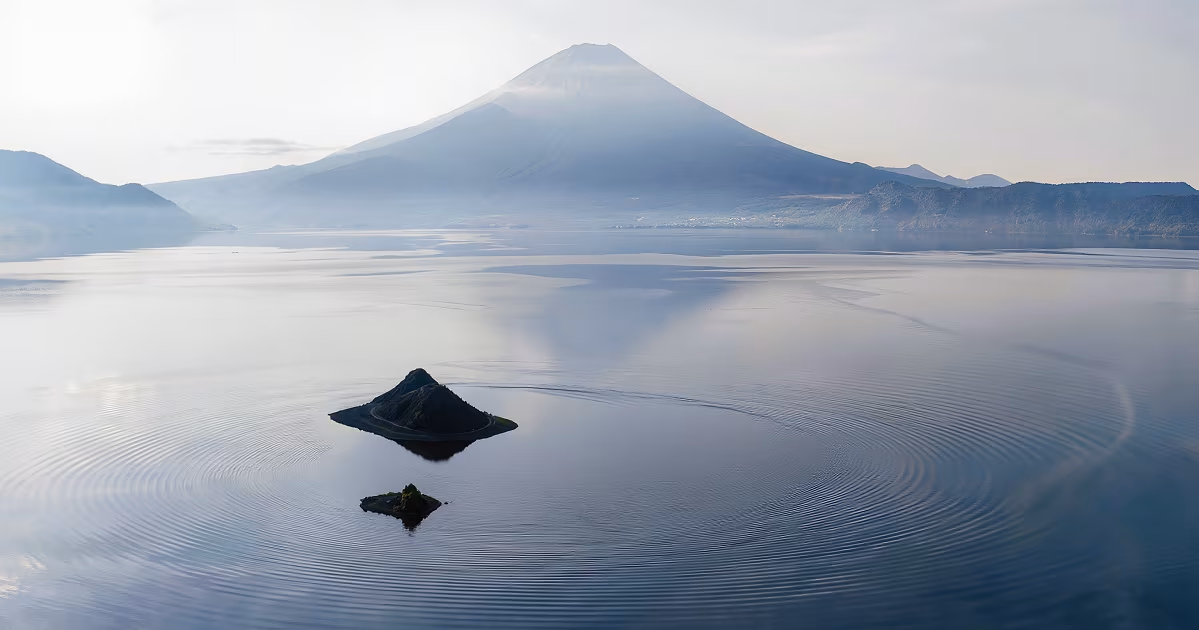
Kyushu caldera lake. Kaimon distant, empty water.
Illustration, not a period photograph.
Opening
Lake Ikeda, a nearly circular caldera lake formed by volcanic activity roughly 6,400 years ago on Japan's Satsuma Peninsula in Kagoshima Prefecture, is Kyushu's largest lake and, at up to 233 meters deep, one of the deepest in the country. It has no river flowing in or out, relying entirely on rainfall to maintain its water level, a detail worth holding onto for what follows. Since 1961, and especially since a single day in September 1978 when roughly twenty people independently reported the same thing, the lake has carried its own local monster, nicknamed Issie after Scotland's Nessie, and a genuine confirmed local resident, a very large, very real eel, sits at the center of the debate over what those twenty people actually saw.
Timeline
1961. The earliest reported sighting of an unusual creature in Lake Ikeda occurs, drawing little sustained attention at the time.
3 September 1978. Approximately twenty people, independently positioned around the lake, report seeing a large, dark-skinned creature with two humps, each described as roughly five meters long, moving through the water. The scale and rough simultaneity of this specific sighting cluster is what shifts Issie from minor local folklore into a story serious enough for the regional tourism authority to respond to directly.
Following the September sightings. The tourism department of nearby Ibusuki city offers a cash reward, reported as 100,000 yen, to anyone who could produce a photograph of the creature, a deliberate civic incentive tying the legend directly to the area's tourism economy from an early stage.
16 December 1978. Toshiaki Matsubara (rendered as "Matsuhara" in some retellings), a man with a personal interest in local folklore and legend, captures a photograph while standing at the lakeshore with his camera, showing what he describes as a large creature breaking the surface. The image is submitted to and accepted for the tourism department's reward.
Same general period. A separate visitor reportedly captures video footage of a comparable creature, with the object in that footage estimated at roughly 14 meters in length, a considerably larger figure than the roughly five-meter humps described in the September multi-witness sightings, an inconsistency in scale across the case's own separate pieces of claimed evidence that later retellings rarely address directly.
Ongoing local context, predating and continuing alongside the Issie legend. Lake Ikeda is home to a genuine, scientifically confirmed and locally protected natural monument: a giant mottled eel population, some individuals measuring up to two meters long and sixty centimeters in diameter, established in the lake since Meiji-era irrigation canal construction connected it to the ocean and allowed saltwater species to move in.
Continued local and tourist folklore, distinct from the eel explanation. The city's own preferred mythological account describes Issie as originally a white mare who lived by the lake with her foal; after a samurai kidnaps the foal and her search fails, she leaps into the lake in despair and is transformed into the giant creature, said to still surface periodically searching for her lost child, a folkloric backstory presented alongside, rather than in place of, the more modern 1978 sighting-and-photograph narrative.
Ongoing tourism identity. The city of Ibusuki has continued to informally brand the creature "Issie-kun," incorporating it into the area's broader tourism material alongside its other genuine natural attractions, including the lakeside rapeseed flower season and the annual Ibusuki Nanohana Marathon held along the same shoreline.
Key figures
Matsubara is the case's central photographic evidence source, a private individual specifically motivated by the tourism department's cash reward and his own stated personal interest in folklore, a combination worth noting as a genuine, if not disqualifying, incentive structure surrounding the case's single most concrete piece of claimed evidence.
The roughly twenty September 1978 witnesses represent the case's strongest claim to multi-observer corroboration, though, as with many such clustered sightings, no detailed formal investigation compiling and cross-referencing their individual accounts in full appears to be widely available or cited alongside the case's popular retellings.
The Ibusuki tourism department is a directly interested party from very early in the case's modern history, having created a specific financial incentive for photographic "proof" before Matsubara's photograph, the case's key evidentiary item, was ever produced.
The lake's confirmed giant mottled eel population functions as the case's most concrete, scientifically documented candidate explanation, a real, locally protected natural monument whose known maximum size, however, falls well short of the far larger figures (up to 45 feet in some retellings, or the 14-meter video estimate) attributed to Issie in the more dramatic versions of the story.
Physical and documentary trail
On the paper, this file has a genuinely dated, multi-witness sighting event from September 1978, a specific photograph produced under a direct financial incentive three months later, a separate video with a size estimate significantly inconsistent with the earlier witness descriptions, and a confirmed, scientifically documented large eel species genuinely present in the lake.
What it lacks is any independent size, distance, or scale verification for either the photograph or the video, any formal cross-referenced compilation of the twenty September witnesses' individual accounts, and any physical specimen, carcass, or DNA trace recovered from a lake that, notably, has no river inlet or outlet through which any large aquatic animal could have naturally entered or left over time.
About twenty more people reported the same thing which appeared from the lake with 5 meter long body and dark skin.
Competing explanations
The lake's own confirmed giant mottled eel population, misjudged for size and shape at a distance, particularly under the excited, rapidly spreading conditions of a multi-witness sighting event. This reading requires no unknown species at all, but strains against the eel's own documented maximum size of roughly two meters, far short of the five-meter humps described in 1978 or the 14-meter video estimate.
A genuine, still-unidentified large aquatic animal, a reading complicated significantly by the lake's specific hydrology: with no river connecting it to any other body of water, any large species present would need to have either been established since the lake's formation roughly 6,400 years ago, or introduced by some other specific and currently unexplained mechanism, since ordinary river-based migration, the explanation typically offered for other lake monster legends with active inlets and outlets, is not physically available here.
A financially incentivized hoax or honest misidentification specifically produced in response to the tourism department's own cash reward, given that Matsubara's photograph, the case's central piece of evidence, was captured and submitted directly into a program explicitly created to generate exactly this kind of image.
A combination of a real, if modest, multi-witness sighting of ordinary lake wildlife (the eels, waterfowl, wave patterns, or floating debris) in September 1978, subsequently amplified by folklore, tourism marketing, and a reward-incentivized photograph into a considerably larger and more dramatic legend than the original event itself likely supports.
Later life of the case
Issie remains a modest but persistent fixture of Kagoshima regional tourism, deliberately marketed alongside the area's other, entirely real natural attractions rather than positioned as the lake's primary draw, a lower-key commercial relationship to its own cryptid legend than some more heavily monetized lake-monster tourism economies elsewhere in the world.
Finding
A genuine cluster of roughly twenty independent witnesses reported an unusual creature in Lake Ikeda on a single day in September 1978, and a photograph produced three months later under a direct cash incentive became the case's lasting visual evidence, despite no independent verification of its scale ever being conducted. The lake's own confirmed large eel population offers a real, documented candidate explanation that nonetheless falls well short of the sizes described in the case's more dramatic retellings, while the lake's isolated hydrology, no inlet or outlet, makes any genuinely unknown large species considerably harder to account for than in most comparable lake-monster legends.
What still will not resolve: independent scale verification for either Matsubara's photograph or the separate video's 14-meter estimate, and any explanation for how a large aquatic species, if genuinely present and not simply an oversized eel, could have established itself in a lake with no water connection to any other body over its roughly 6,400-year existence. Until either is addressed, Issie remains a case where the area's own real, protected wildlife offers the closest thing to a documented answer, without fully closing the gap the 1978 witnesses' own reported scale actually describes.