POPE LICK
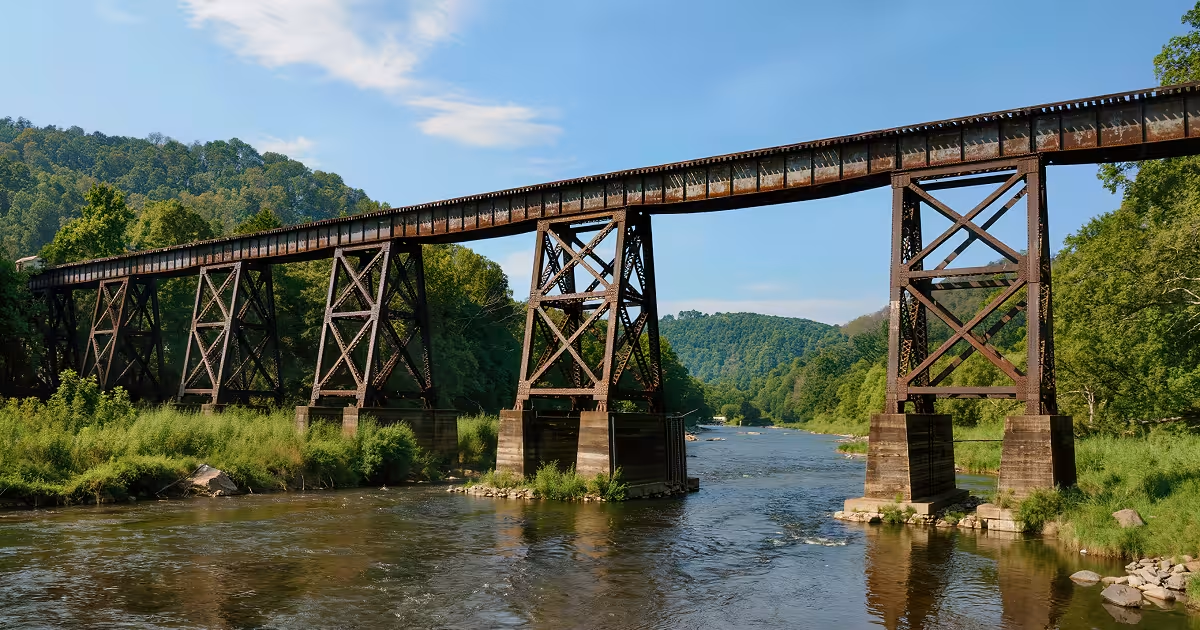
The steel trestle bridge over Pope Lick Creek on a summer day.
Illustration, not a period photograph.

Opening
The Pope Lick Monster, a legendary half-man, half-goat figure said to lurk beneath an active Norfolk Southern railroad trestle over Pope Lick Creek in the Fisherville area of Louisville, Kentucky, is among the very few American cryptids directly responsible, however indirectly, for a documented string of real human deaths. Since 1988, at least four named individuals have died at the trestle itself, each while visiting specifically because of the legend, seeking out a creature no one has ever produced physical evidence for.
Timeline
Origin, undated and disputed. The monster's backstory circulates in at least three competing versions among locals: a former circus freak-show performer who survived a train derailment at the trestle and was left permanently vengeful; a local farmer who sacrificed a herd of goats to Satan in exchange for supernatural power and was transformed into the creature as payment; and, in a real historical figure sometimes conflated into the legend, Charles McCartney, an actual itinerant preacher known as "Ches McCartney" or the "Goat Man," who genuinely traveled the United States for 57 years accompanied by a herd of goats, a real person whose documented wanderings have nothing to do with the Kentucky trestle specifically but whose existence lends the broader "goat man" archetype an unusual grounding in real Americana.
1988A low-budget, roughly $6,000 independent short film centered on the Pope Lick Monster legend is produced and circulated, an event later researchers and journalists specifically credit with taking what had been a smaller local campfire story and substantially amplifying it into wider regional and eventually national attention, giving the legend its first attested documented appearance in written or recorded form.
1999-2000David Wayne Bryant, 19, dies from injuries sustained after jumping from the trestle roughly a year earlier to avoid an oncoming train.
November 2000Nicholas Jewell, 19, dies after falling more than 80 feet from the trestle. Per the four friends present with him at the time, Jewell was attempting the common teenage dare of running across the trestle before an approaching train could reach him; caught roughly halfway across, he tried to move to the side and hold onto a railroad tie, but the vibration from the passing freight train shook him loose.
23 April 2016Roquel Bain, 26, a tourist from Dayton, Ohio, visiting Louisville specifically after hearing about the legend, dies after being struck by a train while walking the trestle with her boyfriend, who survives by hanging from the side of the structure as the train passes.
26 May 2019Savanna Bright, 15, is pronounced dead at the scene after she and another teenager, Kaylee Keeling, are struck while on the tracks near the trestle; Keeling survives and is taken to University of Louisville Hospital.
Ongoing, per local historian David Domine and other regional chroniclers. The legend continues circulating locally in multiple, mutually inconsistent forms, with the creature variously described as luring victims onto the tracks through hypnosis or voice mimicry, dropping directly onto passing vehicles from within the trestle structure, or reaching up between the ties to physically hold running trespassers in place until a train arrives.
OngoingDespite the trestle remaining an active railroad structure, with genuine safety hazards, height, an active freight line, and no pedestrian walkway, requiring no supernatural explanation at all for why visiting it is dangerous, the site continues drawing "legend trippers" specifically seeking a glimpse of the creature.
Key figures
Bryant, Jewell, Bain, and Bright are the case's confirmed, named human casualties, each death independently documented through local news coverage and, in Jewell's case, direct witness testimony from friends present at the time, making this one of the small number of cryptid legends where the human cost is verifiable fact rather than folklore.
McCartney is a genuine historical figure whose real, documented decades of wandering with a goat herd predate and are entirely separate from the Kentucky trestle legend, though his existence is sometimes informally cited by retellers as if it lent the Pope Lick story itself more historical grounding than it actually has.
Domine is the case's primary named local historian and chronicler, whose on-record explanations of the competing origin stories, the circus performer and the Satanic farmer versions specifically, represent the most consistently cited authoritative account of how the legend is actually told within the Louisville area itself.
The unnamed 1988 filmmakers are the case's most consequential figures for the legend's modern scale, since their low-budget production is specifically credited with transforming a smaller local story into the widely known regional phenomenon it has since become.
Physical and documentary trail
The record has a genuinely rare feature for a cryptid case: verified, named, dated human fatalities directly connected to visits motivated by the legend, confirmed through independent local news reporting across nearly two decades. It also has a specific, dateable point of media amplification, the 1988 film, that later chroniclers consistently identify as the moment the story scaled beyond its original, smaller local circulation.
What it lacks, entirely, is any physical evidence for the creature itself: no photograph, footprint, or physical trace has ever been produced, and the legend's own origin story exists in at least three mutually incompatible versions with no single account treated as authoritative even within the local community that tells it.
They say he's part man, part goat, maybe even part sheep.
Things you might not know
- The trestle is 772 feet long. It crosses Pope Lick Creek in the Fisherville area of Louisville.
- It is not abandoned. Many visitors assume it is, but it carries a main line into Louisville, with heavy freight trains crossing several times a day.
- The legend says it lures people out. In some versions the creature uses hypnosis or mimics voices to draw trespassers onto the tracks ahead of a train.
- The film cost $6,000. Ron Schildknecht's 16-minute The Legend of the Pope Lick Monster premiered at Louisville's Uptown Theater on 29 December 1988.
- Young people have died there. Deaths at the trestle include teenagers in 1988, 2000 and 2019, and a 26-year-old visitor from Ohio in 2016.
- An 8-foot fence has not stopped them. The railway has warned that anyone caught on the trestle will be arrested.
Competing explanations
A purely folkloric legend with no basis beyond storytelling, drawing on much older archetypal goat-human hybrid figures (satyrs, the Christian devil, comparable American "goatman" legends in Maryland and elsewhere), where the real deaths reflect the genuine, ordinary danger of trespassing on an active elevated railroad trestle rather than anything supernatural, a reading requiring no unexplained element at all beyond the sociological question of why the story continues drawing people to a genuinely hazardous location.
A media-amplification feedback loop, in which the 1988 film's specific dramatization increased public awareness and, in turn, the number of people visiting the site specifically to test or debunk the legend, thereby directly increasing exposure to the trestle's real, non-supernatural hazards, a reading some contemporary journalism examining the case has explicitly raised as an uncomfortable possibility: that telling a dangerous story about a place can itself make that place more dangerous by drawing more visitors to it.
A genuine, if unconfirmed, cryptid, the reading some committed cryptozoology enthusiasts continue to entertain, resting entirely on the accumulated oral tradition itself rather than any physical evidence, sighting report with a named credible witness, or photograph.
Later life of the case
The Pope Lick Monster remains one of the most frequently cited American urban legends specifically because its documented casualty list is real and verifiable rather than itself a matter of folklore, distinguishing it from most comparable cryptid stories where even the claimed "evidence" of harm is anecdotal. Its continued draw for legend-tripping visitors, despite repeated, well-publicized fatal warnings, has made it a recurring subject in journalism specifically examining how folklore itself can function as a hazard independent of whether the underlying creature exists.
Finding
The Pope Lick Monster itself has no physical evidence behind it and exists in at least three mutually inconsistent origin versions even within its own local tradition. What is entirely real and independently documented is the trestle's genuine physical danger and the confirmed deaths of at least four named individuals who visited specifically because of the legend, deaths the local historical record treats as directly connected to the story's continued pull rather than to anything the creature itself did.
What still will not resolve: any confirmed origin for the legend predating its first documented 1988 appearance, and, more practically, why the site continues drawing fatal visits despite a well-publicized, repeatedly renewed record of exactly this outcome. This report treats the monster as folklore and the deaths as its real, tragic, and entirely non-supernatural consequence.
Evidence signature
5/9 Solid
- Witnesses
- one person, or a tradition
- Instruments
- photo, film or physical traces
- Paper
- formal investigation, court or declassified file
How well documented the case is, not whether it's true. A strong record can still have an ordinary answer, and a thin one can still be real.
You decide · POPE LICK
What do you think happened?
One vote per case, anonymous. You'll see how other readers voted once you've voted.