HMS DAEDALUS SEA SERPENT
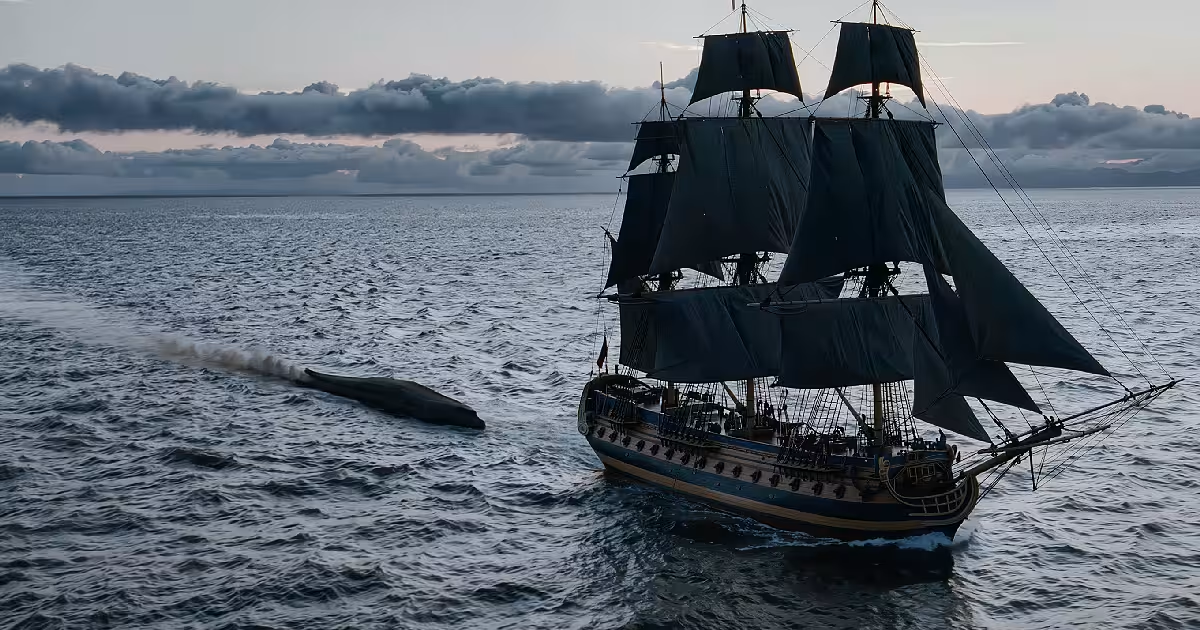
A long dark shape cutting the sea beside an old sailing frigate.
Illustration, not a photograph.

Opening
On 6 August 1848, the Royal Navy frigate HMS Daedalus was sailing home from the East Indies, in the South Atlantic between the Cape of Good Hope and St Helena, when a midshipman called out that something was approaching the ship. The captain, Peter M'Quhae, a lieutenant, the sailing master and others watched what they described as an enormous serpent pass close by, its head and shoulders held about four feet out of the water, at least sixty feet of its body visible.
M'Quhae put it in an official report to the Admiralty. When The Times published the story that October, Britain's most famous anatomist, Richard Owen, said the captain had seen a seal. The captain disagreed in print. It became the most respected sea serpent sighting of the century: trained naval officers, an official report, and a creature no one has identified.
Timeline
6 August 1848At about 5 pm, in dark, cloudy weather with a fresh wind from the north-west, roughly 300 miles off the coast of what is now Namibia and homeward bound, midshipman Sartoris alerts the quarterdeck. The officers watch the animal pass rapidly and close under the ship's lee quarter, moving steadily with no visible undulation, its head held above the water. M'Quhae later says it passed so close that, had it been a man he knew, he would have recognised his face with the naked eye, and that it stayed in view for about twenty minutes.
The same dayLieutenant Edgar Drummond writes his own account in his diary and makes sketches. His version is less serpent-like: a long, pointed, flattened head about ten feet long, a fin on the back roughly twenty feet behind the head, dark brown above and brownish white beneath the lower jaw. He notes that it held a steady course and did not seem to come up to breathe. The two men's positions for the sighting differ slightly, with M'Quhae's report giving 24°44' S, 9°22' E.
October 1848Daedalus reaches Plymouth. M'Quhae reports the sighting to the Admiralty.
10 October 1848The Times reports the sighting, six days after the ship's return. The Admiralty asks M'Quhae for a full account.
28 October 1848The Illustrated London News publishes M'Quhae's report with engravings he commissioned from an illustrator, working from his sketches.
November 1848Richard Owen argues in The Times that the creature was most likely a large seal, probably an elephant seal, swimming in open water, and that the "tail" was the eddy left by its body. M'Quhae replies, rejecting the idea and standing by his description.
1858An anonymous letter from an "Officer of HMS Daedalus" estimates the creature's speed at about ten miles an hour. The same year another captain suggests the Daedalus crew had seen floating seaweed, a claim The Times rejects.
April 1849Officers of another Royal Navy ship, HMS Plumper, report a long black creature off the coast of Portugal. The Illustrated London News prints a sketch on 14 April.
1977Drummond's own sketches of the animal, unseen since 1848, come to light. They look more like a whale than the serpent of the published engravings.
2015Evolutionary biologist Gary Galbreath argues in Skeptical Inquirer that the officers saw a sei whale skim-feeding at the surface: a baleen whale that can reach about 60 feet, whose upper jaw rides above the water when it feeds this way. The fin in Drummond's sketch sits roughly where a sei whale's dorsal fin would be.
Key figures
Captain Peter M'Quhae commanded Daedalus and wrote the official report. Midshipman Sartoris was the first to see it. Lieutenant Edgar Drummond, one of the officers who confirmed it, kept the diary account and the sketches that resurfaced in 1977. The sailing master was among the other witnesses. Richard Owen, later the founder of the Natural History Museum, led the scientific case against a serpent.
Physical and documentary trail
The record: M'Quhae's official report to the Admiralty, the newspaper accounts and engravings of October 1848, Owen's reply and M'Quhae's answer, and later letters from officers who were aboard. Questions were asked in Parliament about how a naval captain had allowed such a report to be printed. There is no physical specimen, and no other ship reported the animal.
The published engravings were drawn months later under M'Quhae's direction and show the serpent he believed he had seen. Drummond's diary and sketches, made on the day, are the closer record, and they describe a head and a back fin rather than sixty feet of serpent. M'Quhae also described the animal as dark brown with a yellowish-white throat, and something like a mane or a mass of seaweed washing about its back.
at the very least sixty feet of the animal
Things you might not know
- A midshipman saw it first. The junior officer Sartoris raised the alarm before the captain was called.
- It didn't wriggle. M'Quhae said the creature moved fast and straight, with no snake-like undulation he could see.
- The captain hired an artist. The Illustrated London News engravings were made under M'Quhae's direction.
- Owen became the "sea serpent killer". His argument against the Daedalus serpent made him the leading sceptic of the age.
- Parliament got involved. MPs questioned why the Admiralty had let a captain's sea serpent report be published.
- The lieutenant saw a fin. Drummond's diary describes a fin on the animal's back, something no serpent has and many whales do.
- The best sketches were lost for 129 years. Drummond's drawings from the day only came to light in 1977.
- The yellow throat may be baleen. A sei whale feeding at the surface shows pale baleen beneath its upper jaw, which could explain the yellowish-white throat both men described.
Competing explanations
A known animal, misjudged. An elephant seal (Owen), a sei whale skim-feeding at the surface (Galbreath), a giant squid, or an oarfish. Each fits part of the description. The sei whale explains the size, the raised "head", the pale throat and Drummond's fin, but M'Quhae was a career sailor who saw whales often, and a whale's spout and rolling back are hard to mistake.
Floating debris. A mass of seaweed or a tree trunk. It does not fit the officers' account of a fast-moving animal passing under the stern.
An unknown animal. The view M'Quhae held until the end. No such animal has ever been caught, washed up or filmed.
Later life of the case
The Daedalus serpent is still the sighting sea serpent believers cite first, because of who saw it. For a freshwater cousin, see Loch Ness.
Finding
Experienced naval officers saw something large in the South Atlantic in 1848 and reported it honestly and in detail. It was most likely a known animal seen in unusual circumstances, with a skim-feeding sei whale the best current candidate, and Drummond's same-day diary and sketches fit a whale better than the captain's serpent. Their account can't be tested now.
What still will not resolve: what the officers saw, since the only evidence is their testimony and the engravings made from it.
Evidence signature
5/9 Solid
- Witnesses
- trained, independent witnesses
- Instruments
- nothing on record
- Paper
- official records at the time
How well documented the case is, not whether it's true. A strong record can still have an ordinary answer, and a thin one can still be real.
You decide · HMS DAEDALUS SEA SERPENT
What do you think happened?
One vote per case, anonymous. You'll see how other readers voted once you've voted.