ALTAMAHA-HA
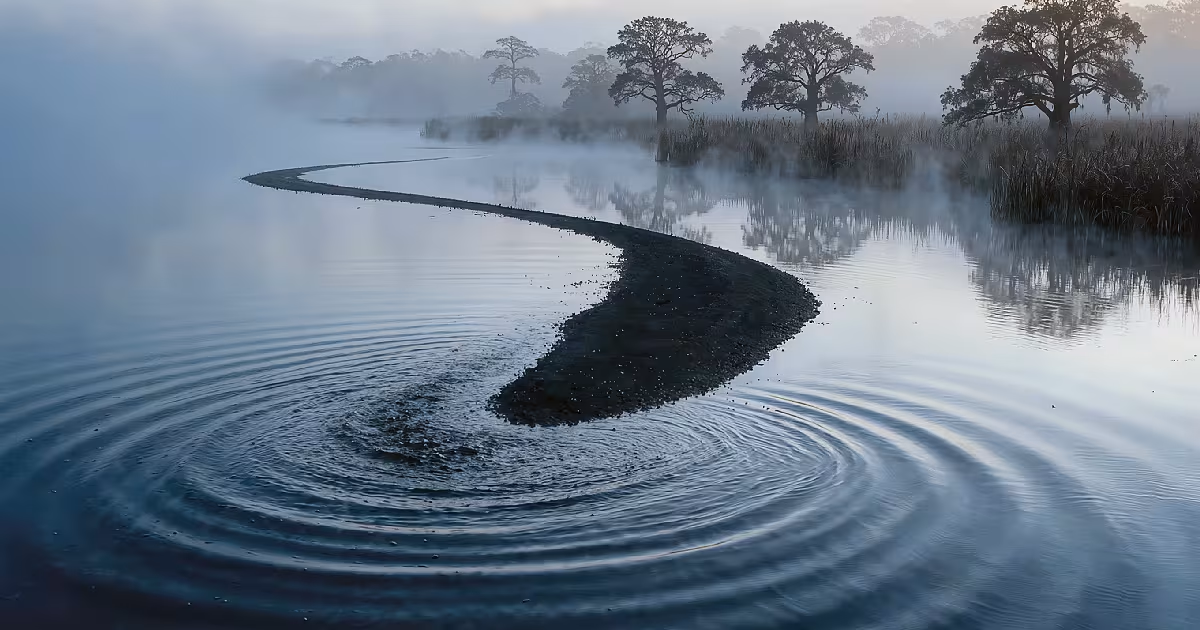
A curved dark shape in a misty river, ripples spreading.
Illustration, not a photograph.

Opening
Where the Altamaha River reaches the Atlantic in southeastern Georgia, among marshes and old rice fields near Darien and elsewhere in McIntosh County, people have reported a large serpentine animal for nearly two centuries. They call it the Altamaha-ha, or Altie. It is described as sturgeon-like, grey or green, with a crocodile-like snout and a ridge down its back, and as anywhere from ten to thirty feet long.
It is a small-scale river monster, local and quietly affectionate, with a sculpture at the visitor centre and a cheerful place in the town's tourism. It also has one of the neater recent footnotes in cryptozoology: a carcass found in 2018 that was made by an artist.
Timeline
Before European settlementThe legend is said, by a local newspaper and a popular history site, to have roots in Muscogee tradition, a giant hissing snake-like creature. I did not find a primary source for this.
18 April 1830A correspondent for the Savannah Georgian reports sightings. The main witness is Captain Delano of the schooner Eagle, who saw a large creature off St. Simons Island, which lies below the river's mouth. His estimate is about seventy feet, with an alligator-like head. Five other men on the vessel and several planters on St. Simons are said to have seen it too.
1920sTimbermen riding the river report a large snake-like water monster.
1969Two brothers fishing at Clark's Bluff see an animal ten to twelve feet long with an alligator-like snout, a horizontal tail and a triangular ridge. They first took it for a sturgeon, then thought otherwise.
1980Two men report an animal stranded on a mud bank near Cathead Creek, about twenty feet long, thrashing half out of the water. It frees itself and submerges. In December another witness reports a snake-like animal with two humps in Smith Lake.
2010An amateur photographer films something swimming in the channel off Fort King George in Darien.
2018Decomposing remains found on a beach at Wolf Island National Wildlife Refuge are taken for an Altamaha-ha. The performance artist Zardulu claims them. They are a stuffed shark and papier-mâché.
Key figures
Captain Delano of the Eagle is the best-placed early witness, as a ship's master reporting through a newspaper. The brothers of 1969 and the men of 1980 are the main later accounts; the popular source I found does not name the 1980 witnesses, though another gives the names Andy Greene and Barry Prescott. Zardulu, a performance artist, claimed the 2018 remains. The paleoartist Rick Spears made the sculpture displayed at the Darien-McIntosh County Visitor Center.
Physical and documentary trail
The record: newspaper reports from 1830, a run of later accounts gathered by local history writers, one short video in 2010 and the 2018 remains. No body, bone or tooth has been recovered. The only physical object to be linked with the creature was shown to be made of a shark and papier-mâché. The popular accounts are mostly local tourism and blog material, and the sources I read hedge most descriptions with phrases like "said to" or "reportedly", and note that no physical evidence has been found. Some of the details differ between them: one fan site, which I did not trust, gives a longer length for the 1969 animal and adds a Boy Scout sighting I could not verify.
The description is the strongest clue. A long, sturgeon-like body with a bony ridge is how a sturgeon would look to a witness who saw only part of it, and the 1969 brothers first made that guess themselves. The alligator gar has been proposed for recent sightings, in a 2014 Tulane News article. I found no analysis of the 2010 video.
Things you might not know
- The first report is a ship's captain. The 1830 account names the vessel and the master.
- The brothers first thought sturgeon. In 1969 they changed their minds.
- It has a sculpture. The visitor centre in Darien displays one.
- It was made a video-game boss. It appears in South of Midnight.
- The 2018 carcass was art. A stuffed shark and papier-mâché.
- The accounts span two centuries. Sightings run from 1830 to the 2010s.
Competing explanations
Large known fish and reptiles. The strongest reading. Sturgeon, alligator gar, alligators and eels explain the colour, the ridge and the snout, and a stranded animal on a mud bank could be any of them. Water, mud and a brief look are poor conditions for estimating length.
Folklore with a long tail. A tradition said to be older than the colonies, kept up by tourism and local pride, makes every large ripple a candidate.
An unknown animal. Possible only if the description is accurate, and I have found no specimen or clear photograph to test it.
Later life of the case
Altie has become a local mascot rather than a research subject. It sits with the other small American lake and river monsters in the archive, such as Champ and Chessie, and like them it has produced a steady supply of witnesses and no body.
Finding
The Altamaha-ha is a regional legend with a reasonably old paper trail, since the 1830 report is a real newspaper item, and no physical evidence. Large sturgeon and gar are the best match for the described animal, and the one carcass offered was an artwork.
What still will not resolve: what Captain Delano and his crew saw in 1830, since a seventy-foot estimate from a ship cannot be tested and the report survives only through a newspaper correspondent.
Evidence signature
1/9 Thin
- Witnesses
- one person, or a tradition
- Instruments
- nothing on record
- Paper
- nothing on record
How well documented the case is, not whether it's true. A strong record can still have an ordinary answer, and a thin one can still be real.
You decide · ALTAMAHA-HA
What do you think happened?
One vote per case, anonymous. You'll see how other readers voted once you've voted.