CADBOROSAURUS
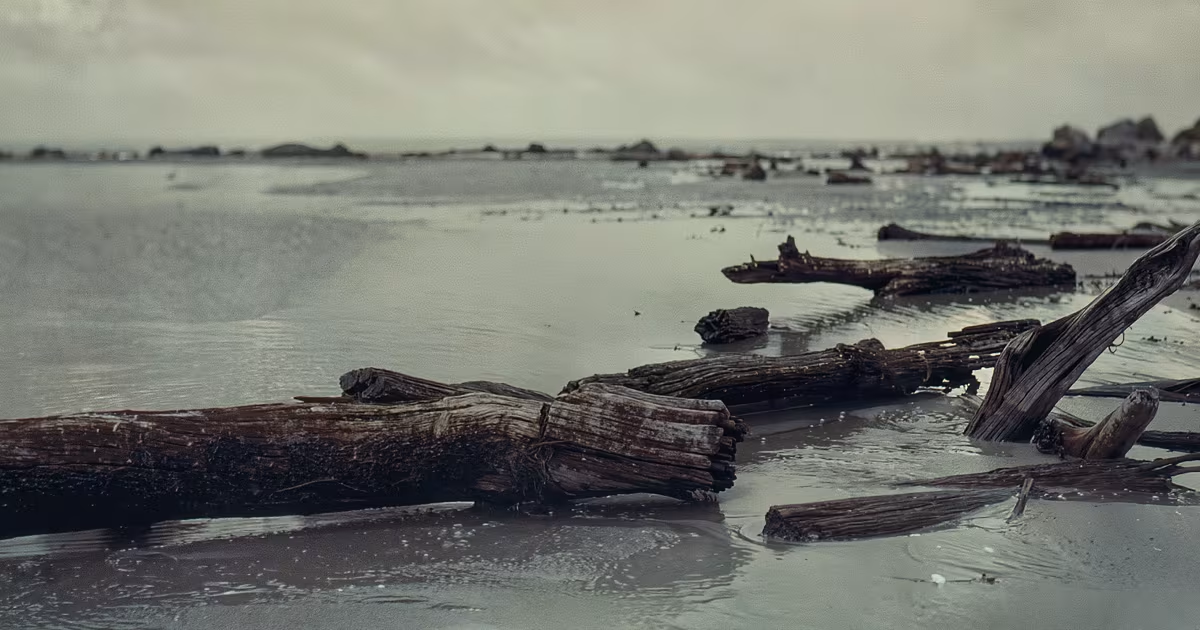
Driftwood logs washed up on a grey British Columbia beach.
Illustration, not a period photograph.

Opening
In October 1933, Major W. H. Langley, clerk of the British Columbia legislature, and F. W. Kemp of the provincial archives reported a huge animal in the water off Chatham Island, near Victoria. They described a dome-shaped back the size of a large whale, dark greenish-brown with serrated markings. The Victoria Daily Times put it on the front page.
The Times managing editor, Archie Wills, gave the animal a name, Cadborosaurus, after Cadboro Bay, which readers shortened to Caddy. Sightings multiplied, and papers across North America and Europe picked up the story. Nearly a century later there are hundreds of reports, several carcasses, and one formal scientific name, but no specimen in any museum.
Timeline
1932Kemp later says he saw something similar in roughly the same waters a year earlier, in a narrow channel with steep rock on one side.
October 1933The Langley and Kemp sighting runs in the Victoria Daily Times. Wills takes up the story, and the rival Daily Colonist, after first ignoring it, tries to rename the creature Amy.
July 1937Workers at the Naden Harbour whaling station in the Queen Charlotte Islands, now Haida Gwaii, find a long carcass in the stomach of a sperm whale caught off Langara Island. It is photographed. The Victoria Daily Times of 23 July reports that museum director Francis Kermode identifies it as a fetal baleen whale.
31 October 1937A photograph of the carcass appears on the front page of the Daily Colonist.
1943Two police officers in the Strait of Georgia report a huge sea serpent. Through binoculars, Sergeant Russell identifies it as a bull sea lion leading six others.
August 1968William Hagelund says he caught a baby Caddy near De Courcy Island and let it go. He publishes the claim in his 1987 book Whalers No More.
1995Edward Bousfield and Paul LeBlond formally describe Cadborosaurus willsi in the journal Amphipacifica, using the 1937 photographs as type material.
Key figures
Archie Wills named the animal and made its publicity a personal project. The scientific name honours him.
Langley and Kemp were the respectable first witnesses, a legislative clerk and an archives employee, which helped the story travel.
Francis Kermode, director of the provincial museum, gave the first expert reading of the Naden Harbour carcass. The zoologist Ian McTaggart-Cowan reportedly disagreed and called it valuable evidence.
Bousfield and LeBlond, a marine biologist and an oceanographer, collected more than 200 sightings and argued no known animal fits them. Bousfield died in 2016 and LeBlond in 2020.
Physical and documentary trail
The record: the 1933 newspaper reports, photographs of the 1937 carcass from F. S. Huband and from G. V. Boorman's whaling album, the 1937 station report describing a dog-like head and animal-like vertebrae, and the 1995 Amphipacifica paper. The carcass itself is lost. A sample is reported to have gone to the provincial museum, but no specimen is known to survive, so the photographs are all that can be examined.
Things you might not know
- The holotype is a photograph. Bousfield and LeBlond named a species with no body, using the Boorman photographs as holotype and paratype.
- Its own journal's editors objected. Amphipacifica editors Craig Staude and Phil Lambert objected to the paper being published as a formal species description.
- There was nearly an Amy. The Daily Colonist tried to brand the animal Amy Cadborosaurus. Caddy won.
- Loch Ness got there first. The Loch Ness monster had been big news in Britain earlier in 1933, months before Victoria found its own.
- One sighting was identified on the spot. The 1943 police serpent turned into a sea lion herd once binoculars came out.
- The 1937 carcass has had three identities. A fetal baleen whale in 1937, a basking shark in a 2000 analysis, and a decomposed sturgeon in a 2017 review.
Competing explanations
An unknown marine animal. Bousfield and LeBlond's case is that more than 200 accounts, many describing flippers both front and back, form a consistent picture that no known species matches.
Many known animals. Sea lions, elephant seals, conger eels, oarfish, humpback whales and basking sharks have all been proposed. The palaeontologist Darren Naish argues the conflicting accounts are most simply read as descriptions of many different things.
A misread carcass. Decomposing basking sharks often lose their jaws and fins in ways that leave a long neck and small head, and several beach carcasses offered as Caddy were later identified as whales, sharks or elephant seals.
Later life of the case
Caddy settled into British Columbia culture as a regional mascot. A 2009 video by fisherman Kelly Nash, said to show several animals in Alaska's Nushagak Bay, aired briefly on television in 2011 but has not been released in full.
Finding
The 1933 sightings were real reports by named, credible people, and the 1937 carcass was a real object that was photographed and then lost. The data points to many animals rather than one, and the carcass photographs are better explained by a known fish or mammal than by a surviving marine reptile. That does not account for every sighting, and some remain unexplained.
What still will not resolve: the Naden Harbour carcass, which was the best evidence anyone ever had and was never kept, and the full Nash footage.
Evidence signature
4/9 Solid
- Witnesses
- several people
- Instruments
- nothing on record
- Paper
- official records at the time
How well documented the case is, not whether it's true. A strong record can still have an ordinary answer, and a thin one can still be real.
You decide · CADBOROSAURUS
What do you think happened?
One vote per case, anonymous. You'll see how other readers voted once you've voted.